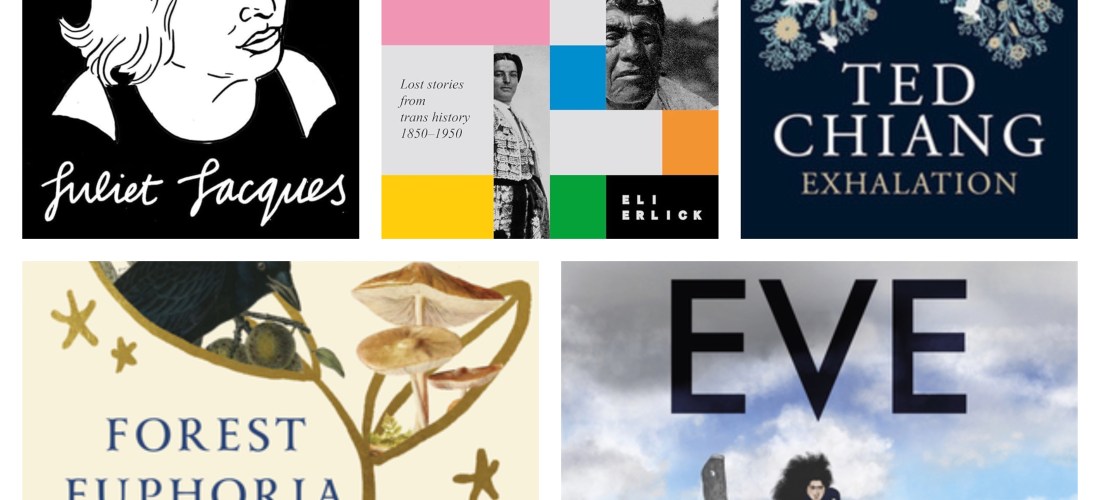
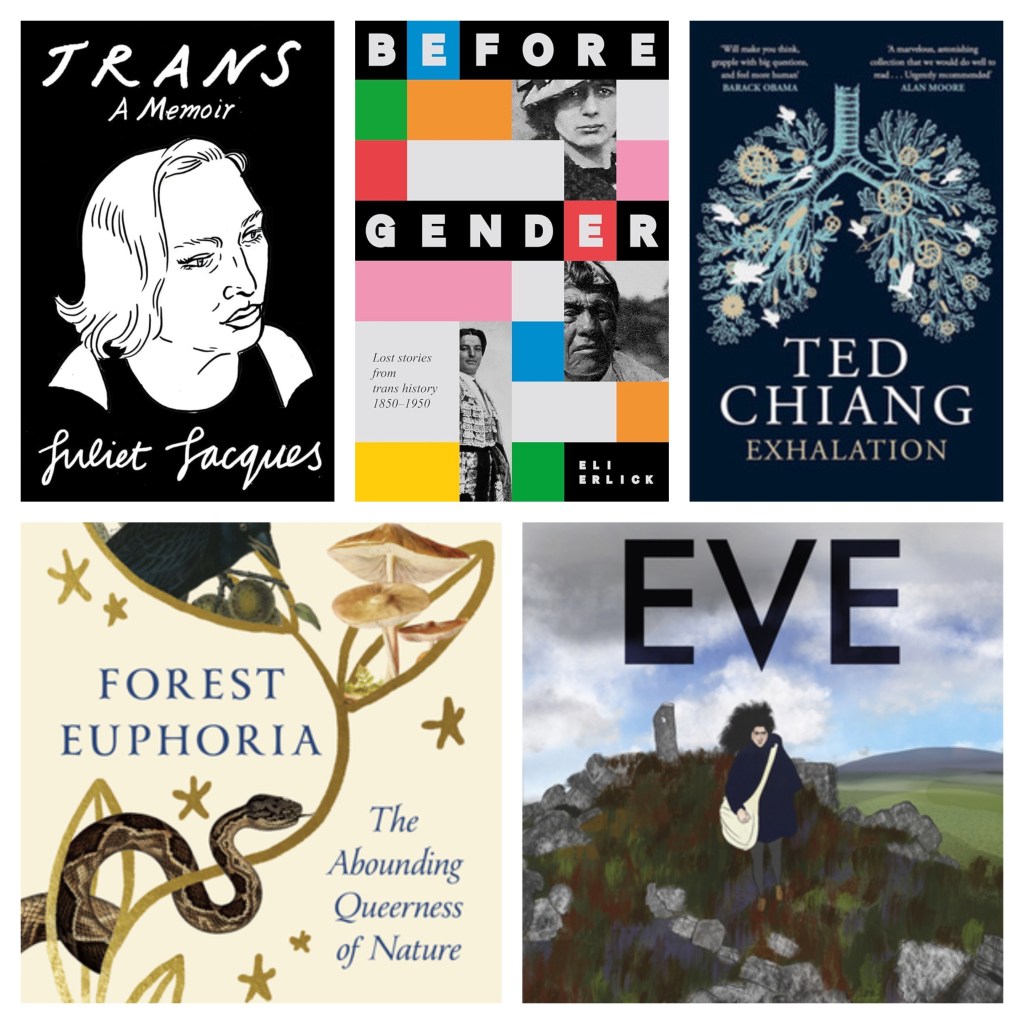
Eve by Una
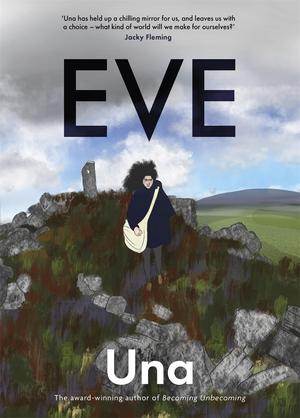
A gorgeously dark graphic novel. I admired this author already – having read her debut, Becoming Unbecoming, which had a great impact on me. This is her most recent work and far more complex in terms of the art’s rendition. The story is still set in the north of England (where I live). It imagines a bleak near future in which climate collapse and the spread of far-right politics dominate the country. Eve, the main character, is born in the 2020s – a decade of great upheaval – from an English mother and an immigrant father who is a refugee in the UK. The story follows Eve’s upbringing alongside that of two of her closest friends, Si and Ruby.
Whereas Si and Ruby must eventually conform to a different set of standards, Eve remains creative and wild. When a terrible storm brings unprecedented chaos and violence to the country, she decides to walk away to nature all on her own. She may be only sixteen, but it’s clear that she’s done with civilisation. She’s confident she can survive in the wildness (having been taught various survival skills but her parents) and she doesn’t mind the solitude. Her friends, on the other hand, seek the comfort and security of community by joining two different organisations.
Si, the son of a single mother, joins a juvenile military squad. This is part of a national measure offered by a far-right party that promotes the militarisation of youth as a key effort to preserve the ‘nation’ and the ‘British values’ safe. Ruby, the daughter of a rich family, becomes a political activist with the most extreme far-right organisations. She goes around the country spreading chaos and violence to ‘wake people up’ and even gets herself pregnant via artificial insemination because she believes that, as a white woman, it is her duty to ‘preserve’ the purity of the race.
Against all odds, these three characters end up encountering each other in the wilderness as society seems to be collapsing in England. Tired of fighting and living through violence and trauma they decide to start all over together despite their many differences.
This felt like a dark and disturbing book to read – especially at this particular time of war in which countries are becoming more heavily militarised societies and even bringing back conscription. I had a few conversations about this in January with several students of mine at university (we discussed what the UK would look like if conscription was reintroduced, we talked about the familial memories my students had of their grandfathers fighting in the Second World War… etc.) – so when I picked this book at random from my local library and I found similar themes it all felt too familiar.
A brave work from an author with a very distinctive voice. I definitely recommend her work. Check here for a fascinating interview about her creative process and this book.
Trans by Juliet Jacques
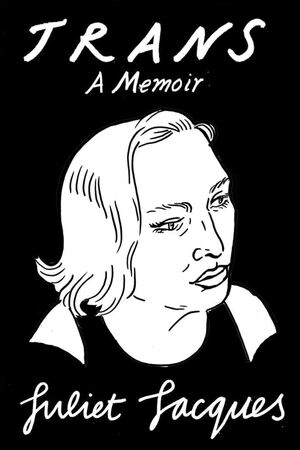
I picked this book from my local library – and I thoroughly enjoyed it. Jacques is a talented writer and this memoir is also ambitious in the way that is narrated, with a very strong focus on history and setting. It starts with Jacques writing about going through sex reassignment surgery in great detail – I felt a bit queasy as someone easily terrified by surgery and medical procedures of any kind. Apparently, this part of the book is based on a series of articles commissioned by The Guardian in 2012 and titled ‘A Transgender journey0.
From then on, there is a jump back in time to Jacques as a teenager. She then starts narrating how she realised she was trans and how rhea impacted her experience as a university student. The book also covers the period in which Jacques pursued hormonal and then surgical transition and how she navigated the NHS and the medical system to obtain this. But this book is so much more than a story of transition. This is also a book about the struggle of pursuing an artistic career, about being trapped in soulless jobs which trigger depression. It’s also about Jacques’ passions: music, cinema and football. I loved reading about it all.
Jacques voice is honest and raw when it needs to be – but also, at other times, incredibly funny. One of the most touching scenes for me was when Jacques describes a conversation with her parents. She has her sex reassignment surgery scheduled and has been told that the recovery time will be quite lengthy (two months). Jacques’ parents don’t understand their daughter’s transition but when they talk about recovery they are concerned that Jacques will be on her own in her London apartment. Jacques tries to reassure them by explaining that her flatmate will help her. But her parents are not sure this will be enough and so convince her to move back home so they can take care of her instead. To me, this a sign of love – even though they don’t fully understand her journey they still want to be part of Jacques’ life and help her go through complex surgery. In subsequent scenes, we get to see how this experience of recovering at home helps Jacques get closer to her parents and in fact it leads to some significant conversations between them.
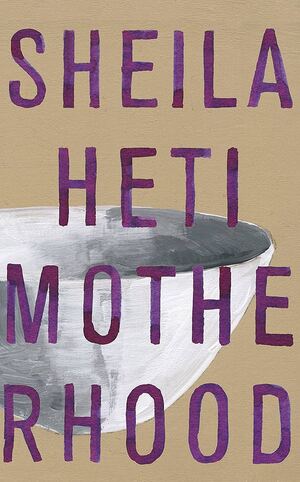
The end of this book features an interview that author Sheila Sheti did to Juliet Jacques. I really liked it – it gave me a good insight into Jacques’ creative process behind her memoir. I wish more books included extras such as this!
Before Gender: lost stories from trans history 1850-1950 by Eli Erlick

This book covered many stories about trans people living in the 19th and 20th century. It was refreshing and very interesting – and showed how trans individuals have always existed (as we all know) and lived integrated in their own communities (with more or less success). One of the most interesting stories perhaps was the one about trans brothers Mark and David Ferrow in the UK.
In a chapter about German trans woman Gerda von Zobeltitz, I found a lengthy description of a violent altercation (in which she had been present) which involved a queer organisation from the Weimar Republic and a police sport club. This happened at an inn on the Rauchfangswerder peninsula in south-east Berlin which the queer organisation had rented to have a celebration. It was really disturbing to read such a detailed account of the event at a time (this happened on the 5th of July 1930) in which being gay was allowed at the Weimar Republic.
Even though I enjoyed the book and I think this was very refreshing research I found the writing a bit too plain and repetitive. This is possibly because I believe the author, a scholar, wrote this book as a PhD thesis, at least initially, and it definitely reads like that.
Exhalation by Ted Chiang
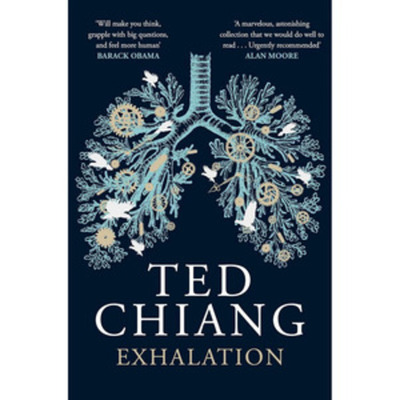
I had this book for years but I didn’t dare to read it. Why, you ask? Well, Ted Chiang is one of my favourite writers. And he doesn’t publish books all that too often, so I was keeping it as a treat. Time finally came this February of 2026 which has been a very trying and sad month for all sorts of reasons. And this book somehow kept me company and brought me instants of solace in the midst of bleakness.
Chiang writes short stories – a form that I love, more and more, as I develop as a writer. Every time I read a collection by him I adore every single short story which is extremely rare. My experience of reading a short story collection is that I’d find a few pieces brilliant, a few pieces good and some meh. Not with Chiang, though. Maybe this is because every short story tends to be quite different, in terms of tone, formatting and themes. I can almost see him (as a writer) challenging himself with every single piece. A new creative puzzle. (Also, in a world where many authors are compelled and told to put new work out constantly, Chiang seems to be taking his sweet time, and I admire him for it).
The Merchant and the Alchemist Gate – this has elements of historical fiction and fantasy. It’s a creative exploration of an idea developed by physicist Kip Thorne – who suggested that it should be possible to create a device that obeys Einstein’s theory of relativity but also that, apparently, we can’t change what has already happened in the past (something that time-travelling stories tend to go against, as many of them are about the butterfly effect produced by someone tinkering with events that have happened before).
Exhalation – the story that names the collection. The style in this piece is lyrical, full of detail, oneiric, beautifully sad. It tells the story of sentient creatures who are also machines – and are having to come to terms with the fact that they will also ‘die’ as the mechanisms which keep them functioning and ‘alive’ will eventually deteriorate with the passing of time.
The Lifecycle of Software Objects – one of the saddest stories I’ve ever read. A tech company develops cute AI pets that users can ‘grow’ and ‘evolve’ in their own time by interacting with them. In my mind, these AI creatures (‘digients’ in the story), are a sort of tamagotchi. What starts as something simple soon becomes more nuanced as one of the newest employees of this company, Ana Alvarado, who has experience working with animals, decides to start caring for digients as one would care for another human being. With time and effort she starts creating a real connection with them – and even stars teaching them new skills as one would teach a young child. Her methods soon become non-viable – tech advances way too fast and digients end up being phased out as digital pets by newer and sexier advances. But throughout the expand of two decades our protagonist and her friend invest their time in a handful of digients showing that time, care and empathy may be essential to create an artificial consciousness. It was really interesting to read this story in this new AI era (I’m saying this as someone distrustful of AI as it is now). I’m not sure Chiang would have quite written the same piece say in 2026 – you can read his thoughts on generative AI here if you are interested. Yet this story really moved me and I found its suggestions (time, empathy and care equal love) inspiring.
Dacey’s Patent Automatic Nanny – a short but fun and dark story about a 19th-century male engineer who decides to create a mechanical nanny to streamline the complicated process of taking care of an infant. To prove the value of his creation he decides to use it on his own son. Surprising no one, the story gets quite disturbing, but it is also a delicious parody of several (now considered old-fashioned) parenting techniques.
The Truth of Fact, The Truth of Feeling – what if technology developed to create a software that allowed us to record all we experience giving us, in this way, a library of perfect memories? How would this alter our own sense of self? And our relationships with others? Would this change society irrevocably, the same way that written language forever altered societies? In this piece, a well-known journalist who has always refused to use this specific software (in part because he thinks that holding on to sad or traumatic memories doesn’t do any good) decides to use it for the first time to write an article to criticise it. But by doing so, his relationship with his daughter is forever changed. This was such an ambitious, complex and perfect story. I loved the combination of timelines and focal characters. And the ending – with a great twist – was just sublime.
The Great Silence – and extremely brief piece about parrots and how amazing they are. Did you know that parrots give themselves names? And that their use and understanding of language exceeds that of many animals, including apes? You are welcome…
Omphalos – another brilliant story set in a parallel reality to ours – similar in all ways except of one key thing. In this world, the existence of God has been scientifically proven and as such the idea of God (and religion) is essential not only to science but to how people understand each other and their place in the vast universe. I loved how the beginning considered the existence of ‘primordial creatures’ (that is, creatures created directly by God, creatures who are parentless and never evolved from infancy but already started perfectly formed in adulthood). The ending also came in with a surprising powerful (and moving) twist. In fact, this short story could make an incredible movie.
Anxiety Is the Diziness of Freedom – to me this was the most complex story in terms of science and mechanics. It considers a reality in which humans are able to contact parallel universes which contain alternative versions of themselves. It considers the idea of free will in quite an interesting way – that is, you would think that if there are different universes with different versions of ourselves perhaps all of these other versions are exploring different life choices. But what if our character, our inclinations, our tastes and our curiosity always led us to a collection of similar outcomes instead of wildly different scenarios?
Forest Euphoria by Patricia Ononiwu Kaishian
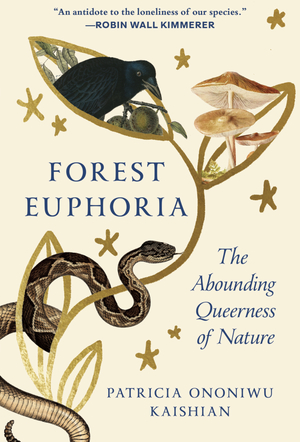
I bought this book on a whim when I was visiting Sheffield – and upon discovering its gorgeous bookshop Juno which has an amazing selection of queer and feminist books. Not going to lie here – seeing that Robin Wall Kimmerer (I loved her book Braiding Sweet Grass) had written an endorsement for it really encouraged me to purchase it.
I ended up enjoying it thoroughly and I’d say that if you like Kimmerer’s work you’ll probably like this too. Kaishian is a talented writer and mycologist and she blends memoir with science research in really fascinating ways. This was a book that taught me a lot – as I was reading it and discovering pretty incredible stuff about fungi, snakes, ravens and cicadas, I’d be talking to my partner about it – I really needed to share it with someone!
One of the most interesting aspects of this book was how Kaishian wrote about her own gender identity – and how she feels she’s in between female and male. She also speaks of nature with such reverence and compassion. There’s a beautiful chapter about finding her own ‘secret’ spot in nature wherever she goes – a place that feels special and safe to rest away from everything else. I relate to that – I also have my own special secret place in the countryside near where I live. (I’m thinking of a specific spot with a gorgeous hawthorn three and beautiful views of the river and the mountains where I’ve always felt embraced).
Kaishian’s writing is also incredibly lyrical – her description of snails having sex is so lush – and believe me, I wouldn’t have thought I’d be saying this about snail sex like… ever. You have to be a truly talented writer to pull that off.
These are other things that felt like delicious discoveries in this book:
- First of all, fungi have more in common with animals than plant. Yes, this means, in Kaishian’s words, that we are more similar to the mould appearing on a bit of bread that we forgot in our counter than the mould is to the praying plat in the kitchen’s windowsill – like… what???!!! (Apparently, it was Carl Linnaeus who mistakenly saw fungi as ‘inferior’ plants…)
- The marks we have in our fingertips (fingerprints) come from us a babies in the womb pressing our little still-forming hands against the walls of the womb – am I the first one to ever realise this? Did everyone know already? Why wasn’t I taught this in school?
- The breeding cycle of the cicadas is absolutely fascinating. Basically, some species of cicada develop as larva underneath the ground to then emerge all together every 13 or 17 years. Scientists are still unsure of how exactly they all when is time to come out. Apparently, if one cicada is ‘ready’ before this it just goes closer to the surface and waits there for her friends. How considerate. The reason why this happens is that cicadas need to breed as soon as they all emerge – but they are also very vulnerable to predators. Appearing in massive numbers maximises their chances to create the next generation. Kaishian actually compares this to activism and collective movements – how sometimes revolutions may seem too sudden but actually many of them have been brewing ‘underground’ for a very long time.
- Scientists still don’t know how animals manage impressive migration routes that can take them from one side to the world to another. But apparently animals (including us, humans) have a bacteria living inside our guts with some magnetic particles. Some scientists have proposed that this magnetic particles are what allow animals to intuitively move around the planet. It’s not completely proven – but it sounds like a fascinating idea to me. I also absolutely adore the fact that we are who we are thanks to all the bacteria that decided to live inside us, making us stronger because of it. Which reinforces the idea that neither ‘strength’ nor ‘dominance’ drive evolution and survival – collaboration is still the most important skill.
- Finally, beauty (which we can easily connect with art) does play an important part in evolution even though for many centuries scientists refused to believe it. Kaishian gives the example of bowerbirds, who spend a large amount of time building these little shrines to attract females. This is important, because females choose who they will mate with completely based on how they like (or not) the shrine – that is, they don’t consider if the bowerbird is strong, or weak and so on. Apparently there are even examples of male bowerbirds who live together so the less experiencing one can learn from the building expertise of the older one.
All in all, I loved this book, and I can’t wait to see what Kaishian writes next. Also, what a beautiful job she has – as the Curator of Mycology at the New York State Museum. I hope she’s really enjoying it.









 Inés G. Labarta