Bury Your Gays by Chuck Tingle

This was a hilarious horror book, which is a difficult combination. Yet the author made it work – mostly. It follows the life of Misha, a Hollywood scriptwriter who has created a series in which the two main characters – both women – have been implied to be gay from the first season. However, the moment he decides to show them openly as lesbians, he’s told by his producer that at least one of them needs to die on screen. If the show is going to feature a love story, it can’t be anything but tragic. This is a fun prompt – because the ‘kill your gay character at the end’ trope is so annoying, yet so prevalent on screen.
Misha, the scriptwriter, who is also gay, is outraged by this proposition, to the point where he vows he won’t ever write an ending where his gay characters die, come what may. His producer tells him there’ll be consequences – but Misha ignores this. Until things start getting really weird and characters from the horror movies and series he’s written in the past start coming for him to kill him.
The writing style is great – I read this book very fast and thoroughly enjoyed it. It has some very successful horror scenes – for example, the time Misha gets trapped in the plane with one of his foes, or a torture scene that makes you feel sorry for one of the book’s villains or another gore scene that involves guts and self-surgery (I had to read this one very quickly skipping some parts). There are also some great comedic moments: how Hollywood is depicted as a storytelling factory, how AI actors are being created to perform because they are much more ‘sustainable’ than real people. Also, I loved how Tara (Misha’s best friend) was the secret weapon at the end since ‘every story forgets about the asexual characters’. The flashbacks that showed Misha’s childhood and his first queer experiences were quite dark and sad – an interesting contrast with the rest of the book – but were also honest, and raw, and emotionally true.
There are other things that didn’t work as well with me. For example, there’s an abundance of clichés and tropes which, to an extent I understand, since this book is trying to satirise them, but at times I wish Misha’s monsters and villains would have been a tad more unique. Zeke – Misha’s patient and understanding boyfriend – is way too perfect to be real. But apparently Tingle, the author, is known for celebrating queer joy and he always wants to include a positive romance in every of his books. So, sure. Also, the science behind some of the horrors in the story… I felt that, the more the author tried to explain it, the less realistic and scary it seemed. I think the book would have worked even better if it had been left as a mystery.
The Safekeep by Yael van der Wouden

I grabbed this book on a whim at the library. Even though I’ve been trying to learn the language since 2015, I don’t know much about Dutch history, specially from the 20th century. This book is set in The Netherlands in the 1960s and focuses on a young woman, Isabel. She lives alone in a large, beautiful house in the countryside. Her siblings (she has an older brother and a younger brother) have moved away from the family home and started their own lives and careers. She stayed behind taking care of their sick mother, and after the mother died, her life doesn’t seem to have much of a direction. Well, it does, actually. As many other women in her time she’s expected to marry and have children. And even though she has a neighbour who seems very interested in becoming her husband, she’s not precisely elated at this and prefers to enjoy her own solitude.
The event that kickstarts the novel is her older brother’s new girlfriend, Eva, who Isabel immediately dislikes. When her brother has to travel far away for work, Eva asks to stay with Isabel. Isabel doesn’t want this (at all); she’s convinced Eva is hiding something and shouldn’t be trusted, but she hasn’t got much choice on the matter since the house is not technically hers but her uncle’s (and he’s planning to leave it to her older brother anyways).
This book discovered me some interesting facts about Dutch history. I didn’t know that The Netherlands had gone through a terrible period of famine from 1944-1945 known as the Hunger Winter. I also learned about how many Dutch people who happened to be Jewish lost their homes – often because they couldn’t afford to pay the mortgage anymore after they were lucky enough to be released from concentration camps at the end of the Second World War. When this happened, their homes were then given to other Dutch, (non-Jewish) citizens. Often the money these Dutch Jews owned the government also came from extensive medical bills after they had been taken to hospitals in other countries – like Switzerland – to recover from being in the camps themselves. I was talking about this with a Dutch friend and she said that people tend to think The Netherlands is a great advanced country – but they have their own very dark and twisted history as well. Her own father was a prisoner of war to the Japanese in Indonesia – and she explained that the Dutch government left a lot of its citizens there without resources even after the war ended instead of picking them up to bring them back home like other countries did with their nationals.
But back to the novel: this story is written in a very engaging way. I enjoyed the focus on the relationship between the three siblings and how two of them experienced being queer in the 1960s. Also, this book has one of the best sex scenes I have ever read (also a long one, as it lasts for a whole chapter!) Now, it’s very difficult to write a good sex scene. It’s very easy to make it sound very clumsy or silly but in this book it’s done so well that I may end up using it as an example in my writing workshops.
Some personal thoughts about the ending (and please avoid reading this if you don’t want spoilers): I didn’t quite buy how good it all turned out (all things considered) but at the same time I’m happy for the characters that it did. Van der Wouden is a very talented writer – there’s no doubt about it. I didn’t know she was also intersex, queer and that she has lived across various countries (Israel and The Netherlands). I also found this essay written by her on her experience growing up in The Netherlands and becoming a writer which I thought was very interesting (it touches on historical memory as well and how different countries handle this).
Famesick by Lena Dunham
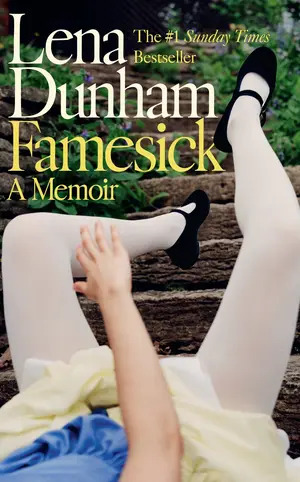
Last month I read Dunham’s brother memoir A Year Without A Name and this month I decided to try this book as it came recommended by several people. I feel like I really know the Dunham family now, which is a bit weird.
I have to confess that I tried to read Not That Kind Of Girl before (also by Lena Dunham) and I couldn’t get past the first few chapters. I just didn’t vibe at all with narrator’s voice, I found her entitled and annoying and I wasn’t really interested in the story so I put the book down (which for me, is rare). I should also mention that I knew barely anything about Lena Dunham’s life and that I have never watched the show Girls – which she wrote and starred in and made her extremely famous.
I did finish Famesick though and in general I found it much more interesting – specially how it candidly describes Dunham’s struggles with becoming a celebrity while struggling with very serious physical illnesses. In a society where we are told we are worth what we produce it’s important to write and read more about having a human body (and all that can come with it).
The first chapters of this memoir read almost like a fairy tale: Dunham is the daughter of two artists and has always wanted to be an artist herself and leave a mark in the world. Film is her chosen medium and as university student she starts creating small pieces. She stumbles upon her mother’s diaries – and is surprised to see that she relates a lot to who her mother was when she was also a young woman. She writes a script, her mother reads it and she believes is very good, so she convinces a few of her friends to donate money so they can produce it (still with very minimal equipment). This short film – Tiny Furniture – ends up receiving some important awards and, quite suddenly, everyone wants to know what Lena Dunham will do next. Barely in her twenties, she ends up with an HBO contract in her hands to write her first series – which would go on to have six seasons. Even though she’s initially reluctant, she also ends up playing the series’s main character on screen.
You would think that Dunham is incredibly lucky to have so many resources to fulfil her artistic vision. And she is. But at the same time this is a huge enterprise and the industry is anything but kind to her. When she starts suffering from some weird health symptoms everyone assumes is stress – and she’s barely given any time (if at all) to recover. As she puts it in her memoir, it’s not only her life and career but those of many others in her team which are at risk. Eventually, by pushing herself so hard, she ends up with some pretty intense mental and physical health issues. It takes her many years (through which she’s gaslit by medical professionals and colleagues alike) to discover she has endometriosis and Ehlers–Danlos syndromes (EDS). These diagnosis don’t take her symptoms away, and she’s not really cured, but knowing that these are conditions she can name and identify feels like a triumph.
So yes, she becomes an extremely successful artist – just like she wanted to – but she also spends a lot of her thirties suffering in terrible ways. Her relationships with partners and friends disintegrate and her family life is placed under incredible strain. Ultimately, this is an honest book about fame, being a woman, someone with a chronic illness and an artist.
How To Make Life Better by Simone Lia and Fluffy Pulcino
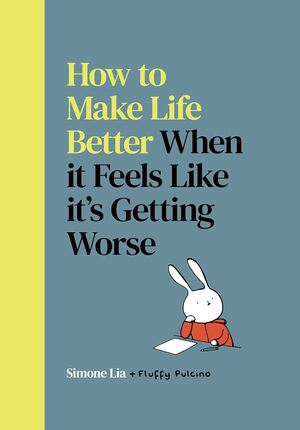
A quirky sometimes dark and definitely very honest graphic novel. It follows Fluffy, a talking rabbit created by the artist Simone Lia. Fluffy walks on two legs and dresses like a human being – he’s also creative, annoying, kind and a bit of an existentialist. During the story, we see him grow up and become and adult – struggling with his academic studies and wondering what the purpose of life is beyond school. When I picked this graphic novel I was attracted to Lia’s particular drawing style. She has gorgeously rendered and super-detailed backgrounds of London, the city where she lives in. She draws the ordinary streets, the parks, the businesses and the houses in a way that feels both cozy and nostalgic. Fluffy the bunny is also the cutest little character interacting alongside all the other human characters.
I wasn’t expecting the seriousness of the work though – as Lia dwells into very important life questions through Fluffy’s perspective. I really enjoyed some of the reflections in this book around finding one’s meaning in life and purpose. If you are an artist, like Fluffy, you will also like this work as you see him struggle through the great (and stressful!) process of creating a whole graphic novel by himself.
I actually bought this book after attending an event with Simone Lia which was part of the International Comics Art Festival celebrated in Windermere in 2025. Lia was candid and honest and I really liked her energy and demeanour during the talk – specially how she discussed the issue of the publishing industry not paying living wages for writers and artists.
La Madre de Frankenstein (Frankenstein’s Mother) by Almudena Grande
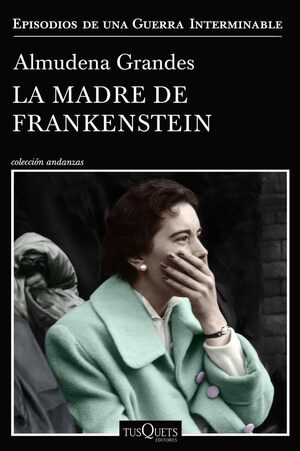
My first book by Almudena Grandes, a very famous Spanish author who died (relatively young) a few years ago. It’s somehow a bit of a wonder that I hadn’t ever read a book by her – probably due to the fact that I read much more English-written literature these days. In fact, it was an English friend who let me borrow it from her collection of Grande’s books thinking this would be a good one to get introduced to this particular author.
This is the last novel Grande published before her death – and she had a prolific career. I wonder what a last book can say about an author… Personally, I was immediately into this novel from page one and devoured it in less than week. Its structure was similar to Soldados de Salamina / Soldiers of Salamis (another very famous Spanish novel, which I also read also this year for the first time): it’s narrated through multiple perspectives and timelines which, to me, makes it a really interesting object (as a writer, I’m forever obsessed with structure and plot and the ways in which we decide to tell stories).
The main voice is the novel is that of Germán Velázquez, a Spanish psychiatrist exiled in Switzerland after the Spanish Civil War who comes back to post-war Spain to work at a women psychiatric. Despite being the son of another psychiatric who opposed to Franco’s regime and fought for the republic, Germán is now allowed to come back because he has pioneered (in Switzerland) a new treatment for schizophrenia which consists in using chlorpromazine with his patients.
There is another voice in the book, a young nurse named María who is working at this psychiatric in Cienpozuelos. She was born there, and is the granddaughter of a couple who were granted a home in the grounds as the husband took care of the garden and the general maintenance of the property. After their daughter dies in the war they both take care of María, the granddaughter, who grows up feeling very attached to the place.
And yet, the character that haunts the narrative in the most powerful way is Aurora Rodríguez Caballeria who, a patient in the psychiatric condemned to live there for life after the murder of her own daughter. Aurora is such an interesting (and terrifying character). She’s a real historical figure – you can read more about her here — who dedicated her life to the pursuit of knowledge. She had very interesting ideas around feminism and sex but she was also was into eugenics. Her long-life obsession was to create ‘the woman of the future’ which was the reason why she had her own daughter (Hildegart) and ended up killing her when she became ‘a disappointment’ (that is, when she started having ideas that deviated from what her mother thought it was correct). It’s a fascinating story, one of those examples in which reality is stranger than fiction. I completely understand Grandes wanted to use this character in her fiction.
Aurora’s sections are narrated in a very immediate first person point of view. At this point, she’s been in the psychiatrict for many decades and she’s become depressed and disenchanted with life. That is, until this new doctor, Germán, appears and Aurora believes she’s finally found someone worth of being her intellectual partner. She’s so deluded, that she believes that her supremely intelligent mind can rule over her body and make her able to conceive a child again (even though she’s well into her seventies) and have another go at educating a ‘super human’. Interestingly enough, Grandes conceived the idea for the novel initially as a play;Aurora’s sections read t like a monologue that could work very well on stage,
This is sad, dark novel that deeply resonated with me. Germán left Spain as a refugee when he was barely nineteen – he went from having a fulfilling and sheltered family life to becoming a political dissident, forced to start over in Switzerland. He’s lucky though that a former student of his father – a German Jew – is happy to welcome him in his family and helps him out – otherwise he probably wouldn’t have made it. He ends up studying psychiatry and even marrying one of this man’s daughters and becoming a very successful doctor. But he’s still dealing with lots of trauma: the Civil War, the fact that he can’t really go back to the country he’s from and to his family, his father’s death and how he’s seen as an enemy of the state now. When he’s finally welcomed back to his country he jumps at the opportunity, overwhelmed by nostalgia and a strong desire to go back to the culture and the place he knows: Madrid. Even so, his mother (who still lives in the capital) is terrified for him and thinks he’s just going backwards in both his life and his career.
Life in the psychiatric at Cienpozuelos is as harsh as one could imagine. Spain is in the early postwar period: many people in Madrid were convinced at the end of the Second World War that Franco wouldn’t last long in power and would eventually encounter a similar fate to those of the other fascist dictators in the continent such as Hitler and Mussolini. Yet, it’s not like that at all: Franco (and the Church’s) power in Spain is just getting stronger. Which leaves many people – including Germán – feeling both shocked and depressed as well as unable to digest the horrors they witnessed during the war.
Grandes showed the psychiatric as an institution very well. This is a place ultimately controlled by the Church and prominent people within it which believe that psychiatric patients have undesirable treats and character features and so they don’t deserve to live normal lives outside. One of the most heartbreaking scenes in the novel shows the nuns who work there giving out the baby of a woman with schizophrenia who is interned in the hospital to a ‘proper Catholic family’ (lying to the biological mother by telling her the baby died in childbirth).
Unsurprisingly, Germán superiors are not completely on board with his novel treatment as they can’t accept that a pill can ‘fix’ mental issues when God can’t. It’s because of this that even though the results of the trials are overwhelmingly positive and many women experience incredible improvements, the people in charge find ways of delaying and even stoping the drugs from being available. It’s clear that what moves this institution is not health or compassion but rather repression and control of parts of society they don’t deem as ‘good’.
Feeling completely defeated by a toxic system while you are trying to bring in positive change was the main message I took from this book. Germán, who already came to Spain dealing with a severe case of PTSD after the war and his experiences as a refugee, is not full of strength and motivation. He tries his best, even though he’s horrified to find a Spain he can’t recognise anymore. Even then, there are some hopeful moments in the book. He becomes very good friends with one of the other doctors who turns out to be gay. Despite of how dangerous this is in the dictatorship, this doctor still manages to find a way to have a lover and live life in the most fulfilling way that he can.
Another character who was full of life, hope and optimism is María. She grew up as a child in the psychiatric and became very good friends with Aurora as a child. At some point, Aurora considered María as her project and spend much time teaching her how to read and write; she also introduced her to culture and science. Because of this, María is smart and better prepared than many other women of her time: she’s able to see beyond the Church’s indoctrination and she’s able to believe she deserves more than what she’s been given in life. In the last third of the novel, María’s point of view offers readers access to her own story. After her grandfather died suddenly, she and her grandmother were kicked out from the house they had been living in the psychiatric’s grounds. María was sent to work as a maid in the capital and there she soon learned about the class system as she’s treated like a dumb animal by her employers. There she also befriends another maid who works in the same house. Those sections were hard to read: there’s the brutality of the job they have to perform for insignificant pay. But there’s also a very clear sense of how they are perceived by the richer classes of society. It may be a bit cliché but María’s story with the son of her employer (how he seduces her, gets her pregnant and then gets rid of her) has a lot of emotional resonance. In the end, María, like Germán when he was younger, realises she can’t live in Spain anymore. It’s too constraining and dangerous for her and so with the help of many (including Germán) she manages to escape to the United Kingdom – to Manchester.
There are more characters who are also fighting the regime and finding ways of resisting within it. German’s sister and her husband are part of a clandestine movement which helps people like María leave the country or start a new life somewhere else where their dangerous pasts won’t follow them. That gave me hope and reminded me that even though a government can be very damaging and authoritarian that doesn’t mean (not in the slightest!) that all its citizens support it. It also reminded me that the sum of apparently small actions can trigger change and that there’s a lot of power in organising and finding community.
All in all, this was a dark novel but a very accomplished one. The historical research was superb, very well integrated into the narrative. The voices were all distinct and even though Aurora’s character is definitely monstrous she’s also depicted with nuance and compassion. At the end, there is a detailed author’s note in which Almudena Grandes describes finding the original diaries of a doctor in the Cienpozuelos psychiatric for women and how this inspired parts of the novel. She also travelled there and talked to people who still remembered what it was like to work in this institution during the post war period and the dictatorship.
I’m glad Spain has such talented and curious writers – and I’m very intrigued to keep reading Grandes novels from now own.
ADHD Unpacked by Alex Conner and James Brown
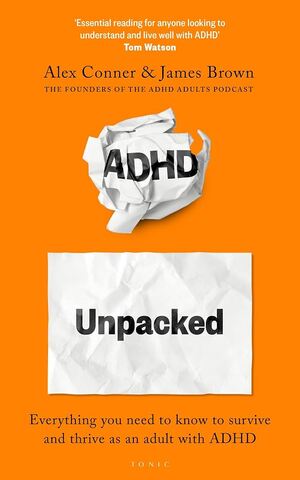
I wanted to know more about ADHD but I was overwhelmed by the sheer amount of literature written about it. I was a bit lost and wasn’t sure which books were more trustworthy or more based on current research – especially when it comes to ADHD in adults. A very good friend who has ADHD recommended this one, specially the audio version. I really, really enjoyed it. It’s written by two English academics who also got diagnosed with ADHD as adults. They both have great voices and take turns reading chapters, which makes it very entertaining. I loved how clearly the information was presented, and how the relevant sources were always mentioned. It’s also written with that delicious English dark humour that I love. Some parts of it were literally mind-blowing. I’m definitely buying the physical version to refer to it and I’d say if you need someone to understand what ADHD is and how it can manifest definitely recommend them to this book.

