
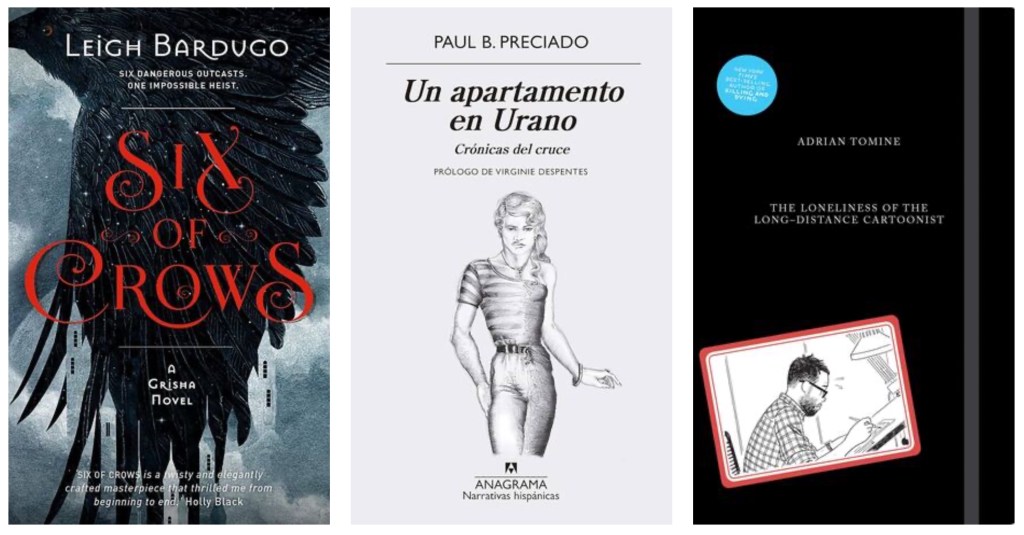
Un Apartamento en Urano (An Apartment in Urano) by Paul B Preciado

Since last year, it seems that I’ve been on a self-imposed quest to read Preciado’s entire backlist, and what can I say? I’m loving the journey, and I can’t stop talking about how great he is as a writer and philosopher. This book is a special one, as it’s a collection of short articles that Preciado originally published in French in the newspaper Libération from 2013 to 2018. This is, coincidentally, the time when Preciado decided to transition and started using a male name and male pronouns, so many of these articles – which he refers to as ‘crónicas del cruce’ (‘chronics of a crossing’) – document it. But Preciado is not only experiencing a gender transition – as he writes, he goes through an important romantic break-up, he travels from France to Spain to Greece and many other countries in between. He reflects deeply on the idea of belonging to a place (and a gender).
I really, really enjoyed this book, and I found that it would be an ideal starting point for people who don’t know Preciado. Because these are newspaper articles, Preciado’s language is a bit less formal and not as academic and theoretical as in his other books (which I also adore, but are more dense in that regard).
One of the most fascinating ideas in these articles is the connection between gender fluidity and migration. Preciado writes:
‘Me atrevería a decir que son los procesos de cruce los que mejor permiten entender la transición política global a la que nos enfrentamos. El cambio de sexo y la migración son las dos prácticas de cruce que, al poner en cuestión la arquitectura política y legal del colonialismo patriarcal, de la diferencia sexual y del Estado-nación, sitúan a un cuerpo humano vivo en los límites de la ciudadanía e incluso de lo que entendemos por humanidad. Lo que que caracteriza a ambos viajes, más allá del desplazamiento geográfico, lingüístico o corporal, es la transformación radical no solo del viajero, sino también de la comunidad humana que lo acoge o lo rechaza’ (2019, p. 29)’
‘I’d dare to say that these processes of crossing are what allow us to have a better understanding of the current political and global transition we face. Change of gender and migration are two crossing practices that put into question the political and legal architecture of patriarchal colonialism, of the gender difference and the Natio-Estate. This is because they place a living human body between the boundaries of citizenship and even what we understand as humanity. What makes these two journeys similar, beyond the geographical, linguistic and corporeal displacement, is the radical transformation of not only the traveller but also the human community who welcomes or rejects them.’ (2019, p. 29, my translation).
This book covers many other topics, such as queer love, found families, European politics, Greece’s recent history (since Preciado moved to this country for a while) and many more. Absolutely recommend it.
Six of Crows by Leigh Bardugo

I didn’t read this book when it was all the rage a few years ago, even though since then I’ve had many friends and students say it’s one of their favourites. Probably it is because I don’t really read much YA literature, and also because one of my best friends (and writing buddy) told me it wasn’t as good. However, this month I had to spend a LONG time on a plane (the longest I’ve ever been on a plane, which is fourteen hours) and I wanted some easy reading to pass the time. I had a copy (borrowed from another friend, who was happy to part ways with it), so I thought, well, why not? And if it’s not my thing, I don’t even need to bring it back.
Surprise, surprise… I really, really liked it? First of all, Bardugo’s writing style is very engaging. You can say many things about this book, but you can’t say that Bardugo is a bad writer. She knows how to spin a story and how to keep the tension. I finished this fast.
I immediately recognised Ketterdam as a fantastic version of Amsterdam, which, considering I’m studying Dutch and I’m somehow familiar with this city, I enjoyed a lot. Also, this story is dark, which again, speaks directly to my tastes. The novel follows six different characters, with short chapters focused on their POVs (using the third person). My writer friends out there – you know how difficult this is to maintain. And, in my opinion, Bardugo totally gets away with it. I liked most of the characters. I can see why some readers wouldn’t quite click with Kaz, the broody genius protagonist, but I was fond of him rather quickly, and I thought Bardugo did a good job of giving him some villainous flaws whilst still making him sympathetic (beyond his dark backstory). Nina was my second favourite character – a hedonist sorcerer who loves good food. Jasper, Inej and Wylan were also quite interesting. Matthias was perhaps my least favourite character – a witch hunter who has been brainwashed to believe that magic is poison – if only because I was never quite as moved by his story as I was by the others’ SPOILERS ahead (his only redeeming quality seemed to be his love with Nina). Their love story seemed a bit forced to me. But it’s not because I’m normally allergic to romance, because I did feel moved by Kaz and Inej’s closeness.
The plot revolved around a heist, which was very enjoyable, in part because of how it was written and also because I liked the world-building of a merchant city, supposedly neutral in a world in which a very dangerous drug has just been released and whoever controls its supply can, effectively, rise above all the other nations. Even though the book ended more or less how I imagined it would, Bardugo managed to throw in a couple of unexpected twists.
I also liked how she didn’t downplay the traumatic events all her characters have gone through before they became members of a criminal gang. I enjoyed having representation of asexual characters, and even a character suffering from panic attacks.
What can I say? I had a good time reading this book, and as soon as I finished, I ran to my local library to reserve the following instalment in this duology (which I will be reviewing next month).
The Loneliness of the Long-Distance Cartoonist by Adrien Tomine

I’ve read a few books by Tomine, but I got this one because I was intrigued by his life as a cartoonist. The edition of this comic book is great – it’s presented exactly as a sketchbook that Tomine himself could have kept all the time to draw about some personal events.
This is a fun and sad book (all at the same time) about Tomine’s experience becoming a very famous cartoonist at a young age and then having to cope with the pressures of fame. Tomine is very real in these pages – showing us how egocentric all of us artists can get, but also how we all secretly doubt ourselves and our work, no matter how many accolades we may have received.
This book also covers some fun, terrible (and sometimes disturbing) experiences Tomine has had during comic fairs and other book events, such as encountering fierce critics of his work or having a ‘fan’ confusing him with a different author and asking him to sign a book that is not his. What can I say, it is somehow reassuring to know that even an artist of his calibre sometimes finds himself waiting to sign books in an empty room, or has awkward conversations with supposed fans of his work.
The last stories here focus more on his experiences as an illustrator and also a father. One of my favourite ones covered his experience having a panic attack while taking care of his two young children (and believing he was suffering a heart attack instead). Again, Tomine’s candour when it comes to writing about mental health is very much appreciated.
A great comic delivered in the author’s well-known black and white style.
 Inés G. Labarta