
Crooked Kingdom by Leigh Bardugo
This is the second (and final part) of the Six of Crows duology. I enjoyed it as much as the first one, especially when it came to the evolution of some of the characters from the previous book, such as Wylan, the disowned son of the wealthy merchant Van Eck. Something I loved about this series is how dark it can get, but also, how it also contains some hilarious moments (such as the gang kidnapping Van Eck’s young wife, who turns out to be a very bad singer who loves to sing…and torments them all). Another character that I enjoyed getting to know more of in this second book was Jasper – a gunslinger with a great sense of humour (and also, a gambling issue). His relationship with his father is both sad and tender (he’s been spending his father’s money while pretending he’s a university student, whereas in reality he’s just devoted to a life of crime as a member of Kaz’s band).
This book also has some very tense moments – as Bardugo shows, no character is really safe in the cruel, unfair world of Ketterdam. In this story, the main threat is not a faraway empire (note that in the first book, the characters were trying to infiltrate Fjerda) but the systems they have grown accustomed to (the gang culture of Ketterdam, the ruthlessness of its capitalist society in which merchants are the ones at the top). There are many twists here – at some point mid-book, it seems that the main issue is solved, but that’s only a trick by Bardugo as more challenges arise soon enough to catapult us to a very bumpy second half. As with the first book, I was definitely in the mood to read this story and enjoyed it unreservedly. The ending also felt satisfactory to me, and I think its bittersweetness served this story perfectly.
Little Rabbit by Alyssa Songsiridey
I was recommended this book about a bisexual woman who has only had relationships with women, but now finds herself in a relationship with a man twenty years her senior. This provokes quite a massive identity crisis in her as she starts losing the support of her queer best friend.
I thought the premise was really interesting, so I was happy when this book arrived at my local library after I requested it. Now, the good things first. This book’s writing is flawless and enticing, so much so that I read it in a day, and I enjoyed losing myself in a book for hours, and I think that’s a really good thing, which definitely says a lot about the author’s skills.
Now, on the other hand, this book made me mad. Which doesn’t mean this book is bad, not at all, what I’m going to describe now is my pure visceral reaction to it. There are some SPOILERS ahead, so please stop reading if this is something you care about.
I’m always looking forward to reading about bisexual/pansexual characters and how they navigate the world. But things here seemed a bit too convenient for the main character, and I wasn’t really into the love story at all. In fact, it made me cringe harder and harder as I kept reading.
First of all, the first man the narrator seems to fall in love with is an extremely handsome, extremely rich man who is also extremely supportive of her nascent writing career and, thanks to his privilege, does everything in his power to launch it, namely, he introduces her to an agent that signs her book, he offers her a room in his fancy flat in NYC and supports her financially so she can quit her boring job as admin staff at a university in Boston and move to NYC to become part of its literary world. I mean… sure, don’t we all dream of this? Of finding someone who is crazily in love with us, who is also great at sex and is there to be all we need at this point in our life? I’m sorry, but I wanted something messier here, something that felt a bit more… real?
I mean, you could argue that the ‘messy’ part of this relationship is the fact that this man is twenty years older than the main character. She’s already thirty, though, which is made clear very early in the plot, so this isn’t your average ‘eighteen-year-old woman who falls in love with a fifty-year-old man’. Some readers may have an issue with such a large age gap – personally, this isn’t normally an issue for me, especially when all characters are adults. I think power imbalances can happen (or not) regardless of age. And there’s an obvious power imbalance there, don’t get me wrong (he’s an established artist, a dancer, and he’s much more financially stable, I mean, he’s rich!) – but this is, at the end of the day, quite a healthy relationship. A lot of the book is the main character struggling with this, not wanting to accept his support because it doesn’t feel ‘earned’. I was also quite distrusting of all his offers, and I thought that maybe at some point it’d become obvious that he is some sort of control freak or that he has jealousy issues or… but no. This guy is just really… a very niceguy who just wants to support our main character’s career, as he says he was supported by his extremely rich ex-wife when he was younger. He just wants to pass it down. I mean, sure. We all artists could do with a rich patron on our corner so we can actually quit our day jobs and focus on making the art we want to make.
To be fair, I wanted more focus on the main character’s friendship group – her queer best friend who feels betrayed (did they ever share more than a friendship in the past?) and any other queer or not queer friends they may have had. I think experiencing an identity crisis at the beginning of your thirties, once you have left the university years behind, is pretty common. I also think that this is a time when some friendships may start to disintegrate as some people may choose to focus on starting their own families. I also don’t normally gravitate towards romance, and I’m more interested in friendship and found families (which again, is a very personal take).
All in all – argh! Talking about this book makes me mad. Do I recommend it? Maybe? I’d love to talk with someone about it.
Lost in the Garden by Adam S Leslie
This was another book I was looking forward to reading, especially as it’s published by one of my favourite publishers, Dead Ink. I was quite happy to see that a queer folk horror book had won a Nero Award. Looking at the blurb, this book had all the ingredients for me to love it. And yet. (Spoilers ahead…)
The first chapters were really, really good. They immediately sucked me into the narrative, giving me some cool Twin Peaks vibes – horror but also surrealism and hints of comedy. But soon enough, I started to find the three main characters of the story – Holly, Antonia and Rachel very, very annoying. I desperately wanted to connect with them, especially Holly (arguably, the protagonist) but I just… it seemed that a lot of her personality was how much she missed her boyfriend Steven and what great sex they used to have… which is good, but also, I really wanted to see other sides of her and I didn’t quite find them? I also wanted much more from Antonia and her unrequited love for Holly. I didn’t find it very convincing. And Rachel… I struggled to care for her, too, and I was never sure what her motivations were. All threecharacters felt underdeveloped, and considering this is a character-driven book where the plot is very much secondary, this wasn’t very good for me.
And then the plot. I loved the surrealism of it. Like, especially the weird shows that the radio in the car kept picking up – those were some of my favourite parts. Their quirkiness reminded me a bit of pieces like Alice in Wonderland and some of the best David Lynch movies. But, in general, the plot felt too meandering for me; it just kept going on and on, and not much would happen. Honestly, I considered quitting the book 200 pages in – but then I thought that maybe the end would have some cool twist that would redeem some of its flaws. (A lot of this book is a bout the characters going to Almanby, a neighbouring town they have been told, since they were children, never to go to because it’s an evil place. So, of course, I was looking forward to seeing what Almanby was and what secrets it may hide…) The ending didn’t do it for me either. I found it flat, unsatisfactory. I was left feeling like I didn’t get it. Now, maybe I’m just not the reader for this book. I can easily see people getting into it. The writing is good, and the vibes (especially at the beginning) were superb. However, this is another one that wasn’t for me, sadly…
Children of Time by Adrien Tchaikovsky
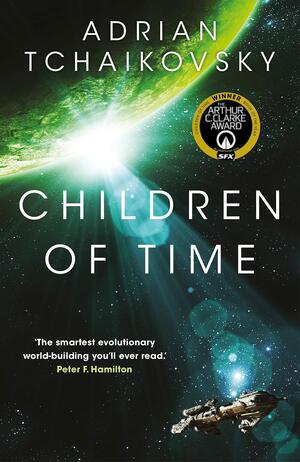
This is going to be one of my favourite books of the year, probably one of my favourite books ever. A very good friend of mine recommended it, then she got it for my birthday and kept asking me if I had read it until I did. I know I’m coming late to the party here (this is my first Tchaikovsky book), but because people had hyped his writing SO MUCH, I was reluctant to get into it. Honestly, I didn’t think it was going to be my thing.
However. From the very beginning, I was hooked by the premise. I think it’s one of the best premises ever for a science-fiction book. Humanity is destroying the planet (of course, nothing new here), so a bunch of scientists develop this virus, which accelerates evolution in a species. Then, they plan to send a group of monkeys to a planet that they discovered, which can be terraformed, infect them with the virus and recreate the human species from scratch to start all over again. A religious group is completely against this (seeing it as meddling with God’s affairs), so they sabotage the expedition. In the end, the virus lands on the soon-to-be terraformed planet, but the monkeys never get there. You know what this planet already has, though? Spiders. Spiders, which, thanks to the virus, are going to evolve very quickly, into super-intelligent beings.
I’m a bit of an arachnophobe. I’m not a fan of spiders or insects in general (except for ants, I’m really into ants, and I think they are pretty incredible). But this book made me consider spiders under a completely new light. By the end, I was definitely on their side; I was feeling moved by them. I think that’s a pretty incredible accomplishment on Tchaikovsky’s side. The way he portrays the creation and development of the spider society is very impressive and engaging. Parallel to the spiders’ story, there’s the story of humanity on board a massive spaceship (the Gilgamesh) as they look for a new earth (having, of course, destroyed the original one). Eventually, humanity will have to fight the spiders for the right to live on the same planet. I was on the spiders’ side all the way through.
The ending was also masterfully written. I didn’t quite go where I thought it was going to go. And the last pages – they made me tear up. I was touchedby the book and its characters, as well as the ideas it presented. A masterpiece, for sure and some of the best examples of sci-fi I have read in the last few years.

