

Mimosa by Archie Bongiovanni

One of the things I enjoyed the most about this graphic novel is how it focused on queer characters in their thirties/forties. A lot of queer literature tends to have a focus on coming out stories, normally featuring younger characters – but I’m often eager to find more literature written about middle-aged queer people and old queer people too!
In this story, the four protagonists (Chris, Elise, Jo, and Alex) are struggling with many different things, from divorce to single parenting to dating in your thirties (when you may feel the extra pressure of having it all ‘figured out’) to looking for a job that feels meaningful and so on. One of the best moments in this story is when the characters decide to put all together a new club night for older queers (that they call ‘Grind’), so the club scene is not only dominated by the younger generation.
This was a comforting read with lots of funny and relatable bits and also a dose of bitterness and sadness (life only gets more complicated the more we live through it, am I right?) For example, one of the characters falls in love with her manager at work, another reveals their real financial situation to the group, causing outrage… and so on.
I really liked the drawing style. I would have liked more nuance from the characters and a bit more exploration of their friendship beyond their romantic interests. I keep saying this about books I read (maybe I should take note, as a writer!), but I’d love to read more about the intricacies of friendship. It seems that romantic love always takes most of the spotlight, and even though this book’s blurb is about, well, found family, there could have been even more of it in my opinion.
Girlhood by Melissa Febos

Febos has been on my radar for a long time, and finally, I got my hands on one of her books. Well, it will definitely won’t be the last – I really, really enjoyed her writing style. Like Leslie Jamison, Olivia Laing, Roxanne Gay, and Maggie Nelson, Melissa Febos effortlessly combines her life experience with very nuanced ideas in a writing style that is very absorbing and accessible.
This book goes over the concept of ‘girlhood’ and how Febos relates to it at different stages throughout her life. It has some heavy, hard stuff in it – but it’s all handled in a brilliant, thoughtful manner. One of my favourite essays was about Febos’ terrifying experience of having a stalker – a man who, literally, looks through her window at night when she’s living in a shared flat in NYC, on the ground floor, right next to the entrance of a subway station; he seems to be pleased that she’s noticing him, whereas she’s (of course) disturbed by this sudden invasion of privacy. From then on, Febos offers an overview of how the figure of the stalker has been romanticised in culture and media (i.e. if you are a young, beautiful woman, you should be grateful for the attention, maybe he’s in love with you, isn’t that cute… and so on).
There are essays here about Febos being a child and growing up – the experience of having a preteen and a teen body and how abusive encounters with friends or people you know are so common for girls that somehow they may feel less important, less of a ‘thing’ one should make a ‘fuss of’. For instance, Febos analyses several occasions and memories that ‘child-Melissa’ processed as being normal or even exciting, but that ‘adult-Melissa’ understands now as abusive and very problematic.
There is also an essay about mothers and daughters and how to ‘be a woman’, a girl often learns from her own mother, and this learning process may also imply that the daughter will, at some point, rebel against her mother’s rules or ways of embodying ‘womanhood’ and ‘girlhood’.
But my favourite essay, which I believe is splendid, is one about physical touch titled ‘Thank You for Taking Care of Yourself’. In this one, Febos is trying to decide why she feels uncomfortable with the idea of physical touch in certain situations. She decides to go to a private ‘cuddling’ party (which happens in NYC) with her girlfriend and another friend. At this party, people wear soft clothing (like pyjamas) and are encouraged to hug and touch each other in a non-sexual manner as long as there is verbal consent given first. Physical touch can be an extremely important part of being human, and Febos established this from the very beginning, explaining also how these parties have been very popular since the COVID-19 lockdowns, which, specially in the big cities, forced people to be isolated for very long periods.
Even though Febos is encouraged by the party organisers to say ‘no’ to any sort of unwanted touch (and without giving any reason or justification to it) she finds it extremely difficult – and ends up accepting some physical touch just because rejecting it seems more painful somehow that having to feel in your skin something that you don’t want. That was so powerful and relatable – I also feel that I’ve been educated to be pleasant, and quiet, and to comply, and seeing others’ disappointment (even when I’m placing boundaries) is often physically painful. A woman’s body is rarely her own – and here Febos gives a strong context as to how and why this happens. The essay finishes with her going to the party a second time – with the promise to herself that she’ll only say ‘no’ to everyone, if anything, just to practice placing these kinds of verbal and physical boundaries.
Finally, it’s worth mentioning that Febos is a keen runner, just like I am – so I loved reading about her experience writing and running (these two activities are also very much interconnected for me).
Hijab Butch Blues by Lamia H
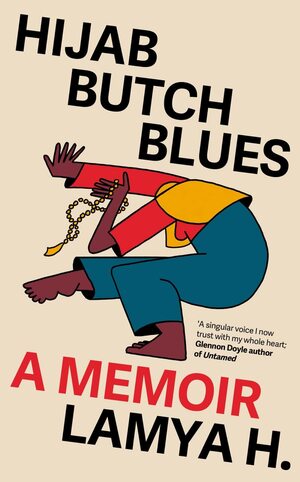
I loved this book so, so much. This is going to be one of my favourite books of the year, probably one of my favourite books of all time. Another extraordinary example of how creative non-fiction can be so powerful and engaging and life-changing.
In this book, the author, who is non-binary, reflects on gender, queerness and faith – and shows many examples of how all of these can co-exist. Every chapter in this book is centred around a story from the Quran that the author revisits and reinterprets through a queer lens. For example, the first story is about Maryam, Isa (Jesus)’s mother, who Lamia H recasts as ‘butch’ (a woman who grows alone, dedicated to her faith, and then has a son without male intervention).
Maryam is a dyke.
Isn’t it obvious? Doesn’t it make sense? She lives alone in a mosque with no one else around, no one to monitor what she does or whom she meets up with, and not a person in the world for company. One day, a handsome and well-proportioned man comes to her door unannounced. No one will know if he stays awhile, no one will know what they do together. But before he can even talk, Maryam asks him to leave. No, thank you, she says, please don’t talk to me. She would rather have her solitude than the company of this handsome man. Eventually, she lets him stay–but only because he’s an angel. She hears him out because he’s an emissary from God. Laughs heartily when he tells her she’s going to have a baby. No man has ever touched me. No man.
(pp. 23-24)
Another story is about God as a non-binary entity (and how God does use a non-binary pronoun in the Quran, even though in some translations this becomes a male pronoun).
In the beginning, God created language and language is power and naming things is power and words like “he” or “she” or “they” are all power. The language God gave us hides meaning, adds meaning, and is constantly shifting beneath us, constantly creating our worlds and constantly creating us.
God knows this, of course. Describes divinity in ninety-nine names that expand language, that collide with the capacity of language to express. Al-Quadir, the One with Most Perfect Power Who Does Not Make Mistakes. Al-Shaheed, the All-Observing Witness. Al-Haqq, the Embodiment of Truth.
And gender is nowhere within the concepts that define the Divine. God is neither man nor woman nor masculine nor feminine, nor not masculine, nor not feminine. This God, who teaches us that we can be both and neither and all and beyond and capable of multiplicities and expansiveness. Nonbinary, genderqueer. They, this God that is the God, my God, my Allah. Who created the world and created language and created the first person, Adam, this first person who was man and woman and neither and both and not a mistake, never a mistake.
Like me.
(pp. 82-83)
This is also a book about migration and displacement. Lamia H is a migrant twice – they move with their parents to a different country when they are very young. Then, they move again to the States to go to university and end up choosing to stay there to live as adults in NYC. It’s very interesting to see how Lamia H comes to terms with their queerness in a society where queerness is made invisible to the point where there is almost no language to refer to it. A chapter of this book argues why they have chosen not to come out to their family precisely because of this – they fear their family won’t understand what queerness means, and they don’t want to lose their love and the harmony in their relationship. In fact, Lamia H defends the right to not come out if you don’t feel it is safe or adequate for you at the point you are in life. At the same time, there are also lots of moving examples of Lamia H coming out to friends in NYC – of showing vulnerability to other people from their newly-found Muslim community in NYC. Some of these friends make space for these revelations; others don’t.
As if it would be that easy to tell my parents, as if it even feels possible. My parents, who live across an ocean in a country where queerness operates so differently, isn’t openly discussed, isn’t an identity. My parents, who don’t know any openly queer people Who have only heard about homosexuality as a sin, as disease, as something that must not be named. What would my telling them I’m queer achieve? My parents would see it as a failure of their parenting. I could never do that to these people who birthed me, who left their families to build a more comfortable life for me in a country where they didn’t know anyone and didn’t even know the language. I wouldn’t be able to be there for them as they struggled with the knowledge of my queerness. I wouldn’t be able to hold them, wouldn’t be able to tell them that I still love them, that I’m still the same me… While we’re so far way from each other, while borders and visas keep them from visiting me, while they don’t even know my everyday life? I’m not planning to come out to my parents, not now and possibly not ever. It doesn’t make sense.
(pp. 99-100)
There’s also another great chapter about how one is perceived – as a non-binary mostly female-presenting person, and also as someone who chooses to wear a hijab. I was so in awe (and inspired, frankly) to see how the author really makes a point of not compromising their beliefs – their faith, their culture, and also their non-binary gender. I think this kind of quiet, brave work is so important. I think it triggers change.
There are also really touching and beautiful chapters about their experience dating in the United States and trying to find a place as an immigrant. They end up in a committed relationship with someone with a very different background (she’s white, and from a protestant family). Once the relationship is established, the author decides to bring her to visit their side of the family that they have living in the States, but the two of them have to pretend to just be friends, because Lamya H hasn’t come out to their family yet. Instead of being a disturbing or strange experience, it seems to go well and be even tender. It’s not ideal, but it is what it is right for them at the moment, and there’s an acknowledgement of the difficult sacrifices their partner has to make. I think it’s important to write about nuances in families and experiences. In an ideal world, things would be simple and satisfactory for everyone. But – who is living in an ideal world?
There’s also a lot here about the immigrant experience – about the cruelty and dehumanising systems we have to go through to justify some kinds of belonging. It’s no surprise to see that the author finds a lot of strength and purpose in their community and chosen family (including the queer Muslim community they find in NYC), but also in their own faith, which they decide to reinterpret in a way that makes sense to them.
All in all, a splendid book.
Playground by Richard Powers

My first book by Pulitzer-winner author Richard Powers. This was a weird one – because I don’t know what to make of it. Overall, I enjoyed reading it. Especially all the interesting bits about marine biology (I didn’t know that manta rays were extraordinarily smart creatures). This is, overall, a book about the sea, and how the different characters relate to it. We have characters living on a tiny island in the Pacific, Makatea. We have a character who is Canadian established in California working as a professional diver. Two university students in the East Coast of the United States. And so on.
Now, the cons. A lot of the story is told from the perspective of an old man, Todd Keane. Todd is also one of the richest people on the planet, being CEO of a company that specialises in social media AI and has revolutionised society as we know it. Now, this is one of my pet peeves – but I just normally don’t care when my narrator is extremely rich. I’m just not interested. So I was a bit frustrated having to read him as a protagonist. It’s worth mentioning that he’s also in his early stages of dementia (and potentially suffering from Lewy Body disease, which is truly terrifying). But still a part of me was like… well, at least you are rich? You can afford all the best doctors? At least you had a good life, and you will have all the comforts when you go through the last stages of your life…
All the other characters seemed more like types rather than genuine humans. Their stories moved rather quickly but there was never time to fully exploring – these characters were Rafi, Todd’s friend from childhood, Evelyne, the professional diver who has to fight against a lot of misogyny to make her career happen, Ina, the sculptor born to a Hawaiian father and a Tahitian mother who ends up marrying Rafi so they both move to Makatea, in French Polynesia… which is the island that Keane’s company is trying to buy so they can have floating cities established in international waters.
And then… the end. There’s a massive SPOILER here.
So, I can’t decide if it’s genius… or just a trick that doesn’t quite work. But at the end, it is revealed that most of the novel (not the sections narrated from Keane’s POV but the rest) is written by the AI that Keane originally created. It turns out that, as he sees his life coming to an end, Keane is feeling full of regrets and sadness, so he asks his AI to ‘tell’ him an alternative version of his life with happier, better outcomes. Ah, I thought, so this is why those parts of the novel felt so strangely flat? Why the characters felt like types but never truly human?
This is, ultimately, a very interesting book about storytelling and technology and, well, play (the human and animal necessity of it). My favourite parts where the scenes with Todd and Rafi as kids – how they bonded over their love for games, and how consumed they were by the Japanese game of Go, which they considered the superior game at the time. (I happen to like Go quite a lot too, and I’ve also written about it in my fiction…)
 Inés G. Labarta