
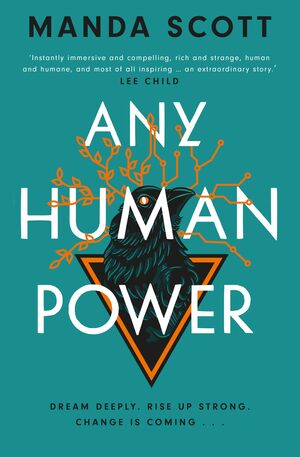
Any Human Power by Manda Scott
This is, probably, one of the books I enjoyed the most this year because I keep thinking about it even months after finishing it. This is a thrutopia, that is, it imagines ways in which we could navigate an uncertain future (considering how things are going right now in 2025, I think we all know what an ‘uncertain future’ feels like).
The start of the book is interesting: we get introduced to Lan, an old woman on her deathbed. Lan is a queer scientist and an English shaman (in that she uses dreams to travel to the ). As she says goodbye to her family, she promises her grandson that she’ll take care of him.
We move forward, and Lan is the Otherworld, enjoying her existence there but somehow unable to cross to the land of the dead as the promise she made to her grandson is somehow keeping her in a sort of limbo (which seems a chill place where she can enjoy wild nature and even the company of a mysterious dog, but still, she’s on her own). Suddenly, she gets pulled back into the world of the living (as a ghost) because her grandson, now a young man, is asking for her help. And from then on, Lan will need to do everything in her power (as a ghost, so she can’t even communicate with the living unless she uses the dreamworld) to save her family, who is about to undergo a perilous time.
This novel has its flaws. At many points, it seems that the author is more interested in getting a message across than in exploring the nuances of plot and character. But at the same time, this message is one of the things that I enjoyed the most about the book. The thing is, Any Human Power imagines a version of the UK very similar to what the country is now and then asks a question – what if power could be redirected to the hands of the many instead of being concentrated in the hands of the few? What if a party was created to rule the country that wasn’t focused solely on ideologies (right, left, anything in between) but in fundamental things the majority of us wants anyways (things like access to a strong healthcare system, access to housing, to education, a sustainable future, jobs that feel fare and don’t make us sick… etc.) The characters of this story (Lan’s family) try to create said party (the idea comes from the youngest member of the family, who unexpectedly goes viral on social media and uses this to reach out to people and communicate this idea). They demand the government introduce three new policies when it comes to the political system: the first one is that politicians get regularly screened for alcohol and drugs, their argument being that people who are going to decide on decisions that affect the many, then they should have a clear mind; the second one is that every political party should offer full transparency of the money that goes in and goes out, including the salaries people earn while on the job and the expenses their jobs incur; the third one is that people as young as sixteen are allowed to vote and people older than eighty-five aren’t allowed to vote anymore (on the basis that people who are sixteen will be affected by the future in a greater manner than people over eighty-five). I mean… sure, depending on who you are talking to, these may seem controversial (especially the third one), but honestly, the first one and the second one seem like something many of us would quickly agree on.
Of course, things aren’t easy, and Lan’s family confronts very difficult situations as their ideas spread amongst the population, and some are definitely not happy about it.
This book also introduced me to some very interesting ideas (Scott actually offers a list of sources at the end of the novel), such as Riversimple’s Future Guardian Governance, which is actually how a company in Wales operates. In this model, the company board of directors has six different roles (with executive power). One person represents the interests of the Investors, another person represents the interests of the Staff, another person represents the interests of the Community, and the final person represents the interests of the Environment. All of these seem essential to the sustainability of a business (and the human race, to be fair), and I wish there were more places enacting policies like this. I wish that, as a worker in an organisation, I had someone on the board of directors who represented our interests and could have the power to defend this. It seemed obvious to me that this is how companies should run before I started working, and I was quickly proved wrong, of course.
All in all, this is a very interesting book – a book that encourages us to consider what the characters grapple with – what are we doing to leave a world behind that the future generations are grateful and proud of?
Black Paradox by Junji Ito

A highly disturbing (and highly entertaining) horror manga by one of the masters in the genre. It follows a group of four strangers who meet to help each other die by suicide. However, by trying to die, one of them ends up slipping into the spirit world… and coming back with a giant marble (I don’t know how better to describe it?) inside his body that is made of a strange non-human material. (The marble ends up being a crystallised soul from the spirit world.) Things change quickly for the group as they realise they can become very rich if they manage to bring more of these marbles.
Like Ito’s other works, this book uses horror to explore many societal flaws and character flaws (from greed to the pressure to keep up appearances). I enjoyed the escalation, the mystery and the twists, and it really shocked me in places. Definitely a recommendation for horror fans and those who already love Ito’s work (since this is not one of his best-known pieces).
This is How You Lose the Time War by Amal El-Mohtar and Max Gladstone

This was an interesting read (picked by local queer book club). First of all, it’s a science-fiction novella. I love novellas as a form, I think to me they are just perfect (many of my favourite books are novellas). I was very excited. The first pages had the most beautiful, visually explosive prose. Then I kept reading. And even though the prose never let me down, I started getting a bit confused. Like, at some point, I had read a bunch of chapters (epistolary letters that the two main characters, Red and Blue, exchange with each other) and I had NO idea what was going on. I was having a really difficult time understanding the plot, which seemed too obscure and complicated. I persevered (this is a very short book, which helped) and suddenly, somehow, past the midpoint, I understood what was going on. And I started loving the book hard because the message landed on me like a meteorite. This is a whole metaphor about humanity, I thought then, about the two main forces that drive us, fear and seeking connection. At the end, I was tearing up. So, a real rollercoaster of a book. I think I really liked it.
This book, to me, is a great allegory. Red and Blue are two spies coming from two different factions that are fighting each other through time. Red comes from a super-evolved military society in which the main emphasis is placed on humans being as strong as machines. Their aim? Conquer as much as they can. Blue, on the other hand, is part of The Garden (a metaphor for Gaia?), a society in which everyone is connected to a collective consciousness and co-operation is the main value. Even though they are rivals sent by these two factions to tip the scales in favour of one side or the other, the unexpected happens. Blue tries to connect with Red because, one may say, that’s ultimately her nature. The two of them start writing to each other in secret, and a romance blossoms.
There’s no perfect ending, and sacrifices have to be made, but this is a book that celebrates connection, communication, and empathy. Reaching out to others, trying to understand. In a way, it is like a very long poem. If I were going to read it again, I’d just let the images flow in my imagination and wouldn’t be as worried about untangling the plot.
Commute by Erin Williams

This book was recommended to me by one of the booksellers at one of my favourite Madrid bookshops (Librería de Mujeres). She warned me it was excellent but a tough read. Boy, she was right.
This is a graphic novel, apparently drawn by someone who has never made a graphic novel before (wow). Williams’ autobiographical story follows her from her home in the NYC suburbs to her job at the city centre and then back. It all seems pretty mundane – except that William uses this (the act of commuting, of sitting on a train every day for at least two hours with many strangers) to reflect on women, their bodies and the idea of consent. At some point at the end of the book Williams talks about her relationship with her own body – what it is to be a woman and to feel that an integral part of your identity is how others decide to perceive your body (as ugly, or beautiful, or too skinny, or too fat, or too this or that) how that makes you detached from your own blood and flesh. How that evokes complicated feelings of shame and revulsion. How difficult it is to enact consent in a culture when, more often than not, ‘we are groomed for compliance’. These last pages rang especially true for me, and I found them very moving. She finished the book with this sentence: ‘shame spills wild’. Which I read as a powerful call to remember that to stop being objectified, one doesn’t need to make herself quiet or small. Sharing our stories (and doing so shamelessly) is our only way out.
Evenings and Weekends by Oisín McKenna

I was really excited to get to this book because I’d read that it’s about queer friendship, queer love, polyamory and chosen family. It’s set during a long weekend of a particularly hot summer period in London. The prose was really good – it reminded me of those authors like Sally Rooney and Rebecca K Reilly that I just can’t put down. It follows different characters and their various miscommunications (which again, reminded me a tad of Normal People). Maggie, who has just realised she’s pregnant and realises she may have to give up her dreams as a thirty-year-old artist and move to the suburbs she escaped from to raise her kid. Ed, Maggie’s boyfriend, is also not all that keen to leave the city and is also hiding a secret (he’s bisexual and has a crush on Maggie’s friend). Then we have Maggie’s best friend from childhood, Phil, who is in love with Keith, his housemate. Keith is in a polyamorous relationship, but Phil is not so sure he’s as important in Keith’s life as Keith is in his. Then we have Callum, Phil’s older brother, who is about to get married (this is the reason why all of them are going to see each other very soon) and has a pretty bad drug and alcohol problem that everyone seems to know about except for his parents. Actually, Callum’s dark descent may have something to do with his and Phil’s mother, Rosaleen, who has recently been diagnosed with terminal cancer. She hasn’t told Phil yet.
And so, you can see the drama that ensues (sometimes comical, sometimes deeply moving, and sad). In the background you can feel how hard is to make it in the big city, the jobs some of these people hate but have to endure, the low pay, the juggling to make ends meet (I’m in my thirties too and I resonated with this, as I’ve never felt more precarious for many reasons).
If there was something that I didn’t quite like was how some characters got what seemed to be ‘an easy way out’ – (massive spoilers ahead) such as Maggie who decides to terminate her pregnancy and move to Berlin and suddenly she’s just the artist she always wanted to be and everything is fine with her? (I’ve strived to be an artist for many, many years, instead of having to cope with a series of more or less soul-crushing jobs, maybe I just need to move to Berlin too?) Other times, I was really interested in (such as polyamory, found families, gender questioning) were not as explored, and I felt that romantic love took the centre of stage here. But then again, these are all personal qualms, and this is a book I really enjoyed overall.
 Inés G. Labarta