Butter by Asako Yuzuki
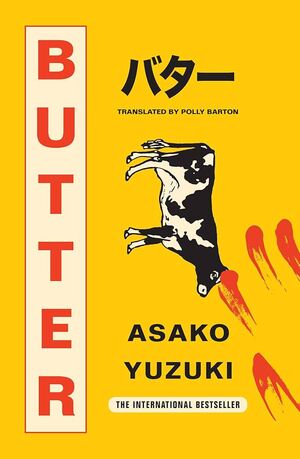
I read this while on holiday and loved every page. Not only is this an engaging thriller, but also an interesting social critique of the relationship many women and femmes have with food and their own bodies. Even though the story is set in Japan, I could still relate to it even from my European experience. The obsession with eating as little as possible to fit into the smallest clothing sizes, for example, rang very true for me, especially as someone born and raised in Spain. (I may be wrong here, but I find the female beauty standards in the UK a tad more relaxed, which I appreciate.)
An interesting thing about this story is that it is based on a real criminal case in Japan where a woman was accused of killing (probably by poisoning them) her much older lovers. Apparently, this was a case that shocked the nation because the woman in question turned out to be ‘not beautiful’ (meaning, she was seen as fat by others) – so everyone wondered, how could she have been desirable for those men who ended up being her victims?
What a great narrative question to start with. And I have to say, Yuzuki doesn’t disappoint. Her main character is Rika, a woman in her early thirties living in Tokyo who is also a reporter. She’s keen on interviewing Kajii, the skilled cook who has been jailed for presumably killing her ‘sugar daddies’. Kajii has refused to talk to journalists, but Rika thinks she can get to her. Because Kajii loves cooking, Rika goes to ask her best friend, Reiko, a housewife trying to conceive her first child and also happens to have excellent cooking abilities. Seiko suggests that Rika approach Kajii by asking her about her own recipes, which Kajii used to publish on her own blog. The plan works – only that when Kajii and Rika meet, Kajii is keen to discuss food but not her presumed crimes. She gives Rita her first challenge: if she wants to talk to her again, she has to go and eat premium quality butter, not margarine or the other disgusting substitutes. Real butter.
This is harder than it seems. Rika is very conscious of keeping her weight in check (as many women do). She underfeeds herself routinely, which, paired with her workaholism, is keeping her way under fifty kilos. Obviously, butter is on her list of forbidden foods. But she really, really wants to interview Kajii because she knows this could be her journalistic breakthrough.
This is a story about food, yes, (and many recipes are described in lavish detail, so much so that they made me salivate). But this is also a story about women and their relationships with each other. For example, we have Reiko, Rika’s best friend, who, from the outside, seems to have it all in life: a beautiful house, a kind husband, and she’s also beautiful and skilled. But she’s also frustrated with her life, with the prospect of not being able to have a professional career (in Japan is still very common for women to quit their careers the moment they marry) and even though having children is the next step in her perfectly curated life she’s actually not keen on the idea. The book really goes deep into the friendship relationship between these two women – the support they give each other and the secret jealousies they hide from each other.
Rika’s mother is another important character – married to her older university professor (Rika’s father) and trapped in an abusive relationship with him, she ends up leaving him. But when Rika’s father abandons himself after the divorce and ends up dying, everyone seems to blame her mother for not taking care of him as a good wife should. In her old age, Rika’s mother is not only a successful business owner (that she built all by herself after her divorce) but also her own father’s carer – who, as her husband once was, is also abusive towards her. She accepts this quietly.
Kajii is the fourth most important female character – a real enigma, as many stories about her past (her obsession with cooking, her blatant antifeminism, her dead, much older male lovers) are unclear and often contradictory.
There were a few strange twists towards the end of the book that were certainly unexpected and perhaps a bit over the top. I wasn’t sure I believed all of them or that they even needed to be there. But I was genuinely moved by Rika’s story – how her awakening to food and pleasure is also linked to a sensual awakening. As she confesses to herself in many points throughout the novel, she’d been underfeeding herself for so long that she couldn’t think or feel things the same way she could on a more careful and generous diet.
And now, about the ending, one of my favourite parts of the novel (so skip if you don’t want to know about it).
I really loved the final scene, how Rika took care to cook an extremely elaborate recipe to invite all her new friends (a sort of found family) and her mother for food. As a main character, she loses a lot through the novel (her boyfriend, the appreciation of those who don’t see her as a ‘beautiful skinny woman’ anymore and almost even her career). But she gains much more: the Rika of that final scene is not longing or lost. She’s satisfied.
Paper Girls by Brian K. Vaughan and Cliff Chiang

I read this during the coldest, most depressing days of the year (dark, late January), off work from The Illness From Hell which wasn’t Covid-19 (believe me, I was lucky with Covid-19 the few times I’ve caught it and it’s always felt like a child) but a bacterial tonsillitis that almost drives me mad. I’ll just say that it felt like swallowing glass for four days, I couldn’t sleep because of the pain, so at some point I was almost hallucinating, and I lost my voice for two solid weeks (I’m a teacher, so my voice is kind of essential).
So I read the whole comic collection from beginning to end. It has a plot that we’ve all seen before – the world is ending because someone has messed up with time a bit too much and our four unwilling heroes must do anything it takes to save it. Yet I loved many things about it: the 80’s feeling of many of the scenes, the crazy time-travelling element, the trippy dream sequences, the friendship bonds between the four main characters, who meet as they are all paper girls, that is, in charge of delivering papers first thing in the morning around their neighbourhoods.
This series gets really dark at times, but that’s always an element that I tend to enjoy. I also didn’t mind when things started getting complicated with all the different timelines – as a reader, I’m always up for a challenge, and I love when authors don’t explain it all to me so I can, instead, go and join the dots all by myself.
A very enjoyable read. I think I still prefer Saga (also written by Vaughan) because of its perfect combination of horror, sci-fi and comedy, but Paper Girls is still very enjoyable, especially if you like time-travelling narratives.
The Sad Ghost Club by Liz Meddings

A sweet short comic about anxiety – how someone young navigates the world around them, having to cope with it. I’m a very anxious person myself, so I appreciated the care and empathy Meddings gave to the story. Plot-wise, it is not very complicated, but the illustration style is really delightful.
La escritura como un cuchillo by Annie Ernnaux

A very short collection that my mother gave me to read when I was on holiday visiting her. This is my first Ernnaux’s book (I know, I know) and I absolutely loved it. The formatting is really interesting – it basically collects a series of interviews (via emails) conducted by writer Frédéric-Yves Jeannet in two different periods (the early 2000s and then post-2020). Jeannet seems a very kind and insightful interviewer, and through his questions we get to learn a lot about Ernnaux’s own creative process and the challenges she’s faced during her impressive career as a writer. Ernnaux also comes through as a very relatable person – she discusses craft in a way that feels realistic and also humble. She talks about writing about her own life, the fear and the shame of it when she started (writing about her experiences as a young, working-class woman). How she combined writing with motherhood, single-motherhood and an array of different jobs, which included being a teacher for many years. How she negotiates telling the truth whilst also telling a good story. I absolutely adored this book and wrote down many quotes from it to use in my own teaching. I haven’t read any other books by Ernnaux (which I should try to fix as soon as possible), but I think when I do, I’ll read the Spanish translations as I believe they’ll be closer to the original, most likely (sadly, I don’t read French).
Something that jumped out to me – perhaps because I’m an immigrant writer who likes writing about a lot of different places, oftentimes invented ones – was Ernnaux interest (‘reverence’ is a word that comes to mind) to use her writing to connect with the very specific places in France she feels she belongs to: first the place where she grew up and second the Parisian neighbourhood where she has resided most of her life. I’m someone who rarely writes about the same place twice – but then again, I have lived in different places throughout my life, and I’m not a stranger to feeling uprooted. So I always find these intense connections between people and the places they connect with over many years fascinating. What can I say – I wish this book were translated into English so I could recommend it to many people I know!
 Inés G. Labarta