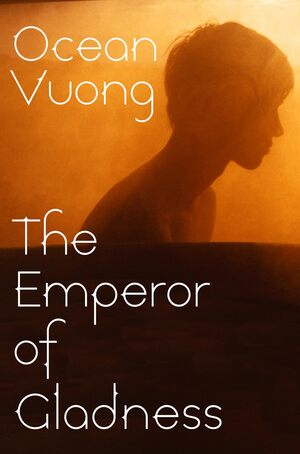

The Emperor of Gladness by Ocean Vuong
I adored this book. The written style is lyrical and contains lots of imagery. In this character-driven novel, the plot is secondary. I’ve listened to a lot of interviews with Ocean Vuong (he’s so wise when it comes to the craft of storytelling) in which he discusses the importance of ‘pause’ and ’emptiness’ at plot level. And this work is a perfect example of that.
The novel follows nineteen-year-old Hai, loosely based on Vuong himself. Hai is depressed after losing the man he loved during his first year at university. As a Vietnamese immigrant in the States, he doesn’t dare to confess this to his mother (he hasn’t even told her that he is gay). So instead he pretends that his breakdown and poor mental health are a direct consequence of his drug abuse. When his desperation takes him close to dying by suicide, he’s unexpectedly saved by Grazina, a woman in her eighties, and also an immigrant herself after the Second World War.
After this, Hai will slowly but surely start to form bonds with Grazina and moved in with her while he tells his mother he’s a medical school in Boston. Later on, he also starts getting close with his colleagues at his new job in a small, non-distinctive fast food outlet in the outskirts of East Gladness, the town in Connecticut where he lives. This was a beautiful book precisely because its characters were adrift, trying to keep hope and inspiration up while still having their souls eroded by meaningless work and/or financial and familial difficulties. The plot meandered showing us these characters in different moments, to a point that the novel seems to have been built around scenes and not very clear plot points. This doesn’t, in my opinion, make it less enjoyable because the emotional truth of this work – its reflections on community, friendship, family and migration – is strong and important. Plus, I found Voung’s writing addictive – his attention to detail really brings every character and setting to life. There was a realness to this work that trumped anything else.
Vuong’s novel contains lots of hard topics, such as severe mental health struggles and Alzheimer’s. Hai may be a nihilist but he’s also an excellent and thoughtful carer when it comes to Grazina. I loved that this version showed this side to masculinity too – and the scene in which Hai and Grazina show each other naked (which is not sexual at all) was one of my favourites.
This is also a book about unlikely friendships and human’s will to find meaning in everything, even in the most grinding jobs and circumstances. It’s my first book by Vuong and now I can’t wait to read more.
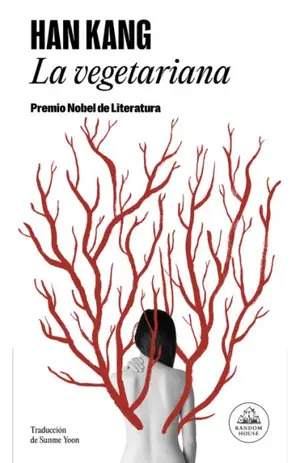
The Vegetarian by Han Kang
I read this book in Spanish, translated by Sunme Yoon a Korean translator who was brought up in Buenos Aires. As someone who speaks different languages (I consider myself bilingual in Spanish and English) I didn’t trust the English translation of this same novel, which is why I waited for a while until I found a translation I thought I may enjoy.
I’ve heard very good things about Kang’s work – and, of course, she became internationally renowned last year after winning the Nobel Prize. But I wasn’t prepared to be so moved by this book.
The story is simple: a young, childless housewife, Yeong-hye, decides to become a vegetarian. What seems to be a relatively small decision ends up having terrible consequences for her marriage and her family life. Both her husband and her father see in this decision an unforgivable act of rebelliousness. Which, really, makes sense, because within only a few pages into the novel one realises that Yeong-hye’s body is not really her own. It belongs to her family, to her husband and to the ideals and morals of the society she is part of. She is no really free to do with it as she wishes – so the idea that she may have control over what she puts inside it seems ridiculous to all people who surround her.
Kang takes this premise to the absurd extreme – because Yeong-hye won’t obey her husband and her father, she is seen as insane and ends up committed to a mental health institution, specially when it becomes clear that she’s ready to harm herself before being forced to eat the meat she now despises.
In this first part of the novel, I saw in the meat a metaphor for misogyny and the violence perpetrated against women for centuries. The reason why Yeong-hye stops eating meat is because she has terrible nightmares in which she has to murder others with her bare hands. The meat then becomes corpses of those who have been murdered unfairly to feed or sustain others. A quick look at our current meat industry confirms this is a business based in violence that doesn’t respect the lives of sentient beings that are more similar to us than not.
However, the novel kept surprusing me as it included other two parts with different narrators. The second narrator is Yeong-hye brother-in-law, an artist desperate to create work that will finally make him famous. He lives completely focused on his art while his wife, Yeong-hye’s sister, slaves away working on her own business which supports them both and also takes care of their young child. In this part the unbalance in the family is obvious: the woman has been tasked with all the care labour and she’s also the breadwinner, whereas the man gets to spend all the time he wants working on his ‘art’ because he’s a ‘genius’. And of course, he resents his wife for making more money than he does.
The third part – and the one that moved me and horrified me the most – is narrated from the point of view of Yeong-hye’s sister. From the outside, she’s the perfect woman. She is traditionally beautiful, she’s the owner of a profitable business, she’s a wife and a mother of a little son. However, her perfect life starts crumbling as Yeong-hye’s decision of becoming a vegetarian and eventually divorce her husband breaks the family apart. Further on, when she discovers Yeong-hye involved in a very strange art performance designed by her husband she ends up separating from him. She then struggles as a single mother while taking care of her business, her son and now her sister, who has been committed once again to a mental health institution. In this final part of the novel, Yeong-hye’s sister makes the long journey to the mental health hospital where Yeong-hye is at. There she has a difficult conversation with her doctors who inform her that Yeong-hye is starving herself to death and refuses to eat. This was the hardest part of the novel for me to read because it shows the extreme violence of a mental health system in which Yeong-hye has already been declared insane. So nobody asks her questions or cares for her well-being or the reasons why she’s ended up in such complicated position. From the doctor’s point of view, the only thing that matter is to keep her body alive, which means force feeding her.
What makes this world so powerful is that even though I don’t have the same cultural background as the author I still connected to the story: to the feeling of being just ‘meat’ or the fear of not having control over one’s own body. This was a perfect blend of horror and literary experimental fiction that will stay with me for a long time.
How to Winter by Kari Leibowitz
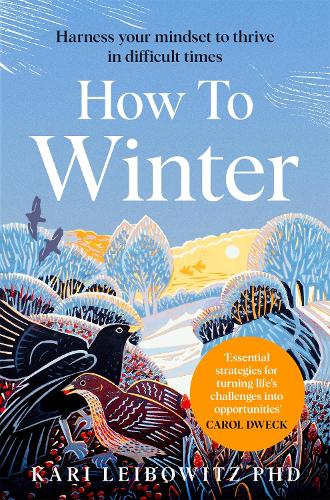
I saw this book at the library and as someone who suffers from SAD (seasonal affective disorder) I decided to grab it and see if it could teach me something new. The author is an American psychologist who lived in Tromsø for two years. And then moved to California, where she currently resides. That made me laugh a bit – because, can you truly call yourself a winter expert if you live in California, a place that doesn’t really have winters?
This book is written a bit in the style of an American self-help book which put me off a bit at the beginning. But eventually I got used to it and I enjoyed it a bit. It actually even questions SAD and suggests that people don’t necessarily become more depressed over winter – although winter does tend to encourage some behaviours that promote isolation or lack of exercise which then in turn can have an impact on our mental well-being.
These are some of the things I got out of the book:
- Candles, fairy lights, mood lights… etc. are a big yes (they actually make all the difference to me, as I discovered in recent years).
- It’s not much about the bad weather but about how we are dressed. So, we need to keep going out as normal even in winter. Is it too cold? Then we need more insulating clothes. Too wet? Then we need better water-proofs. And so on. This is something that living in England certainly taught me – water-proofs make all the difference, and they are essential if you want to keep a walking / hiking / running routine in this country.
- Learn to embrace winter for what it is. The cold. The bare, frozen landscapes. The dark, stormy days. I’m getting a bit better at this. Walking to work I have the privilege to go through an area full of trees and a little stream. The bare trees look extraordinarily beautiful on those bright sunny winter days when the light of the sun have a special golden quality. The frost makes the landscape glitter as if it was a beautiful painting.
- Organise celebrations around winter that are not weather-dependant. In the book, Leibowitz gives a lot of examples of very cold cities (like Tromsø or Calgary) that plan cinema or literary festivals in winter time so people have an excuse to leave the house and meet each other. I realised that during winter I’m also more inclined to play video games, for example, and recently I purchased a new few ones that will keep me entertained in the long, dark evenings. I’m also forcing myself to be social even if I don’t feel like to, which always pays off. Maybe next year I’ll have an official winter celebration at the start of the season…
- The way we understand seasons in our western culture is really making us feel that the winter is longer than it really is. So, she advocates for considering end of October as the beginning of the winter (especially at the point when the clocks change and the days become shorter) with the first of February as the official day when winter ends and the days start to become noticeable longer.
And this is all. November was a very stressful and full with work so I didn’t have much time to read, only two books, which is not much at all for me… This year in general has been really hard mentally and finding time to sit down and read has felt scarce, and difficult. So it goes. But The Vegetarian will probably in my list of favourite books this year and it helped me get out of my reading slump.
 Inés G. Labarta