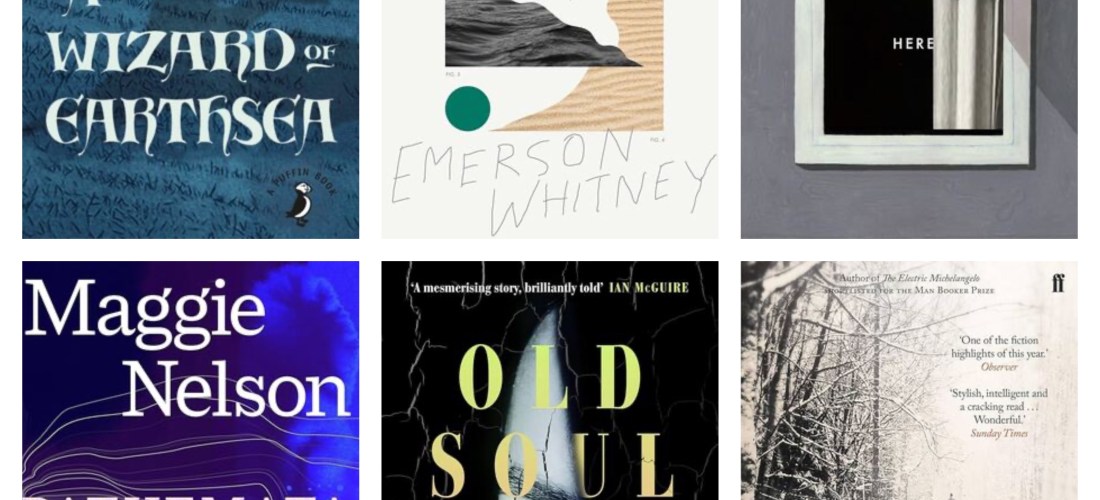
Here by Richard McGuire
When I worked at the bookshop, we had a graphic novel that I would check on occasion. Its concept fascinated me. If you don’t know it yet, Here tells a story through double-page illustrations of the same space – a room in a house – spanning years, centuries, and millennia. For example, if you are watching the space millennia ago, there is only plants, maybe some strange prehistoric animal lurking in the background. In the future, water floods everywhere. Or we may get glimpses of a futuristic society. The present time focuses mainly on the twentieth century, allowing you to see the same family grow and evolve in the same space.
I think the concept is great, and it does inspire awe. As I went through the pages, I looked for connections through the different timelines (some images represent different moments in time simultaneously). In that regard, this graphic novel is almost sci-fi, as ‘here’ is not a static location but one that exists in many different points of time and evolves with them. The style of the drawings is simple yet incredibly precise. I love the colours and the detail around architecture and design.
I read this graphic novel a bit too fast (it was from the library, and I had to return it). It seems that I’d benefit from further readings. I would say, though, that as a work of art, the concept is the most important thing, as characters and plot are secondary and often represented as (literal) sketches.
Old Soul by Susan Barker
This is one of the best horror books I’ve read lately, and I didn’t expect to enjoy it as much as I did. I think it’s because the blurb seems to promise a thriller with some literary and horror elements. But the book is definitely a fine example of cosmic horror.
I have to confess, I love unreliable narrators and fragmented narratives in which one follows different characters and has to actively work to collect clues to understand the wider plot. This is a technique this book employs brilliantly. The ‘main character’ in the story (I hesitate to call him that because this is really a novel told through multiple perspectives) is an Englishman in search of the woman who may have killed her best friend (and may others). His investigation takes him all over the world, to countries such as Japan, Hungary, the United States, Germany, and Wales.
There are some familiar horror elements here – the ‘villain’ of the story is a woman who is, apparently, immortal, and goes around taking photographs of other people (often other women) and by doing so, she destroys them. At first sight, you could think this woman is a vampire of sorts, a soul devourer. But in the lore of the book is unique and very original, as soon soon other elements are introduced, such as a dark, terrifying force associated to the planet Venus and known as The Tyrant. This, to me, was one of the best (and most chilling) aspects of the novel.
The stories of all the women (and men) who have encountered this monster also grow progressively more original and disturbing. Soon, a pattern starts to emerge. This is a book about the human desire of wanting to be seen, and also, about how we are perceived and how this has an impact on our identities. The stories here are about performers, artists, and models. The mysterious woman who brings chaos and horrible deaths to those she meets is always the one in control, the one who is performing the act of the observant. In some timelines, she’s a photographer; in others, she’s a sketch artist. This novel is also about fame, worship, and the lengths one would go to obtain them.
This book captured my attention with the first few pages, and I finished it in a few days. One of my favourite parts was the story of the sculptor living in the desert. The details about her artistry and how physical it is were wonderful. I also enjoyed how her story was the one that broke the narrative pattern and allowed us, readers, to see new sides in characters we thought we knew.
I was fascinated by many of the characters here, and I wanted to know more about them – but of course, this book works because of the small fragments it offers and by urging us to combine them. The ending was perhaps a bit too fast in my opinion, but still satisfactory enough. I guess I’m just saying that I liked this book so much I wished it’d been longer.
Pathemata Or, The Story of my Mouth by Maggie Nelson
The Argonauts by Nelson is one of my favourite books ever, so I picked this one up very intrigued. It’s a very short book that can easily be read in one sitting. I was intrigued by the premise: Nelson finds herself overwhelmed by terrible pain in her mouth and in her jaw, but she doesn’t seem to get a firm diagnosis from any dentist she manages to visit. Then, the Covid-19 pandemic hits, and she’s forced to live in isolation, exacerbated by this terrible chronic pain that is not going away.
I grind my teeth constantly, so I’m no stranger to that insidious jaw pain that sometimes can even trigger migraines. It’d be incredibly debilitating and truly miserable to live permanently with this sort of pain. This book captures very well the experience of those with chronic illness seeking, if not a cure, a diagnosis, something that tells them that the pain they are experiencing is at least real. Nelson tries many different therapies, meds, and approaches. She even goes down the route of more alternative treatment (a therapist takes a photo of her face, promising she’ll send it to her guru, who, apparently, can diagnose any illness just by looking at a person’s face; of course, nothing comes out of this).
Nelson’s pain experience is almost hallucinogenic as she stumbles through her life trying to cope with all external demands, such as her job, her marriage, her friendships, and taking care of her son, especially as the world goes into lockdown. This is juxtaposed with the narrative of different dreams that Nelson is having at that time. Dreams that manifest, in many cases, multiple anxieties about her child, her partner, family, parenthood, friendships, and a mentor figure who is dying. This combination makes the book a bit obscure, because Covid-19 altered our lives in many ways, and sometimes I wasn’t sure if the vignette I was reading was Nelson’s real life or another dream. I suspect, though, that is precisely what she wanted to do with the book: show how the pandemic and chronic illness alter our perception of the mundane, the day-to-day, even of our own sense of being.
The Wolf Border by Sarah Hall
I’ve loved Hall’s short fiction for a very long time, but I never read any of her novels. Like in Old Soul (coincidentally), Hall doesn’t use dialogue speech marks either, which I have to confess makes me a tiny bit mad (what’s the issue with speech marks? Why does this seem to be a ‘sign’ of a special kind of fiction, one that only gets published in Faber or Granta?) Yet, I was soon swept by the intensity of the story and finished this book (which is quite thick) in a heartbeat because Hall is an excellent writer and she does know how to write a novel as well as a short story, which I think is a testament to her incredible talent.
What I love about Hall’s prose is her level of detail, her ability to bring a setting to life in a few sentences. The story follows Rachel, a biologist expert in wolves who is originally from Cumbria but is currently working in Idaho at a reservation watching wolves in their natural habitat. This is a story about wolves, sure, (and there are many interesting facts about these gorgeous animals), but it is, mainly, a story about community. In the first few chapters, Rachel travels back to Cumbria, where an earl wants to hire her to supervise the introduction of wild wolves in his English state. She’s not interested in the project at all (she knows it’ll encounter a lot of resistance from the public opinion, and she’s reluctant to work with a member of the aristocracy to start with). But she takes the chance to travel to England for free and visit her mother, Binny, who is sick and living in a care home.
Binny’s relationship with Rachel is a difficult one – through a series of flashbacks, we learn that Binny was a fiercely independent parent, often to a point that seems to suggest indifference and even neglect. That said, Benny is also shown as a fun and fiercely protective person who inspires Rachel to be confident and stay true to herself.
Barely a few months after she comes back to Idaho, Rachel receives news that her mother has died (it’s not clear if this was because of her multiple illnesses or because she overdosed on her pills on purpose). Almost at the same time, Rachel gets pregnant by accident by a friend who is also co-worker. She wants to terminate the pregnancy, but Idaho’s laws don’t allow this, so she decides to travel back to England. She also decides to accept the earl’s offer to work on his project so she can start a new life back home.
What follows is the evolution of the project that Rachel oversees – with two wolves brought from Romania – and her own pregnancy once she decides she will keep the baby after all. This is a character-driven book, even though the plot is intriguing – I spent a lot of the story worrying about the wolves (and their pups, once they have them) and hoping they’d be ok. Equally, I was worried every time Rachel had to go to the doctor to check on her baby, as I wanted both of them to be okay, too! Another important detail of the story is its backdrop: at the time this is happening, Scotland is voting to be independent from the UK, and in the world of the novel, they succeed and separate from the rest of the country. This schism seems significant in a story that is all about restarting and reconsidering ideas around community and family. I found it fascinating how Hall speculated on how Scottish independence would affect England, but also Cumbria particularly.
There’s a lot of focus here on the relationship between Rachel and her brother, Lawrence. At the beginning of the story, they aren’t really in touch. Lawrence is much younger, so when they were children, Rachel mainly ignored him before she left home for good. As adults, they bond over their shared grief for their mother. Once Rachel’s baby is born, Lawrence becomes closer to her, and adopts the role of a father figure which I found fascinating (at that time Rachel is already seeing someone else, Alexander, the veterinarian of the wolves project, however, it seemed more natural to me that she’d trust her brother more when it comes to the baby and that her brother could feel more invested about it too…) Theirs is not always an easy relationship as Lawrence comes with her own set of issues but, as the story advances, both siblings use each other’s support to confront some complicated things. In Rachel’s case, her fear of commitment (she doesn’t tell the father of her baby that she’s even pregnant, even though they are shown to be good friends), and in Lawrence’s case is his addiction to hard drugs he’s been managing to hide most of his adult life, but that is threatening his life once his marriage collapses.
The last chapters of the book were the most fast-paced as the wolves escape the enclosure and Rachel had to track them to save them (with the baby strapped to her, of course). In the end, come lots of revelations, specially about the earl (who, of course, always had his own agenda).
All in all, this is a beautifully crafted novel. It now occurs to me that it covers a lot of similar themes to Playground by Richard Powers (community, found family, humans versus nature), but in a far more successful way, in my opinion. Whereas I thought Playground lacked nuance when it comes to character (although that’s somehow justified by its final twist), The Wolf Border depicted characters who were flawed and powerfully human. Characters that I felt I knew by the end of the novel. I’ll definitely look forward to reading more of Hall’s novels in the future, and can we please give her a Booker Prize now at the very least?
Heaven by Emerson Whitney
I got this book on a whim when I visited the Gay is the Word bookshop in London. This is a memoir written it what seems to me a collection of lyric essays in which Whitney, a trans author, reflects on his childhood and, especially, his turbulent relationship with his mother and, by extent, womanhood. Whitney is an extraordinary writer. He’s especially good at constructing scenes and characters with just a few details in a way that you feel like you are there with them. Which, given the nature of this memoir, it’s often uncomfortable and heartbreaking (in this book Whitnet mentions a teacher in a writing programme he attended, defining part of his work as ‘trauma porn’). Like Melissa Febos, Maggie Nelson, and Paul B. Preciado, Whitney also incorporates his fair share of theory, especially when it comes to defining gender and the experience of motherhood (being a mother, yes, but also being mothered).
This wasn’t an easy read in terms of content: Whitney’s mother is not the best at parenting. Her abuse comes in the form of neglect, mainly of Whitney, but also of herself, as well as her refusal to see or understand some aspects of her child. A more present and stable figure is Whitney’s grandmother – there’s a lot of tenderness when Whitney describes their relationship. It’s not perfect, and Whitney’s grandmother doesn’t always manage to understand her grandchild either, but it’s clear that she offers unconditional love and support. This is also a book about care, and the absence of it. Whitney, to no fault of his own, ends up in all sort of tricky situations because of a series of systems that, in theory, are there to assure care (social services, education, health…) but which are understaffed, decimated, or directly unaccessible (Whitney is an American author, which means he lives in a country where healthcare is private, and he can’t always afford it, as it happens when he’s in a serious accident, or when he’s recovering from top surgery).
Something I enjoyed here was how Whitney’s mother was portrayed, though. This whole book is, in a way, an ode to her and to Whitney’s family. It shows their flaws and the ways in which they may have failed the author, but also it shows their love, their strength, and their bond. I find that, in memoir, it is always easy to write other characters as black and wait, heroes or villains, and Whitney was definitely able to offer a more nuanced portrayal of the people he knows so well.
A Wizard of Earthsea by Ursula K Le Guin
I’m VERY late to the party with this, but hey, better late than never, am I right? I remember watching the Earthsea Ghibli film when it came out and thinking it was quite dark, but it had some fascinating elements. To be fair, I don’t remember much of it (it was many years ago) apart from the epigraph at the beginning, which comes directly from Le Guin’s novel:
Only in silence the word,
only in dark the light,
only in dying life:
bright the hawk’s flight
on the empty sky
– The Creation of Ea
The novel starts with quite a simple (and well-known) premise in fantasy. We have a young boy who is born with an extremely good aptitude towards magic. Because of his talents, a wizard, Ogion, makes him his disciple, and when the boy grows frustrated because he wants to learn everything about magic as soon as possible, Ogion sends him to a prestigious magic school. Now, even though this may seem a familiar trope (although, arguably, the idea of a school of magic was first used by Le Guin), I was immediately captivated by the novel’s magic system. In this world, magic is tied to words. Every single thing (including people and animals) has a ‘true name’ – if you know it, then you can have power over it.
Even though it may seem this book is written for children (it was originally published as such), it also has its fare share of darkness. The first time the shadow appeared, it spooked me, and it certainly made this whole world feel much more threatening and dangerous. A Wizard of Earthsea may be a book that children will enjoy, but it’s also a superb read for an adult – and I’m not sure I’d have caught all the nuances as a young reader, just as it happened to me when I read His Dark Materials for the first time, when I was only eleven. (When I read it in my twenties, I liked it even more, and I finally understood all its references to organised religion and faith).
Another excellent aspect of this book is its world-building. The idea of a fantasy world, which is also an archipelago, is great. I found myself going back to the map at the beginning of the book almost constantly to follow Ged (the protagonist) through his travels. Every single island feels different, and all the areas have specific cultures and habits, so the world is always vibrant. By the end of the novel, I was completely in awe of the desolate landscape of the islands and the sea, and the wind, and I had the distinctive impression of visiting a different world that felt as real as my own.
I also appreciated that it is Le Guin’s decision to write characters that are not white and are not part of the aristocracy or ruling class (as it happens with many fantasy books). In Le Guin’s world, the most advanced cultures come from dark-skinned people, whereas the barbarians who live in the far north-east are white-skinned.
Finally, I loved the fact that there’s no main villain that Ged is pitched against in the book. There’s, of course, the shadow and the dark forces it brings. This kind of evil is often portrayed in the book as something that goes beyond human comprehension, yet also something we can all enact from time to time. The ending felt tender – with Ged reconnecting with his friend and earning his support in what seemed to be his last quest. This is, above all, a book about friendship and the bonds that tie us all together. I loved this quote from the book that makes reference to Ged’s small pet / familia, a little ‘otak’ (which is a fantasy creature from this world similar to a rat). After Ged tries to cast a spell to save a child from death (and fails), he falls ill and is in a catatonic state. He’s only brought to life by the otak licking his face.
‘Later, when Ged thought back upon that night, he knew that none touched him when he lay thus spirit-lost, had none called him back in some way, he might have been lost for good. It was only the dumb instinctive wisdom of the beast who licks his hurt companion to comfort him, and yet in that wisdom Ged saw something akin to his own power, something that went as deep as wizards. From that time forth he believed that the wise man is one who never sets himself apart from other living things, whether they have speech or not, and in later years he strove long to learn what can be learned, in silence, from the eyes of animals, the flight of birds, the great slow gestures of trees.’
p. 82
I have a volume with the first four Earthsea novels, so I’m already reading the next one, The Tombs of Atuan – so I’ll be writing about it in my next book.
 Inés G. Labarta