
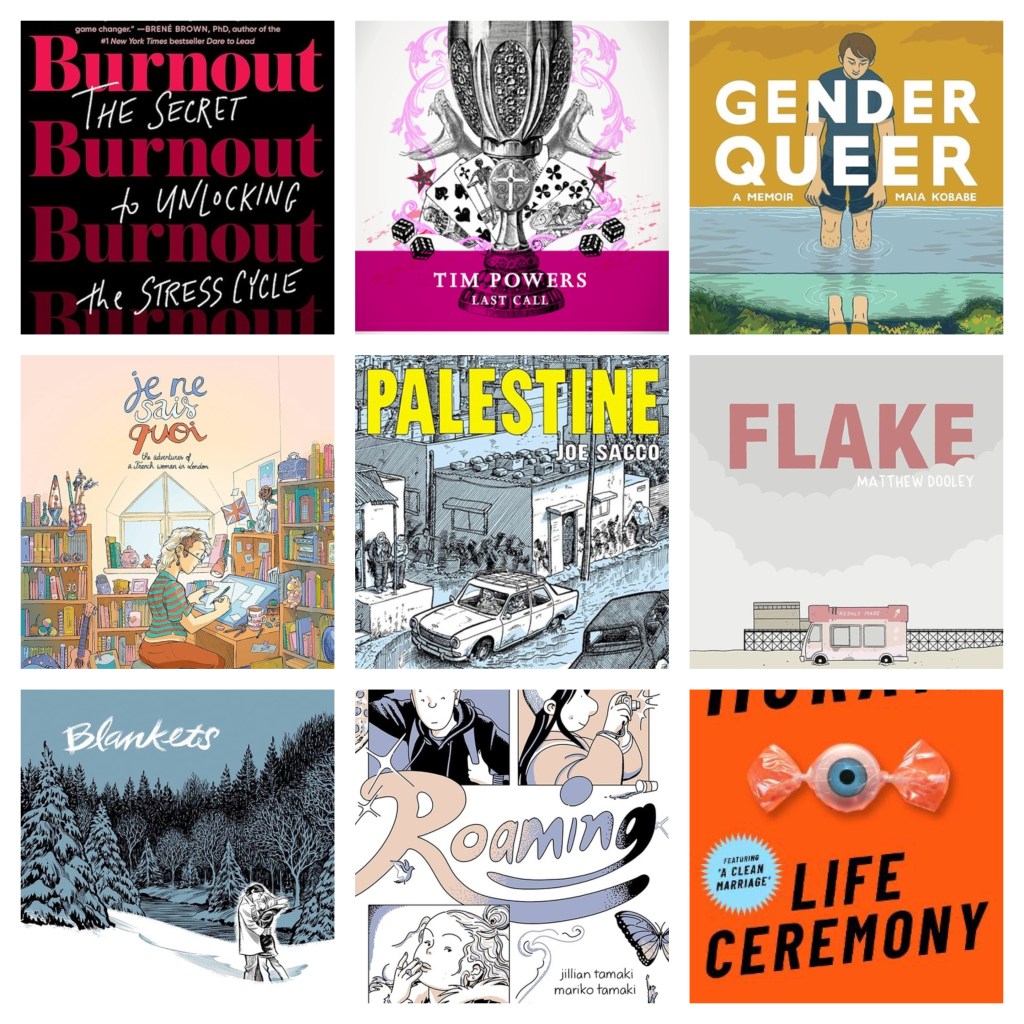
Last Call by Tim Powers
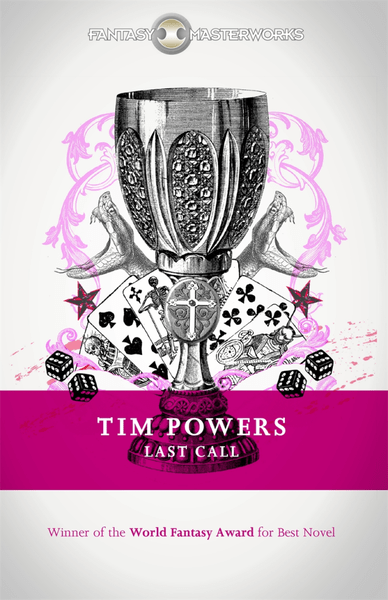
I’m so confused about this book – I’m still trying to decide if I like it or not. First of all, I bought this book ten years ago when I wanted to get into steampunk because I had heard that Powers was a master in the genre. Obviously, I didn’t do my research well because this book is definitely not steampunk.
Back then this was the book I took with me on the plane when I first moved to Lancaster (ten years ago). That day I read a few pages, I was quite confused (the beginning is quite convoluted, although in a good way) and then forgot completelyabout it as I was trying to adapt to life in England while studying for an MA.
This summer I was looking at my bookshelf at home and I realised that ten years had been way too long and I needed to give this book a chance. I was quite eager to get into it and curious.
Well, let’s start with the good stuff first. The writing. Tim Powers knows how to write, and that’s undeniable. He reminded me of Stephen King in that he uses multiple POVs to show the scope of his plot. This was a very entertaining book to read, and you know, as I type this I think that’s enough. I like this book because I had a good time reading it.
Then there’s the atmosphere. I’ve never been to Las Vegas but the way it was described as a place which is both dangerous but fascinating, artificial but also full of myth and magic worked really well for me. I enjoyed reading up about the Assumption game and all its complicated rules (this is a game that the powerful people in Las Vegas play with Tarot cards and which somehow resembles Poker, the main difference being that the Assumption game allows you to buy people’s souls which I think is a pretty amazing concept). This idea reminded me a bit of a short story by China Miéville which I adored titled The Dowager of Bees which may have been inspired by this book.
But there were a few things that didn’t quite work for me. Mainly it was the character of Diana, who could have been so much more interesting but just got her power very conveniently towards the end of the book. Also, (big spoilers ahead), I couldn’t get over the fact that her son is shot in the head and he’s in a hospital in a coma fighting for his life… and that’s barely even mentioned in the end. Like, she’s happier and more invested in getting married again. I mean, I don’t know, I didn’t find it very believable and it felt that the whole point of having her poor son shot was to force her into getting in the high-stakes game.
What I’m trying to say here is that the plot and the world-building were both fascinating, but I didn’t quite connect with the characters as much as I was hoping to, which meant this book fell flat for me at the end, even if the concept was superb. It didn’t put me off from reading more of Powers, though, so I’ll definitely look into reading more of his stuff – after all, I’m still curious about his steampunk work.
Blankets by Craig Thompson
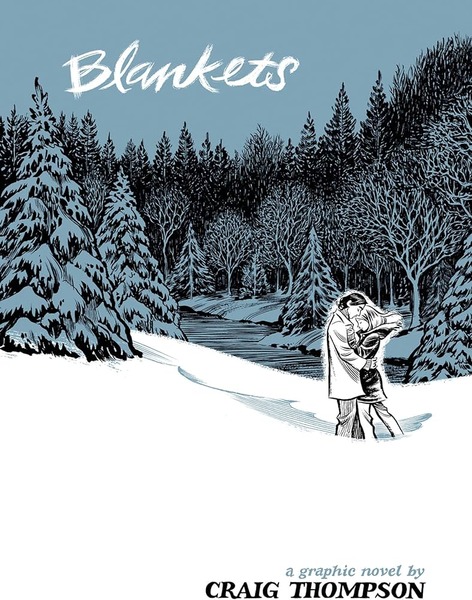
I knew this graphic novel well because of all the critical acclaim it’s received through the years. I had actually purchased a copy thinking I may use it to teach Life Writing (back when I was teaching all the Life Writing and Creative Non-Fiction courses at Wolverhampton) but in the end, I never found time to read it until now.
Thompson’s drawing style is particular, but I personally really like it. He does black-and-white illustrations with what seems to be a brush, and the lines flow across the page to capture the emotional impact of the story he’s telling pretty well. He’s also a very accomplished artist so there’s a lot of detail in his background that gives you insight into the characters’ lives as well as the setting.
This is a memoir based on Thompson’s childhood and adolescence. It’s focused on two main things: his experience with the Christian faith (he was brought up as a fundamental Christian in the American Midwest) and that of his first teenage love.
This is a bittersweet, melancholic story, but a very powerful one, with characters that you believe in and who are portrayed in a nuanced, compassionate way. Most of the story happens in the depths of winter. Midwest winters seem quite intense, of course, especially from my experience as a European living in England. We’re talking about extreme cold and snow that buries cars and locks you inside your house. There’s a lot of darkness and despair in winters like this, which is why people gravitate towards community. I can understand very well that to survive a season like this you go to church almost daily and get involved in as many social activities as possible.
Thompson’s childhood had some episodes that were difficult to read. He doesn’t portray his parents in a bad light, but it is clear that he grew up in an extremely severe household in which his parents took care of his spiritual side but maybe not his emotional side. He’s also the eldest (he has a younger brother) and I could relate a lot to those childhood scenes in which he finds his younger brother annoying but they are also best friends and Thompson feels this overpowering need to protect him at all costs (and feels horrible when he ‘fails’ to do so). It’s also interesting to see Thompson’s relationship with faith changing – how he embraces it as a little boy but starts questioning it later on when he realises there’s something he loves almost as much as Jesus and God, and that is his creative practice and his drawings, which makes him very confused, as he wonders if this could be sinful.
And then, there’s his relationship with Raina. The discovery of the first love, coming to terms with it and the idea that physical touch and sex are pretty much forbidden by his religion (before marriage, that is). This was also a very touching story, again, very relatable to anyone who fell in love and had a relationship as a teenager. Raina is such an interesting character – a one point in the novel Thompson goes to spend two weeks in winter with her and her family, so we get to know her situation very well. She’s someone who gives herself to others – her family is in the midst of a divorce, and she’s being a sort of anchor for everyone. Once again, Thompson portrays Raina and her family in such a compassionate way. There are no heroes or villains here, just a large family with lots of issues but also lots of love for each other.Because this is such an intimate portrait of a family and a specific time I did wonder how Thompson considered portraying them all in his work. I mean, I kept wondering, as I finished this book, if he’s in touch with this woman (called Raina in her work) or if she has any knowledge of this book being published (probably?) Would I be fine with someone portraying their version of my family so openly, in a book? I’m not sure. (An update on this as I edit the post, I ended up reading several interviews with Thompson and it turns out that Raina is a composite character inspired by two different women, one of them Thompson’s partner at the time he was writing and drawing this book. This makes a lot of sense!)
Towards the end of the book, teenage Thompson has a faith crisis when he realises that the Bible is not necessarily ‘the word of God’ as he was told to believe since he was little. Discovering that there were many translations, editions and additions makes him realise this book is man-made and for him that makes it less powerful. He discovers subjectivity, I suppose, and the idea of a fragmented and perhaps even mutable truth. In the end, he decides to stop going to church, even though he still finds Christianity useful.
Flake by Matthew Dooley

One of the things I loved the most about this graphic novel was how northern it felt. I’ve only been living in the north of England for a decade (on and off, as I actually left for the southwest for almost two years). In all this time I’ve learned to be fond of this area, which is celebrated in all its (grey) glory by Dooley.
This story is as whimsical as it is tragic as is funny. It reminded me a bit of that Wes Anderson aesthetic and tone but if Wes Anderson had been born in Lancashire. The plot follows the feud between two ice cream van owners who arefighting for their turf. One of them, Howard, maintains that he’s inherited his turf from his father, also an ice cream van owner. The other one, Tony Augustus, claims it based on him being Howard’s father’s bastard son… A proper war ensues between these two men. Howard is meek and shy, and Tony Augustus is definitely an ice cream gangster. At the same time, we get introduced to the eccentric cast of characters who inhabit the Lancashire seaside town that serves as a backdrop.
The drawing style is very personal and recognisable, full of colour and detail. A few comedic moments in the story made me laugh out loud. In an interview with The Guardian Dooley said that the town he depicts is inspired by Ormskirk, the place where he grew up.
The setting is one of the things that I enjoyed the most here, as well as the mixture of dark comedy and tenderness. Definitely a book I recommend.
Sheets by Brenna Thummler
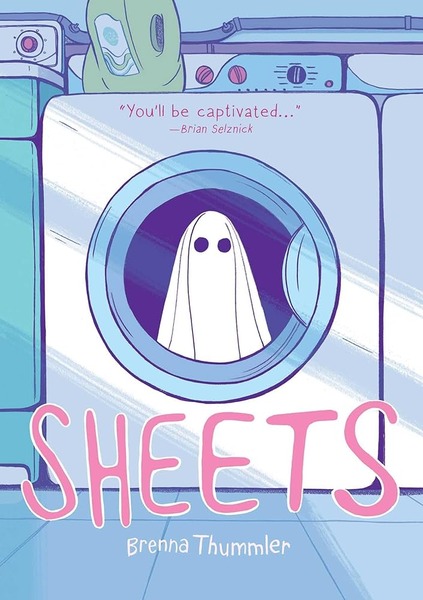
This is the first book in a trilogy of graphic novels – and I read all three books in two days – so I’ll review them all briefly and separately.
I don’t normally read YA but I was recommended this book by a friend. The thing that got me almost immediately was the vibe – the author draws New England in beautiful detail. There’s something so atmospheric and cosy about New England autumn and winter – and I say this without having been there myself, but from films and books I’ve read about it!
The first book follows quite a sad story – Marjorie is a teenager who has just lost her mother. Her father is so overwhelmed by grief he can barely take care of himself, let alone Marjorie and her younger brother. Because of this, and instead of grieving herself, Marjorie needs to become an adult and take care of her family, which includes working for the laundry family business every morning before going to school and in the evenings when she comes back. Things start getting difficult when she is harassed by Mr Saubertuck, a rich man who wants to buy her business to turn it into a yoga studio. The story takes a whimsical turn when we get introduced to Wendell a ghost who is literally made of a sheet who runs away from his world and ends up mixed up with the sheets Marjorie cleans every evening…
One of the things I liked the most here was how this story dealt with grief and death in a tender, realistic manner, without sugarcoating anything. This story is about what happens when you lose someone important in your life – but you still need to keep living, showing up to work or school (or in the case of Marjorie, both!)
Other things that I thought were a tad less convincing were the depiction of the villain in the story – Mr Saubertuck feels more like a caricature than a fully-fleshed human being. He’s effective, but not as nuanced as other characters in the story.
From all the other books in the trilogy, this is the one that felt as if it was written for a younger audience – the characters in the next two were definitely more rounded.
Delicates by Brenna Thummler

When I read Sheets it felt like a complete story to me, so I was curious to see how Thummler would continue it. And she does, by adding another main character that acts as a co-protagonist with Marjorie. This new character is Eliza, a classmate of Marjorie who is being bullied. I thought Eliza was a very interesting character – first of all she’s neurodivergent, and she’s also struggling with depression. To make things even worse, her classmates are mean: they only see her as weird and strange, and so they downright reject her. The only thing that keeps Eliza afloat is her passion for photography, which will eventually connect her to Marjorie and Wendell, the ghost.
Like in the previous book, this story also manages to depict quite dark themes (grief, bullying, depression) believably and tenderly. It was also very interesting to read about teenage friendship – especially through the relationship Marjorie and Eliza develop during the story. The quality of the drawings is even better than in Sheets, which is to say. Thummler is a wonderful illustrator – all her scenes have lots of detail, and her use of colour is superb.
Lights by Brenna Thummler

This is the last instalment in the trilogy and the most mature of the three of them, which makes sense, as the characters grow up with each book. I really loved that Thummler kept focusing on friendship here – Eliza and Marjorie, Marjorie and Wendell. That was my favourite part, really, especially how Eliza and Marjorie had to negotiate some aspects of their friendship to keep it strong.
There was a secondary and important plot here – which focused on Wendell and where he came from. From book one we knew that Wendell is the ghost of a preteen but his story (and the cause of his death) was never fully revealed. Well, we get that revelation at length in this book. This definitely added a lot of tension and urgency to the plot. But also, I have to say, I felt that Wendell’s story was perhaps a tad too melodramatic. Did I care about this? Well, at this point in the trilogy, I was so invested in the characters and the setting that I just went with it. Overall, I really liked this trilogy and how it focused on dark, heavy themes through a YA lens.
Gender Queer by Maia Kobabe

This was a reread. I rarely reread things because there’s always so much new, exciting stuff out there. But I loved Gender Queer when I read it back in 2022, so I went back to it as I was preparing a Graphic Novel Writing course for uni. It makes me really sad to know that this is one of the most banned books in the States. I do not get or, quite honestly, support the idea of banning books. I think everything should be read and challenged with a critical mind – but downright banning things doesn’t help anyone. Reading is like having a conversation with another human being. You can still disagree, be critical or have a very different worldview, but listening is important.
To the point – Gender Queer is an honest, empathetic memoir. Maia covers most of eir life, from being a child to an adult, focusing on those moments in which ey realised that ey were gender fluid. At the same time, Maia observes the way gender impacts our society – and, to a point, traps us individuals into very specific cages. For example, I related a lot to Maia’s experience as a child of wanting to go shirtless (and how eir teacher immediately forced em to cover up). It still baffles me that some bodies (i.e. traditionally masculine bodies) can be ‘shown’ whereas traditionally female bodies need to remain hidden lest something horrible happens to their owners.
Gender Queer also covers Maia’s experiences as an adult, including coming out as non-binary to eir family and friends, as well as at work. It also focuses on eir experience dating different partners, which made em realise their asexuality.
The drawings are sweet, and detailed and become whimsical and surreal when Maia explores eir own feelings and realisations.
Roaming by Mariko Tamaki and Jillian Tamaki

I loved the Tamaki cousin’s work and I was eager to get my hands on their latest collaboration. Roaming doesn’t disappoint, and in fact, thematically, it feels like a sequel to This One Summer (which is the Tamaki cousin’s perhaps most famous piece). If This One Summer focuses on that time of life in which one goes from childhood to adolescence, Roaming is about leaving adolescence behind but not being quite an adult. The story follows three Canadian friends who spend three days in New York. They are all nineteenth. From the very beginning, there are many unbalances and tensions in their relationship – two of them, Dani and Zoe, had been best friends all throughout their childhoods but now they go to different universities. Fiona is Dani’s charismatic dormmate and she’s decided to join the trip last minute. In the space ofthose three days, Zoe becomes infatuated with Fiona to the point where Dani feels left out.
As the story progresses they travel around New York experiencing the intensity of the city which has an impact on how they relate to each other. For example, Zoe has changed a lot since the last time Dani saw her – she’s fully embraced her queerness and a more androgynous appearance.
Something I love about Mariko and Jillian Tamaki’s work is the empathy they have to create their characters. For example, Fiona could have been easily cast as a villain in this story – she’s beautiful and charismatic, but also opinionated and disruptive – and yet you can’t avoid feeling tenderness towards her by the end of the story. This captures moments about travelling and being with friends so well (there is a moment during the trip where Zoe just wants to get home, but she can’t, she’s trapped in a little hotel room she’s sharing with two other people in one of the busiest cities in the world). It’s such a delicious metaphor for adulthood – for all those moments when you just wish for the easy way out and instead, you have to deal with a big, ugly mess because there are no places to run to anymore.
Je Ne Sais Quoi by Lucie Arnoux
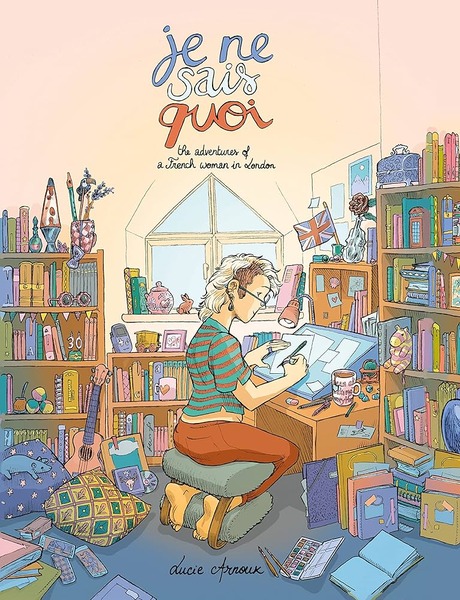
Another graphic novel – this contains episodes from the life of the author, spanning from childhood to the present day. What I loved about this work was the themes – the author was born in France but emigrated to the UK (London, in her case) as a university student and decided to stay there (which is, in a way, my story too). It was so refreshing to read – after ten years living in the UK (and going through Brexit as an immigrant) it’s easy to focus on the things I don’t enjoy about it and get gloomy and critical. But of course, I also love this country (and England, specifically, which has been my home for so long) and Arnoux does too, with a daring intensity. I really needed to remember that, and I did so through her drawings and adventures, many of them similar to my own.
Arnoux’s style is colourful and intricate. The story is, as I said before, pretty episodic. Some of the chapters are only one page long, while others contain a few. This is almost a portrait of the artist herself – she goes over a lot of things, such as childhood, family, the immigrant experience, her experiences with gender, friendship and romantic love. I did wonder if the short formatting of the episodes here is because perhaps she started publishing some of these on social media before she started working on the book. Above all, a tender and inspiring book that felt like a nice hug from a friend, or a warm cup of tea on a rainy day. I really needed to read something like this when I did.
Palestine by Joe Sacco
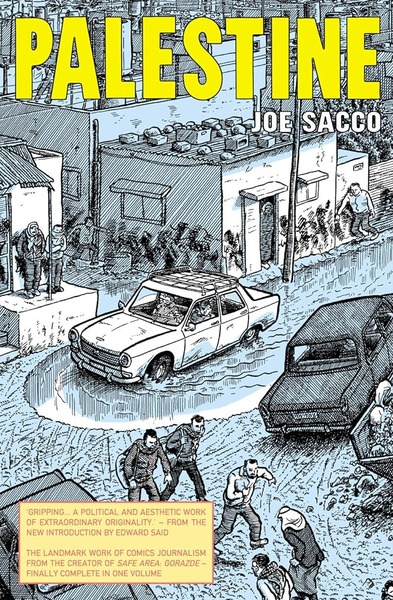
I read Paying the Land by the same author last year, which I thought was very good but very hard to read. This one was too, even though it took me a few weeks to finish it. I had to take regular breaks from it – which makes sense, given the heavy subject. There’s a lot to take in.
This graphic novel covers Sacco’s experiences as a comic journalist in Palestine in the early nineties. This is very long ago (around the time I was born myself) and yet it feels so familiar considering the current situation with Palestine. In the beginning, I had trouble connecting with the drawing style and the tone this is narrated. Sacco’s drawing style in this work is quite caricaturesque in places, I’m not sure how else to define it, but it’s not my taste, although I have to say it is quite striking and doesn’t diminish the meaning of what he’s trying to convey. The tone was quite interesting – it has a lot of self-deprecating humour and irony that initially felt jarring considering that he’s narrating very difficult, dark and violent episodes. But as the book advances I got more used to it and to me it ended up being a way of showing how Sacco was trying to cope with what he was seeing – with the fact that he was a witness to this horrific situation of violence but hecouldn’t do anything to help, except drawing what he saw and getting it published to bring the word out to the world.
There were a few episodes here that I found particularly intense. One was about the Israeli jail Palestinian men involved with the Intifada were sent to – how so many things there were designed to make them lose their humanity (torture, lack of hygiene, lack of food…) and yet they managed to organise themselves in a union and created systems to take care of each other. Other episodes about women in Gaza were also very interesting to read. And of course, the last episodes with Sacco in Israel, questioning his Israeli acquaintances about the horrors of the war and the violence (and listening to the strange logic some of the people in Israel tried to apply to it to justify it).
I think this is an important record of a time and a place that shows both sides of the conflict with an emphasis on the Palestinian perspective. It has an introduction by Edward Said in which he says that this work, like art should do, doesn’t bring solutions or answers to the table but it challenges readers instead, urging them to question what they thought they knew.
Life Ceremony by Sayaka Murata
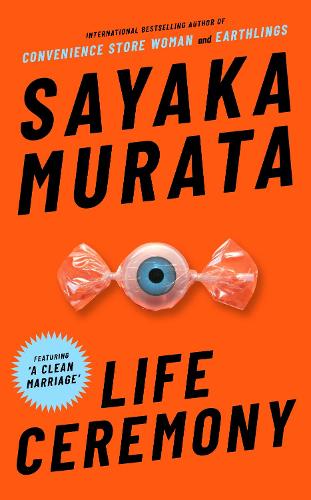
A collection of short stories by Murata – I’ve read two novels by her before, Convenience Store Woman and Earthlings – (this last one I found delightfully horrifying in all the best ways, and also quite shocking at parts). I was immediately drawn to the tone and the atmosphere of these short stories. Murata writes about strange, sometimes repugnant characters and situations but the characters themselves can often be quite deadpan or directly oblivious to the horror setting. For example, in one of the stories of this collection is socially acceptable to use materials from dead bodies (such as skin and bones) to create furniture and even clothes. In another story, the one that gives the title to the collection, people get together in ceremonies to eat their dead. Murata often plays with ideas like this – considering what would happen if something that is clearly taboo in our societies (i.e. using our bodies as materials, the same way we do with animal bodies) became normalised. I also enjoy the way she writes female characters – they feel very authentic – and how she often features themes like asexuality and alternative family structures in her work. For example, another of her short stories is about two female friends who decide to live together as adults and have a family together. Instead of looking for male partners they resort to artificial insemination to have children they bring up together. I never thought of a family like this but it seems to make a lot of sense in my mind – blending in parenthood and friendship seems like a good mix. In another short story, that is both funny and unnerving, an asexual couple decides to go through a special medical process that promises them the conception of a child (they both are eager to become parents) without physical intercourse.
The more I read work by Sakaya Murata the more I become interested in her world and her vision. After this short story collection, I watched this interview which I found fascinating.
Burnout by Emily Nagoski and Amelia Nagoski

A book I got recommended on the topic of burnout. I didn’t know what burnout was until I did my PhD and found myself in the midst of it. I even remember that conversation with my PhD supervisor – how she told me what I was experiencing was probably burnout and that it was very common in academia.
A few years later this topic is still very interesting for me. Burnout was definitely something I don’t wish on anyone – as it basically means that something that made you happy and fulfilled (such as writing, or a job you were passionate about) suddenly seems the worst thing in the world. It’s like waking up one day to find every food you try tastes like ashes. It’s not going to kill you, but it’ll definitely steal the joy out of something you have to do every day (eat) and that used to be quite pleasant.
Emily and Amelia Nagoski’s (who are sisters, by the way) approach to burnout is interesting because they consider it in a social context – women and minority populations are more likely to suffer from it. Some professions, especially those which are considered vocational, or those in which you work with other people very closely are also at a particular risk.
It was interesting to learn about the stress cycle – about how our bodies react to perceived threats (which in this day and age could be a complicated relationship with someone at the office, or a series of deadlines that seem impossible to meet) and how important it is to complete said cycle. They offer all sorts of practical solutions to it – one of them is intense physical exercise – which explains why going for a run when my anxiety is high usually works to calm me down.
Other chapters of the book were quite interesting – how they explained that our brains need to have at least 45% downtime to function properly (this includes sleep). In a culture that seems to value productivity above anything else, it is refreshing to read about the importance of rest for your physical and emotional well-being. It’s especially important for people like me – I still often feel like I need to fill in every minute of my day with tasks and purpose.
So much of this book focused on showing – with examples and research – how the game is ridged. How women specifically have so many extra emotional demands placed on them, as well as societal demands (i.e. specific ways of looking and behaving) that contribute to their general exhaustion.
If I have to take one concept away from this book would be the idea of society being divided between ‘Human Beings’ and ‘Human Givers’. ‘Human Beings’ are defined as those whose main purpose is to exist and realise themselves. ‘Human Givers’ on the other side need to be pretty, calm, generous and attentive to the needs of others. It’s easy to see how, historically, these two labels could be exchanged by the words ‘Men’ and ‘Women’. In the book, Amelia Nagoski asks a question to her university students about what would be better for society – have everyone be a ‘Human Being’ or a ‘Human Giver.’ The students seem to quickly propose that ‘Human Beings’ are the best of the two. But of course, a society of individuals exclusively focused on their own self-realisation seems quite tricky (I mean, how about creating community, caring for others and so on? Are these not some of the things that truly make us human after all?) So I suppose it’s all about that complex balance – and about accepting that the system is ridged and, at the same time, looking for ways to get out of it, even if it’s in small aspects of our lives.
I’d say this is one of the best books I’ve read on this specific topic so far.
 Inés G. Labarta
2 thoughts on “Travelling all Over: August 2024 Reading Log”