

Daisy Jones & The Six by Taylor Jenkins Reid

This seemed a fun book and I was in the mood for something I could read on a long train journey. It was a quick, entertaining reading – even though it’s narrated in quite an interesting way. Basically, it’s written in the form of interviews and statements made by people who belonged to the fictional rock band from the title. This American band became extremely famous in the 1970s and is loosely based on Fleetwood Mac. This formatting threw me off at the beginning but I soon got into it and I think that, thanks to it, the book is certainly quite pacy.
One of the things that I didn’t like (subjectively) was how Daisy Jones (the band’s female lead) was depicted from the beginning. She’s from a rich but emotionally detached family, and she’sbasically born gorgeous (she’s described as beautiful as a girl, as a teenager, and as a woman, no matter how much alcohol she drinks and how many drugs she does). She’s also incredibly talented music-wise. And everyone loves her. But she’s also kind of broken inside because it’s so hard to be perceived ‘only’ as a beautiful girl… I mean yes, but also, give me a break. I’m so tired of female characters that have beauty as their primary characteristic.
Actually, the female character that interested me the most in this novel was Karen: she’s the keyboard player in the group.She’s also a woman who has decided to not have children and dedicate herself to her career (first in the band from the title, then in other music projects). That’s the story I really want to read! But Karen turned out to be a secondary character who had a short plotline – she has a brief romance with one of the band’s male members. Karen gets pregnant and decides to get an abortion; her boyfriend is heartbroken after this because he really wanted the baby so he leaves her (I mean… ok.)
This book relied a lot on (BIG SPOILER) the romantic relationship between Daisy and Bill, the leader from the ‘The Six’. He’s already married to a very supportive wife. He’s also an ex-alcoholic and ex-drug addict who finds Daisy triggering (as someone who is pretty much on drugs all the time and/or drunk). To me, there’s nothing romantic about loving a woman but not wanting to be with her because you are already married to another woman you have three children with so you’d rather not ‘break’ that ‘perfect family’. (I mean…. uh?)
That said, I can see how a lot of people would adore a book like this. I enjoyed reading about the ins and outs of the band’s life on tour, and what happens during an album’s production (the chapters about how they decided on the lyrics, on which songs were going to be the singles, on which order they were going to be featured in the album… etc all of that was fascinating).
I hear the TV series that they made from this book is very good. I may watch it when I’m on the plane next week…
Nonfiction by Julie Myerson

I picked this book because I’m morbid – the story of a writer having to deal with her daughter who is a drug addict? And a book that may be loosely based on the author’s life? Sure, I was curious.
The writing style was quite literary, and it reminded me a bit of Rachel Cusk’s Second Place in the way it reads almost as if it were a memoir even though it’s technically fiction. Or a hybrid form. (I can’t decide and I’m also fascinated at the factthat it seems to be both at once).
This novel is also written in the second person singular, with the main character addressing her daughter all throughout. The novel jumps back and forth through different timelines. We meet the main character as a middle-aged woman with a teenage daughter who has become a drug addict, we also meet the main character as a young woman with her daughter as a toddler, and even the main character as a little girl herself, having to live through her parents’ highly traumatic divorce.
A lot of this novel is about pain and horror. The main character is married to a man who is older than her and they have a comfortable, middle-class life somewhere in the south of England. Her daughter has been cherished since the moment she was born and has been given every opportunity in life. Then, why does she end up the way she does? The narrator (and certainly those around her, family and friends) can’t comprehend what happened, and why things turned out so incredibly wrong.
But as the story advances we discover that the narrator has a lot of guilt, not only about the kind of mother she perceives herself to be but also about the kind of daughter and wife she is. To start with, the narrator’s relationship with her own mother is complicated, to say the least. The mother is quite narcissistic and manipulative, to the point where she doesn’t hesitate to blame her daughter for her granddaughter’s addiction. It’s interesting to see how the narrator spends most of her life avoiding her mother, feeling that her mother prefers her brother and not her (there’s some underlining sexism in this decision, it seems) and then finally manages to become closer to her once her mother passes away. There’s a very tender moment in which the narrator is looking at a photo of her mother as a five-year-old child a bit before she was sent to a boarding school in a different country by her own parents (can you imagine anything more horrifying, to be sent away by your family, at such tender age?)
Another strand of the narrative explores the narrator’s marriage – and her infatuation with an ex-lover she had when she was young. His character is quite interesting — and unnerving. He’s narcissistic and manipulative (he’s actually very similar to the narrator’s mother) always acting seductive but then retreating every time she tries to initiate a proper relationship with him. At times it seemed he was trying to punish her. At some point is suggested that perhaps he can’t get over the fact she was the one who broke up with him when they were younger She did so in quite an extreme way: she left the house they shared without a word and never came back (a sort of ghosting, I suppose?) In the end, the narrator spends a few years of her life looking for ways to have an affair with this man (who never gets physical with her, really) but she’s constantly been let down. This comes back to haunt her later on once the problems with her teenage daughter have started, putting a new, even more bitter strain on her marriage.
The final thing I want to point out about this book is how it gets a bit meta (again, Second Place did this too, and I wonder if when you are a writer of some success you also start writing about being a writer, as Rachel Cusk, Sally Rooney and Haruki Murakami do). In this part of the book, the narrator mentors a young woman who wants to be a writer. In the beginning, the mentee doesn’t take the narrator’s criticism very well, but as the story unfolds and they keep meeting and talking about writing the mentee seems to reach some important realisations of her own. This section did feel a bit self-indulgent (almost as if Julie Myerson was talking about her writing practice to us readers) but at the same time, I resonated with a lot of what she said there – about how we all infuse our own experiences in our writing (even if we are writing fiction, and even if we don’t realise at the time).
I collected these few quotes from the scenes, as I found the reflections on writing non-fiction and life writing quite interesting:
‘I told you before the novel wasn’t autobiographical, that none of the characters are supposed to be me? Well, I wasn’t lying. I think at the same time I did genuinely believe that. But after our last session, I started thinking: how can I be so sure this isn’t about me? And once I’d the thought, well, that was it, I saw the whole thing through new eyes. And all I can say is that the entire novel has changed shapes in ways that I could never have predicted. (…)
I can’t believe this novel will ever be published, but at the same time I can’t quite believe that it won’t be published. It’s the weirdest feeling. But in a way none of that matters. What I do know for sure is that I’m going to finish it. I know that it needs to exist. Not just needs to – it does exist – (…)
I’ve never felt so certain about anything before and the feeling is like nothing else. I feel so alive. It’s absolutely fucking fantastic.’
(p. 221-223)
‘Because the thing is, even though the book’s most definitely a novel, she has to admit that, – as she might have mentioned when we met in the cafe – she’s taken some risks with it. Some of its content is, at least, loosely – or perhaps even occasionally not so loosely – inspired by certain events within her family. When she says ‘inspired by’, what she means is that, although every single one of the characters is absolutely and entirely fictional, she kept finding herself bouncing off real things, real emotions, real events – certain significant moments from her own real life – and in the end it all just felt so right she just stopped worrying about the consequences.
Though not everything in the novel is real, of course.
She wouldn’t want anyone to think that.
Most of what she’s written is pure fiction.
Or perhaps it’s more accurate to say that it’s a kind of fiction which could not possibly have been written were it not for the real things that have happened to her in real life. But then isn’t that true of almost all novels at the end of the day?’
(p.254)
‘I don’t go with the idea of writing as therapy, she says. But it’s weird how much calmer and lighter I feel. Almost as if I’ve written my way to some of rapprochement, or at least an understanding of sorts.’ (p. 255)
Material Girls by Kathleen Stock
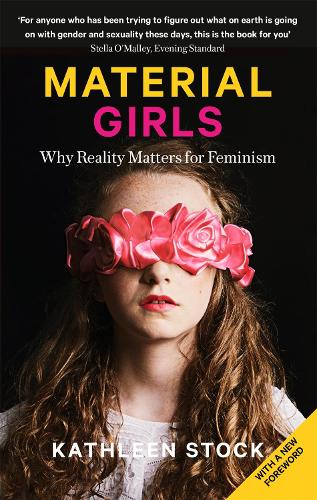
I’ve been reading a lot about gender because I find it such a fascinating subject and so at some point I wanted to read something written by someone who is very critical of this idea (and the ways it connects with sex).
A lot of this book was written in a clear, simple way, arguing about the importance of defining the idea of ‘woman’ according to very specific biological characteristics (i.e. chromosomes, sexual organs the such). There was also a lot about the need to protect these women from abuse and victimisation. I do agree that ‘women’ (however you want to interpret this word, I personally still think gender is a construct) is a group of humans who carry with them a great deal of trauma. I mean, I’m still angry that I can’t go topless as soon as it’s even a tiny bit hot here because I’m a ‘woman’ and apparently my breasts could be seen as offensive or could entice some unwanted sexual attention. ‘Men’ clearly don’t have this issue here in England, where I live. This is just a very simple example, and I won’t even start talking about the permanent state of hyper-vigilance I feel I need to be in every time I leave my house.
That said, I found a lot of the arguments from Stock unconvincing. Her stats about the violence that some trans women can inflict on cis women, the fact itself that trans women can be violent… I felt like I could substitute the word ‘trans women’ with ‘immigrants’ in her arguments and then it would sound a) very familiar and b) disturbing. As an immigrant myself, I’m not strange to the idea of ‘don’t let these dirty/dangerous/mad immigrants come to our country to rape our women and steal our jobs!’
Also – I find the so-called issue of having trans women in women’s toilets as a dangerous thing really funny. Let’s be real here for a second. If someone wants to assault me (a man, a bear, who cares at this point) in a women’s toilet all they’d need to do is simply come in. Toilets and changing rooms are not high-security facilities. Yes, assault can happen, and we should consider how to prevent it very seriously, but I don’t think it’s going to be solved or even improved on by the measures Stock proposes in her book.
The Water Outlaws by S. L. Huang

This was a very engaging and entertaining book to read. It reminded me a lot of Outlaw, a book I read last year and that disappointed me somehow – I thought the premise was quite promising but the delivery wasn’t as distinctive and rebellious as I had expected. The plot was also quite simple (I’m a fan of big, complicated plots…)
The Water Outlaws has similar vibes to a Western, even though it’s set in China during the 16th century. It is a queer retelling of the Chinese classic saga ‘Water Margin’ an example of a classic Wuxia story (a literary genre about martial artists in ancient China).
There was a lot here I absolutely adored. First of all, this was a story in which the characters weren’t black and white – it would have been easier to portray the bandits as the ‘good rebels’ and the empire officers as the ‘terrible villains’ but of course, things are never that easy. Even the main characters (all of them women) confront a series of moral conundrumsand react to them in very realistic and, sometimes, flawed ways.
The story follows Li Chong, a martial arts master who loses her reputation and freedom after her superior tries to sexually assault her and she defends herself. From there she goes on to become a criminal and a pariah – she’s forced to leave the empire she’s been loyal to for all her life and has to live (at first reluctantly) with a bandit gang who is eager to use her skills as a martial artist (so she can train the bandits). The other main character, Lu Junyi, is Li Chong’s best friend who gets in trouble with one of the emperor’s advisors after she tries to defend her friend. She’s blackmailed by him and forced to work for him into developing a terrifying military weapon – based on alchemical, magical power.
I enjoyed reading about the bandits the most – their community is not perfect and Li Chong almost immediately notices some class tensions amongst them. Yet the way they carry themselves is so interesting – as well as how they manage to consider themselves citizens of the Empire while still understanding there are many wrong things with this institution that they want to challenge.
This was a book about the importance of rebellion against unfair systems and how outcasts can come together to create better and fairer communities.
Something that I enjoyed and yet struggled a bit in this book was its military focus. The battle scenes were masterfully narrated (which is not easy, I can tell you!) but were also quite long and especially towards the end of the book became a tad tiresome for me (even though they were very visually striking). S. L. Huang is also an author who puts a lot of emphasis on plot (instead of character), which some people may not love as much, but I definitely enjoyed it. Also, the scene when some of the characters escaped from a high-security prison was absolutely incredible and I loved reading every bit of it.
The Appendix by Liam Ronemann
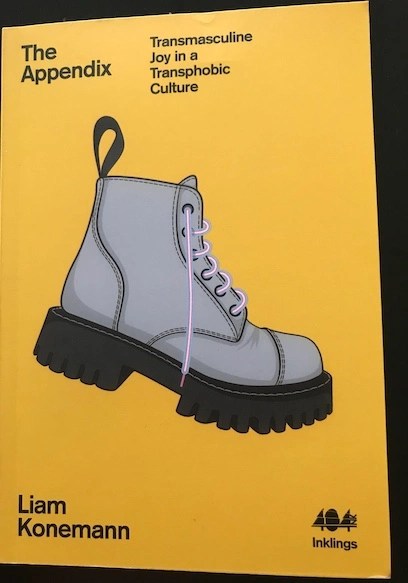
At the end of March, I booked myself a mini-solo holiday in Edinburgh, one of my favourite cities in the world, and whenI was there I made a point to visit their famous Portobello Bookshop that I’d never seen before. I loved it and I spent a lot of time there. One of my purchases was a couple of Inklings (short non-fiction books from 404 Ink, one of the best indie publishers out there).
This book is about the transmasculine experience – and how a trans man copes with all the very negative rhetoric about trans identities found online and in the media. The appendix in the title starts as a document Liam Ronemman keeps about all the times he reads online about trans hate – it soon becomes too frequent to document.
There is a lot here about trans joy as well – about the beautiful feeling of living in a body that slowly but surely starts feeling a bit more like your own. I haven’t read much about transmasculine experiences so this was definitely something that I enjoyed and made me see things from a completely different point of view.
The Lonely City by Olivia Laing

This is the first book I’ve read by Olivia Laing, a writer who’s been on my radar for the longest time. I was reminded of them after reading A Real Piece of Work last month – where Erin Riley writes a whole chapter dedicated to her writing heroes, Maggie Nelson and Olivia Laing. So I picked it up from the library.
I think Olivia Laing may have become one of my new literary crushes. First of all, their prose is absolutely flawless and so engaging. Their books are so captivating that they barely last me a couple of days. This one is a queer love letter to New York and many artists connected to the city, with a big emphasis on how one can feel so lonely, especially in a large city, and how art can bring us together and create the community we all crave or serve as a medium to communicate with others where language or other more standard tools fails.
Every chapter is focused on a particular artist that has some connection or other with New York, with a couple of artists getting a bit more space: Andy Warhol and especially David Wojnarowicz. I didn’t know the latter and it was fascinating to learn about him – he was someone that clearly inspired Laing a lot. His life was very interesting – he grew up in extremely difficult conditions and carried a great deal of trauma. Later on in life, he also struggled with AIDS having to take on not only the physical symptoms of this illness but also all the social hatred that came with it. And yet, he was someone who found art a tool to feel empowered and used it to create community and advocate for change. His story should definitely be known by more people, and I’m glad I learned about him in this book.
There were other many things that I found out through this book that were fascinating:
- The marriage between Edward Hopper and his wife Josephine Verstille Nivison. I didn’t know that she also had a career in painting but left it aside to take care of him (as an artist and a human). She was the model of many of her painters (she would pose for him and then he’d alter her specific physicality on purpose to turn her into many different women). After her husband died, she donated all his paintings (and hers) to the Whitney Museum of American Art. This institution disposed of her work almost immediately (it wasn’t considered as ‘valuable’ at the time, even though today critics admit that Hopper took a lot of inspiration from his wife’s painting style and artistic vision).
- The incredible story of Henry Darger, an artist who worked as a hospital custodian and devoted all his life to producing art (writing, collages and drawings) of a fantasy world he had created and that he didn’t share with anyone else. He left behind a mammoth of a book, a 15,000 pages piece titled The Story of the Vivian Girls, in What is Known as the Realms of the Unreal, of the Glandeco- Angelinnian War Storm, Caused by the Child Slave Rebellion. His story may seem dark but I also found it moving. It’s a real example of how art can be a support and a means in itself to find a sense of self and belonging. Like David Wojnarowicz, Henry Darger also had a story of childhood abuse and art was also something he used as a tool to process what could have potentially been a lot of traumatic events. This story in particular made me feel that reality can be, at times, stranger than fiction. I recommend you find images of Darger’s art to get a sense of its eeriness. It’s also interesting to me to think that perhaps none of what he was creating would have been considered worthy, or ‘real art’ if he had gone and shown it to say, art critics, when he was alive, but of course, today he’s considered an artist in all his rights and his work is exhibited in international exhibitions. Something else I found touching about Darger’s story was his friendship with another man (probably one of his very few friends, if not his only friend) that ended suddenly after this man died, leaving Darger heartbroken.
- The chapters on Andy Warhol. This was, of course, an artist I knew very well, but someone who, up until this point, never really interested me all that much. It was fascinating to read about his life (I didn’t know he was the child of Austria-Hungary / current Slovakia immigrants and that his real surname was ‘Warhola’). Something I found fascinating about his childhood was his shame of having an accent when he spoke in English – apparently, the reason why he hated speaking in public all his life and defaulted to talking in whispers or with an intended strangeness. His commitment to art was veryinspiring, as was his embrace of queerness. An episode of his life Laing also focuses on is his attack by Valerie Solanas, the woman who shot him but didn’t kill him (although he’d end up dying from health complications caused by the attack). Valerie Solanas is a very strange figure, one who definitely fits in this cast Laing has decided to bring together in her book.Laing narrates Solanas’ life with empathy – she also had an extremely abusive and deprived upbringing, being always kicked out from every community she tried to join (finding community was what saved people like Warhol and Wojnarowicz, I don’t doubt for a moment their lives would have been quite different if they had also been rejected by their found families). Valerie Solanas is also the author of the anarcho-feminist text SCUM Manifesto which she self-published in 1967 – it was actually published by a press in 1968 after she shot Warhol (I guess they wanted to get advantage of the free marketing??)
Olivia Laing is an extremely talented writer with an uncanny ability to blend their research and arguments with vivid storytelling and insightful autobiographical notes. Their reflection on loneliness in a large city rang painfully true to me – as someone who was born in the capital and lived there for a long time. One of my favourite quotes from this book was Laing’s noticing of how language changes depending on place – and how to be in a different place also means having to adjust to different ways of speaking, even if you already know the language:
‘On East 9th Street there was a café that looked out over a community garden planted with an enormous weeping willow… it seemed a safe place, in which my solitary status was unlikely to be exposed. Each day, though, the same thing happened. I ordered the nearest thing to filter on the menu: a medium urn brew, which was written in large chalk letters on the board. Each time, without fail, the barista looked mystified and asked me to repeat myself. I might have found it funny in England, or irritating, or I might not have noticed it at all, but that autumn it worked under my skin, depositing little grains of shame.
It was such a stupid thing to get upset about a minor artefact of foreignness, of speaking a shared language with a slightly different inflection, a different slant. Wittgenstein speaks for all exiles when he says: ‘The silent adjustments to understand colloquial language are enormously complicated.’ I was failing to make those complicated adjustments, those enormous silent shifts, and as such I was exposing myself as a non-native, an outsider, someone who doesn’t know the code word is regular or drip.’ (p. 48)
There were also some interesting reflections on gender and queerness throughout the text. I related a lot to the second one about the frustration and tiredness of having to live almost exclusively under the male gaze:
‘God I was sick of carrying around a woman’s body, or rather everything that attaches to it. Maggie Nelson’s stunning The Art of Cruelty has recently been published and there was a paragraph I’d underscored and ringed in pen, struck by how well it explained my attraction to the world of the piers. “Of course,” she wrote, “not all “thingness” is created equal, and one has to live enough of one’s life not as a thing to know the difference”. In parenthesis, she added: “This may explain, in part, why the meat-making of gay male porn doesn’t produce the same species of anxiety as that of straight porn: since men – or white men, at any rate – don’t have the same historical relation to objectification as do women, their meat-making doesn’t immediately threaten to come off as cruel redundancy.’ (p. 120)
‘All women are subjected to that [male] gaze, subject to having it applied or withheld. I’d been brought up by lesbians, I hadn’t been indoctrinated in anything, but lately I’d begun to feel almost cowed by its power. If I was to itemise my loneliness, to categorise its component parts, I would have to admit that some of it at least was to do with anxieties around appearance, about being found insufficiently desirable, and that lodged more deeply beneath that was the growing acknowledgement that in addition to never being able to quite escape the expectations of gender, I was not at all comfortable in the gender box to which I’d been assigned.
Was it that the box was too small, with its preposterous expectations of what women are, or was it that I didn’t fit? Fish. I’d never been comfortable with the demands of femininity, had always felt more like a boy, a gay boy, that I inhabited a gender somewhere between the binaries of male and female, some impossible other, some impossible both. Trans, I was starting to realise, which isn’t to say that I was transitioning from one thing to another, but rather that I inhabited a space in the centre, which didn’t exist, except there I was.’ (p. 125).
I loved this book so much that the next thing I did was to get another book by the same author (Everybody, one of their most recent works) which I will talk about in my readings next month. But I can say now with confidence that Laing has joined my list of literary crushes alongside the likes of Mariana Enríquez, Ted Chiang, Ursula K Le Guin and Maggie Nelson.
Dear Astronauts by Jeff Vandermeer

I loved Annihilation when I read it (I still need to finish the Southern Reach trilogy, I have just not managed to get my hands on the other two titles that follow this one!) I found Dear Astronauts in the library by chance. It has a gorgeous psychedelic cover and I love how Jeff Vandermeer blends in the weird with horror and nature. So I decided to give this one a chance, intrigued because I had heard that it was very experimental.
What can I say about this book? It is experimental. 60% of the time I spent reading this book I wasn’t even sure what was going on. And yet, I still loved it, even if I’d honestly struggle to explain why.
I think it comes down to a series of things. I read this book while on holiday, enjoying a very well-deserved week off work after an incredibly stressful and challenging teaching term at university. I had rented a cabin in the middle of nowhere in the isle of Skye, near the Black Cuillins, one of my favourite mountain ranges (ahem, hills) in the whole world. When we arrived at the cabin, which was tiny and painted blue, a storm was about to hit the island. The winds that night reached 90km per hour, which is something I don’t think I’ve ever experienced before. The whole structure of the already small cabin was shaking, it felt like a crowd of rock giants were stomping on us. Of course, I didn’t sleep that night (even though I was extremely grateful to see the house was still standing when I woke up). The storm continued for most of the day so I couldn’t venture out to run or to walk around the hills (if you know me well, you know the weather has to be extreme if I’m not leaving for my daily dose of fresh air). So I made very strong coffee and I sat on the sofa, right in front of the large living-room window (where I could see the hard rain and the clouds) and read, and read, and read. With that mild fear of an apocalypse, this book was a very enjoyable experience. It felt like eating mushrooms: I went on a very strange, sometimes terrifying, sometimes beautiful journey I couldn’t quite make sense of.
The plot moves through a cast of characters that sometimes morph into other different characters in subsequent chapters. There is a lot here about violence: violence humans inflict on each other but mainly the violence we inflict on animals and the natural world. Foxes were an important symbol throughout – as deities, as creatures that outsmart humans, as bothavengers of the natural world and also tricksters. Salamanders were also beings of importance – appearing as clairvoyants and bridges between the world of the known and the unknown. I enjoyed the experimentation with layout, how some voices disintegrated in the pages and others gained importance and loudness thanks to it.
This is not a book to read say on the plane or when you just want to chill. But it is a very interesting book that conjured images in my mind I’m still thinking about. It has encouraged me to keep reading Vandermeer’s work. As a writer, it also reminds me that obscure work also has its place because art doesn’t always need to be understandable easy, or entertaining. Sometimes it can be something really strange and this may not work for many, but it will still manage toattract some.
 Inés G. Labarta
One thought on “Non-fiction and psychedelics: April 2024 Reading Log”