
Notes on a Scandal by Zoë Heller

This was a reread – I came by this story back in 2014, when I was researching unreliable narrators – before that I watched the film adaptation when it came out in cinemas in 2007.
On this second read, I enjoyed the story even more. First of all, Barbara Covett, the narrator, is so interesting. She’s a twisted and opinionated sixty-something year old History teacher in a secondary school who becomes obsessed with her younger new colleague, Sheba Hart.
At first glance it may seem that the focus of this novel is the illicit relationship between Sheba, the new teacher, and one of her pupils, fifteen-year old Steven Connolly. But this is really the story of two women who will end up tied to each other, against all odds.
Hints at Barbara’s lesbianism were even more noticeable to me on this second read. She doesn’t make direct reference to it once but she reveals to be someone who’s maintained a series of obsessive friendship with women exclusively, many of them younger than she is, as it’s the case with Sheba. I believe, though, that Barbara’s intense friendships go beyond sexuality. She likes Sheba and she hates her too because she has all the things that Barbara wants: youth, beauty, social status (which, coincidentally, are many of the things women are socialised to crave from a very young age, specially the first two).
In fact, Barbara is quite critical of her own physical appearance which contrasts with her scrutinity of Sheba’s.
‘It’s always a disappointing business confronting my own reflection. My body isn’t bad. It’s perfectly nice, serviceable body. It’s just that the external me – the sturdy, lightly wrinkled, handbagged me – does so little credit to the stuff that’s inside. Sometimes, when I lie in bed at night, I can lose all sense of my body, my age. In the darkness, I could be twenty years old. I could be ten. It’s a lovely sensation to slough off one’s battered old casing for a moment or two. But then, I always wonder, what must it be to have a beautiful body? A body that you don’t want to escape?’
p. 96 – Zoë Heller
I read this as an example of body dysmorphia. A woman that’s not beautiful and young – is she still a ‘woman’? Barbara is certainly not only a misanthropist – who is not agreeable with anyone except when she’s working on seducing them for her own gain – but also a misogynist. Even though she’s obsessed with Sheba she’s also happy to see her fail – she facilitates the discovery of her affair. This second time I intuited that it was a way of punishing her because Sheba is so good at being a ‘woman’ loved and liked by almost everyone. And yet, Barbara can’t help notice how, once Sheba’s failed, she becomes a joke of a woman, a caricature of what she was one – which doesn’t happen to men accused of similar crimes.
‘Is it so much better, to be laughed at than to be feared? Being a public monster must be – well, monstrous. But becoming the punchline of a smutty joke is no pleasure either. And evil at least has some heft.’
p. 86 – Zoë Heller
The Heavens by Sandra Newman

A strange little novel. I dived in right in without reading the blurb or the synopsis and I was surprised when the timeline jumped from the 21st century to the end of the 16th century. The concept is one I enjoyed: a story about dreaming and the impact dreams (including prophetic dreams) have on our lives. One of the two main characters, Kate, keeps dreaming she’s a woman from Elizabethan England called Emilia. Now, I’ve dreamed many times that I was a complete different person, and I have sometimes been really shocked by these dreams, but if I was constantly dreaming I was the same strange person I would also act like Kate does – she starts questioning her own reality, specially as she discovers that by doing things in her dreams as Kate-Emilia things start changing in her life as Kate-Kate in 21st century New York.
This is, perhaps, one of the most terrifying aspects of the novel. The changes in the present timeline. It starts with small details – for example, she stops having curtains in her flat and now she has ugly, cheap blinders. Or she looks for a carving on the table at her parents’ place that she and her brother did in secret and it’s not there anymore. But then, it starts becoming more serious: she’s convinced that Al Gore is president… but wait, he’s not, or at least, not anymore. Suddenly, she’s pregnant and she doesn’t know who the father is (can you imagine anything more violently terrifying?), or she doesn’t have a younger brother anymore and of course this is when she goes completely mad. The worse part of it? No one can understand her grief, they think she’s making up things to call for attention, and she’s even called a narcissist.
‘Of course, Chen was better than Gore. Everything was better in Kate’s lost world. The real world harrowed and shocked her, and Kate now openly remarked on its badness. She was scandalised by all the advertising (which was strictly regulated in her world) and surprised that people didn’t ‘just rise up’. How could there be so many homeless people when everyone else had money to burn, when they were going out to restaurants and buying new clothes? Why did policemen all have guns? If people could vote, why would anyone want to give policemen guns?’
p. 156 – Sandra Newman
The second character in the story is Peter, who falls in love with Kate in chapter one of this book. They meet randomly at a part launched by a common friend – the extremely rich, also extremely direct Sabine. Their first interactions reminded me a tad to Cleo and Frank in Cleopatra and Frankenstein (not one of my favourite books by any means but somehow the first scene, which contains a conversation between these two characters, is still imprinted in my mind). Peter is kind of a grey character and to me, he was way less interesting than Kate. He likes her, he wants them to live together even if Kate tells him she doesn’t have a job and she’s not great at keeping them so she probably can’t contribute to rent or to the common expenses (and then, months later, when they live together, he complains when this is what ends up happening… Kate, as it turns out, is much busier trying to understand why she is Emilia in her dreams than getting a job in the real world… which I sneered at, I confess, when reading this, because come on, who can afford to be like this? But also, dreaming you are the same person constantly has to change the way you perceive reality, for sure).
It was pretty early in the Kate-Emilia timeline that I realised that one of her friends, a sullen shy playwright called Will, had to be William Shakespeare. From then on the plot picks up the pace and Kate realises Will’s fate is in her hands – he can die (as he originally did in her Kate-Kate timeline, where no one in New York has heard of Shakespeare) or she can save him, and then he can go on becoming one of the most celebrated artists of all times. But such a change will have terrible consequences. As in, having the apocalypse triggered.
Exaggeration? Actually, not for me. This was one of the best parts of the book – when the timelines started becoming too violent and intense and Kate’s and Peter’s worldviews started collapsing. Kate suddenly understands that the changes she’s triggered in her dreams are completely out of her hands and also, she has to, somehow, try to prevent the end of the world. Peter struggles with seeing the woman she dies becoming mad and talking about things everyone around him keep telling him are product of her own delusion.
In the end, things are revealed and all this madness has quite a neat explanation (spoilers ahead). Kate and Will are what’s called travellers, people who can access other timelines in their dreams and inhabit other identities. José, Kate’s friend in her New York life, is also revealed to be one such travellers. In a key scene towards the end of the novel he tells Kate that she’s not mad – he comes from the future and he’s trying to fix the past in a desperate attempt to save his own timeline – who he’s not even sure exists any more. He explains what’s been going on.
Finally, the process had triggered an apocalypse. The devastated city that Kate saw in her dreams – the one all travellers saw in their dreams – was believed to be a vision of the day when the time travel experiment had first been launched. The people who’d invented time travel were gone, their civilisation erased and every living thing dead. Their experiment had caused the Earth to be destroyed many centuries they came out to be. What’s more, the apocalypse seemed to be creeping backward, coming earlier and earlier. In fact, José had stopped now waking up in his own time. He didn’t want to be dramatic, but he was terrified that everyone he knew was gone, his civilisation erased and every living thing dead.
p. 234 – Sandra Newman
In the end, this books goes back to the beginning. It’s the love story the author promised. The apocalypse has started and the States are ravaged by war and natural disasters. In the midst of it Peter starts realising what few things really matter to him and he decides to travel to find Kate. They broke up because of what he thought was her mental illness, now he doesn’t care any more.
Kate is the character with the happiest ending – liberated from her dreams she’s accepted her grandiose role and as José prophesied she’s on her way to becoming one of the great ones, as William Shakespeare. Even in her small commune in North Carolina she’s working to take care of everyone and make sure they are alright – and she’s already being revered as a leader. Peter seems happy – he just wants to talk again to the woman he loves and he’s happy with his secondary role in her plot.
Saltwater by Jessica Andrews

I’ve actually been listening to Jessica Andrews’ podcast for a while now, which I recommend. She’s a wonderful, kind and insightful interviewer. For example, her interviews to Jenn Ashworth and Rebecca Tamás great.
Now, I knew this book had been really big but I never managed to get my hands on it. I’m glad I did, finally, because this was a fast and immersive read.
I love when books are structured in vignettes, I don’t know why, but there’s something delightful in reading snapshots about a character – and I think vignettes work especially well when the plot is character-centred or, like in this case, auto fiction.
The narrator in the book (Lucy) addresses the story to her mother. The relationship between them is not perfect or ideal by any means. This book is all about Lucy struggling to become a woman, and she needs to break up with her own mother and go back to her to achieve this. I’ve been thinking a lot about gender lately, and about the word ‘woman’ as a label or as an identity. My ideas are not clear at all in this respect because many times I’ve found ‘woman’ to be more of a cage or a series of commandments imposed in my being (a bit like Barbara does in Notes on a Scandal). This struggle is very much observed in Saltwater – to understand Lucy we need to understand the story of her parents and her grandparents, and also know the places the family has moved through (Ireland, the northeast of England). This is also a story of class – Lucy is born into a working class family, which defines lots of things for her, from the way she speaks, from the way womanhood is performed and to the goals she’s expected to have in her life.
At some point in the novel, towards the end, a young Lucy goes to study in London – she’s the first one in her family to go to university – and she’s elated. She’s worked very hard all her life to escape a lot of difficult circumstances – but London doesn’t make her the person she wishes to be, quite the opposite. What she finds there are more impositions, lies, underpaid and unstable jobs. She has to go to Ireland, to the small house her grandfather has left them after his death, to have enough time to read and write and then come to terms with her life.
As in the relationship with her mother, she needs to break up with London and England, to an extent, before she can go back. I was inspired by the character of Susan (Lucy’s mother), who makes many mistakes, but is nonetheless strong and fiercely loyal to her children. There’s heartbreaking scene here in which Lucy’s family come down to London to her university graduation, including her father, who struggles with alcohol. At some point he disappears in a drinking binge. This has happened many times before – and it was, to a point, the reason why her parents ended up divorcing. Up until then it was Lucy’s mother’s role to try and find him to make sure he didn’t hurt himself or ended up dead. In that precise scene Lucy’s mother decides she’s going back to Newcastle with her brother, and she’s not going to try and find him. Lucy is terrified of the responsibility, she’s also really scared of her father ending up dead somewhere in London and asks, begs for her mother to stay with her to help her. But Susan doesn’t.
Now, I’ve thought a lot about this scene. I come from a family where women pride themselves to being able to sacrifice everything (including themselves) for the family. If this was happening to me and I was begging my own mother to stay, I struggle to imagine an scenario in which she would have said no. And yet, this yearning to give everything for love, the astonishing lack of boundaries when it comes to family, also terrifies me. It has a very dark side.
Lucy feels betrayed when her mother leaves. She’s alone with her boyfriend, but I understand she needed someone beside her who knew her father and his particular struggles too. This is the moment of yet another break up in their relationship – first Lucy left her mother in Newcastle when she decided to go to university and now Lucy is left alone in London trying to take care of her father, who can’t take care of himself.
‘As I walk down by the rocks I realise that one of the reasons why my thoughts are thick and heavy in London is the lack of abandoned spaces. Everywhere belongs to someone and everything costs money. There is not much ruin or desolation, or places that are forgotten or on the fringes. Everything is fast and new or being knocked down and renovated and built up again. The public spaces are shaped by other people’s visions. Even the ancient buildings have a certain kind of shine.’
p. 193 – Jessica Andrews
Something else I enjoyed in this novel is how it mixes several timelines. One is Lucy’s ‘history’ from her grandparents, to her parents, to the child and the woman she becomes. Another one consists of prose poetry extracts addressed to her mother which talk about the physical experience of being and becoming a woman. The third one is Lucy in Ireland, living in isolation in her grandfather’s little house, empty, in the tiniest village. Lucy accepting this self-imposed isolation so she can read and write and get the space and the time she needs to process what’s happened in her life so far: her father’s alcoholism, her brother’s disability (he’s born deaf), how the relationship with her mother has changed, how London ended up being such a disappointment. It’s interesting to note here the benefits of isolation and time, when one doesn’t have to worry about making rent in one of the most expensive cities of the planet (London). It’s thanks to this time and this opportunity to reflect that Lucy’s story ends up being, amongst other things, a love letter to her own (imperfect) self and her own (imperfect) mother.
‘I am no longer ashamed of my own desire. I want rich and dirty things. I want dark things, like whiskey and blood-stains. I thought these were things you didn’t understand but now I know that all the longing in my bones is carved from yours. You put aside your needs to care for others but I have learned that I do not have to do the same. I was afraid of the depths of your body for a while but now I want to testate the salt in your blood on my tongue and remember those deep pink bonds that only we know about. The sinews that bind us will stretch and shrink but they are too strong to ever be broken. I want to fill the spaces between us, I want to return to that deep and dangerous place.’
p. 293 – Jessica Andrews
The Confessions of Frannie Langton by Sara Collins

Another famous book – (I remember selling lots of this one when I was working in Waterstones, partially because it was Book of the Month, a marketing strategy employed by the chain of bookshops). I enjoyed it much more than I expected. It’s both, well written and entertaining. At the beginning, the plot reminded me a bit of Alias Grace, a book I read for the first time last year and that I enjoyed enormously because of the questions it asks about gender and the unreliability of its two narrators, Grace Marks and Simon Jordan. ¡
Frannie Langton’s crime is very similar to Grace’s: she’s said to have murdered her employers, Mr and Mrs Benham, and is going to trial because of this. To explain what happened Frannie needs to narrate, in first person, the story of her life, which starts in a Jamaican slave plantation ironically named Paradise.
This book focuses on many women in Frannie’s life, from her mistress at Paradise, the bitter Miss Bella Langton, to her protector as a child, the older servant Pheeba to her new mistress in London, Marguerite Benham. Frannie’s both salvation and curse is her curiosity and her love of reading. After being cruelly punished by Miss Bella when she’s caught with one of her books (she’s fascinated by the object) Miss Bella decides to teach her how to read, almost as a joke. Through literature, Frannie’s world widens. But it’s also because her skills (writing and reading) that she ends up becoming Mr Langton’s secretary and silent witness to his horrifying experiments with black people – Mr Langton is a sociopath who dedicates his life to study their brains and skulls in the hopes to prove, in a scientific manner, the superiority of the white race over the black race.
Taken to London, Frannie is given by her Mr Langton to his friend Mr Benham. This is such a heartbreaking scene – I’ve read that the author, Sara Collins, read about a similar situation during her research for this book (a black man, given as a ‘present’ from one family to another). This inspired part of the plot in the novel.
One of the things I loved the most about this novel is how nuanced Frannie is. She’s gone through so much trauma and she’s treated terribly by many around her. And yet also she’s also harms others and becomes victim to her own passions. Her relationship with Marguerite Benham is twisted from the start: Marguerite is a beautiful woman from a once rich French family who was forced to marry George Bengam to avoid financial disaster. She knows she has to endure the abuse of her husband (who, as Mr Langton, likes to think of himself as a scientist, but whose lack of empathy towards other humans turns him into a sociopath) and is also addicted to laudanum. Frannie is infatuated by her beauty and playful personality and wants to save her. At some point in the novel (and in some of my favourite chapters) Frannie has managed to find a job (as a dominatrix of sorts, physically punishing white men who like to be hit by a black woman) and even a community with the other black women who work the same job. She’s starting to earn her own money and is slowly but surely becoming independent. Yet, when Marguerite calls her back to her side she eagerly returns to the Benham household, which will eventually become her undoing. At that moment you hate Frannie, you want to scream at her to stay outside from that very twisted family and that doomed romantic relationship which has never been healthy healthy. But in tragedies, heroes are their own worst enemies.
The ending surprised and shocked me (avoid reading this paragraph if you don’t want spoilers). The last few chapters this novel became a legal drama, they were interesting to follow (the author has work experience as a solicitor, and it shows). I knew Frannie would be most likely sentenced to death, but I didn’t expect her to die. I wanted her to be saved, somehow, like it happens to Grace Marks. But here, and unlike in Alias Grace, Frannie is looking for atonement. She can’t forget the horrors she saw in Mr Langton’s experiments and the fact that she was, to a point, a silent witness and occasional facilitator in many of them (although it’s clear that she was, first and foremost, Mr Langton’s victim, and that only because she was valuable to him in a different way she didn’t end up on the experiments’ table). I suppose, though, that such a sad and dark ending is true of the time the story is set: in 19th century England people had very little compassion for a black woman like Frannie and couldn’t understand the more complicated story she was explaining to them – a story in which she’s a slave but she’s also a literate woman, a story in which she’s a servant but also the lover of the lady of the house, she’s Mr Benham’s victim and also his murderer.
‘Perhaps someone will be interested in all of this. Though I won’t hold the few breaths left to me. As Langton said once, most publishers can’t see past their noses. Probably not far enough to see a woman like me. I’ve left everything else to Sal, such as it is. I saved a little money at the School-house, and there’s my grey dress, and my copy of Moll Flanders, though she’ll have to get someone else to read it to her. I imagine Sal one day, watching some dusky little mulatta girl hanging off her mother’s hand. She smiles, as she does every time she sees a mongrel who reminds her of me. ‘Look ‘pon dat, Fran, look ‘pon dat. We still here! We fruitful! We multiplying!’ She laughs her big, wide-open laugh.’
p. 370 – Sara Collins
The Twisted Ones by T J Kingfisher
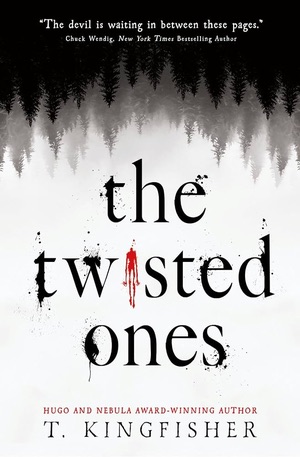
Another read for my horror book club which is discovering to me many books that I’m enjoying in this genre. I’ve never read anything by T J Kingfisher – even though I had her writing recommended to me before by friends. This is a book that I read in a couple of days: Kingfisher has a very cinematic and fast-paced style.
This horror tale has a middle-age copy editor (Mouse) as a main character who has a dog, Bongo, who, by the way, I adored (and I was terrified of seeing die at some point in the novel, considering this is horror and animals are rarely safe in horror plots). Mouse is an unlikely horror protagonist and her first person narrative is colloquial, she tells the story as if she was talking to a good friend. I can see why some people may find her voice slightly annoying in places but it did work for me.
The story starts when Mouse has to go back to her grandmother’s house after she’s died to tidy up. It’s not an easy task: she has to do this alone, because she only has her father left, and he’s old and very ill, so he can’t help her. Her grandmother was also an evil person (everyone agrees on this, including Mouse and her father) who was liked by basically no one, ever. And the worst part: Mouse’s grandmother was also a hoarder, so the house is in a very bad state.
As someone who suffers from claustrophobia and can’t stand terribly messy spaces this is really a nightmarish scenario. I can’t quite imagine being in a huge house packed to the brims with rubbish in the middle of nowhere North Carolina.
As you can imagine, at some point Mouse starts receiving the visit of some very strange beings. At the beginning the supernatural comes in small, almost invisible details (such as a few deer grazing in the garden, very early in the morning, which look only a bit weird). This goes in crescendo building up to a moment where the supernatural becomes real in the plot. It turns out this novel is heavily inspired in another book, The White People, by Welsh author Arthur Machen – I didn’t know about this author before reading this book, but it turns out he was well-known in the weird fiction genre. In fact, the diary that Mouse finds in her grandmother’s house (of course, a weird fiction/gothic trope) is written by her step-grandfather and contains a recollection of The White People as he remembers it.
As much as I enjoyed this book, I was a bit disappointed that Mouse’s evil grandmother wasn’t more of an important character in the overall plot. I wanted to know more about her, specially why the Twisted Ones didn’t want to approach her (I mean, how evil can you be that even the monsters in a horror book don’t want to be near you?)
(Also, no, the dog didn’t die.)
The Wheel by Jennifer Lane
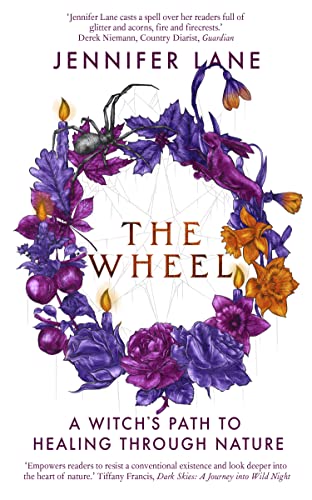
Living in England, specially now that I’m back in the north, has me all interested in the different seasons of nature (as I try to survive the long, dark and rainy winters). This book focuses on precisely this theme from the perspective of paganism and witchcraft. Jennifer Lane’s writing style is very approachable, and as both of us live in the northwest of England I could relate to a lot of the things and places she mentioned here.
I enjoyed her musings around creativity and spirituality and how she used them to get out of burnt out. As someone who suffered from burnt out too (an experience I don’t recommend to my worse enemies) I found myself very interested in reading about other people’s experiences with it. In part, this burn out is linked to our jobs. In my case, if you work in the arts or at the university, doing what you love the most, is so easy to overwork constantly and let the employers take advantage of your time and your energy. Also, burnt out is linked to the seasons. We are always asked to produce more, more, more, more. And when we do, the goals change, so like Sisyphus and his rock, they are always out of reach. It was the same during my PhD – that realisation that, no matter how much I tried, I wasn’t becoming wiser through it but quite the contrary, I was realising how little I knew about the things I thought I knew. There’s no place to arrive to, no victory to claim (not in the PhD, not in life I suspect, either). If only we were allowed to work in cycles, to have times of intense production but also times of intense rest. Times in which we are allowed to search for inspiration and enrich ourselves so whatever we produce next can be better. Energy is not infinite, and replenishing it should be as important as using it to create things.
What I like about witchcraft and paganism (and about Jennifer Lane’s book) is the interest in nature and seasons, the celebration of change and the reconnection with the animal side we all have. Also, as someone who was never brought up in any kind of religion I can see now the importance of faith, of believing on something else beyond the material things we can acquire in this life, beyond the jobs we have and, most of all, beyond what we ‘produce’ for this vast, big, scary machine called capitalism.
Thin Places by Kerri ní Dochartaigh
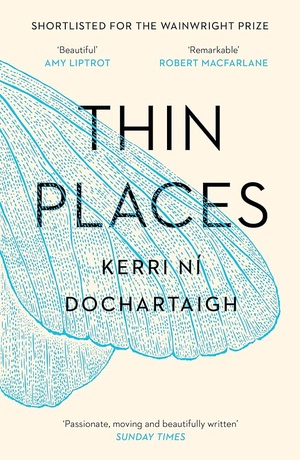
I heard an interview with Kerri ní Dochartaig in Katherine May’s podcast (which I found out after reading May’s book Wintering) and thought she sounded like a very interesting writer. This book is written in a very lyrical style – some bits of it are basically poetry. Yet, this was also a very hard read that affected me deeply – I had to read it in small bits, when I got too much I’d have to stop for a while. The author doesn’t shy away from very dark subjects including mental health struggles, suicide, grief and terrorism. I think, though, that she reflects on this in a very deep and nuanced way. Everyone should read this book, specially those of us who live in the UK and should know more about the Northern Irish conflict.
Kerri ní Dochartaigh starts this book both frustrated and scared after the Brexit results: as she puts it, people from Derry, the place she’s from, and by extent, Northern Ireland, didn’t vote to leave the EU and yet they will be some the most directly affected by this particular decision. She goes on to talk about the place where she lives, a place divided by different nationalisms (those who see themselves as British and those who see themselves as Irish, those who are Protestant and those who are Catholic… etc.) She narrates her own experiences with violence and terrorist (from both sides of the conflict) which are particularly acute as her mother is Catholic and her father is Protestant: as a result she is seen as someone who belongs to none of these groups fully – and this is also why her family is always in constant danger. One of the most terrifying scenes in the book is her recount of her childhood home being set on fire on purpose – and how she was saved by her cat who scratched her face and made her wake up so she could leave before it was too late.
She describes the effect this violence and division has on herself and the people she grows up with. How is not only until she’s in her late twenties that she realises she’s suffering from PTSD, from experiences she had when she was too young to comprehend. This book is also a beautiful ode to nature and to those places which have something special and invite us to reflect or meditate – thin places, she calls them. An ode to the in between (where she finds her own identity, unable to decide who she is from a collection of binaries).
Heartbreaking, beautiful, dark and hopeful. I wish more people wrote as bravely as Kerri ní Dochartaigh does here.
 Inés G. Labarta
One thought on “Experiencing the thin places: November 2023 Reading Log”