
The Wonder by Emma Donoghue

This is the first book I’ve read by Emma Donoghue but it certainly won’t be the last. I immediately connected with the main character in this story, Lib Wright, a young nurse with a tragic past who trained with Florence Nightingale herself. Her voice is strong and distinctive, with a superb attention to the detail, as you’d expect from a nurse, caring, yet strict.
The premise of the story also hooked me from the start: in rural Ireland, an eleven-year-old girl seems to be able to survive, month by month, without consuming any food, her only nourishment being ‘prayer’. Lib Wright is brought from England to investigate.
The mystery is an enticing one and keeps you reading. The most horrific part is not the reveal of how Anna (the Irish girl) is surviving or why she has decided to fast in the first place. The real horror, to me, was the fact that this story is actually based on an array of different cases of young women, such as Anna, who did similar things throughout their lives – always under the excuse of religion, of wanting to feel closer to God. It often ended with their deaths.
There a strong sense of place in this novel. The Ireland that Lib has just arrived to has been decimated by the famine, which adds another dimension to the fact that Anna, a young girl born during this period, is now refusing to consume food. The landscapes are flat and desolate – we are in the Midlands of Ireland, an area I happen to know quite well (I lived there for a while) which has the largest skies I’ve ever seen.
At the beginning of the story Lib is convinced that Anna is performing a scam with the help of her parents – her fasting is attracting the attention of many, and she’s treated with reverence, almost as a saint, receiving money and presents from some of her ‘followers’. However, as Lib gets to know Anna, a relationship starts emerging between the two. Emma Donoghue is really good at writing a preteen child, and Anna definitely becomes a charismatic figure in the plot. She is fierce, and bright, and clever, and, as Lib discovers, she absolutely believes that this fasting will bring her the atonement she’s been praying for.
This is a gothic narrative for sure, as in this story many pasts remerge in the present, like open wounds. There’s Lib’s past, estranged from her own family, and abandoned by her husband right after their young child (only a baby) died. There is Anna’s complicated family dynamics – her parents are extremely religious, to the point their religion becomes a shield they use to not to have to address some very difficult life happenings.
I’d say this is an important theme in the book: the idea that religion can empower individuals (it is certainly empowering Anna to do something extremely difficult many of us wouldn’t be able to keep up for long) but it can also be used to justify and even ignore evil – the evil so may find too difficult to cope with.
The ending comes in with a very interesting twist, that perhaps some would consider far-fetched. I enjoyed it, though, and I thought it made this book really interesting. Above all, I was interested in how myth and religion – especially Catholicism, with its complicated rituals and its fair share of folklore directly adapted from pagan traditions – eventually offered a dark salvation to the characters.
Harrow the Ninth by Tasmyn Muir
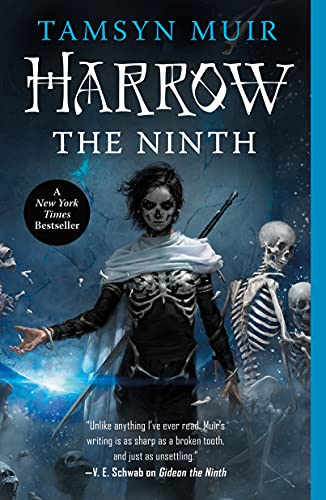
The first thing I did right after I finished was think what the fuck did I just read????
For a bit of context: this is the second book in a series. The first one, Gideon the Ninth, was one of my favourite books of the year. Does this sequel live up to the expectations set by its predecessor? That’s an interesting question. I liked Gideon the Ninth more. As a book, it feels more rounded. I can also understand that after the success of this first instalment Tasmyn Muir could have been very worried of repeating herself. She’s trying something completely different in this second book (as different as it could be, really).
The first two thirds of the book were quite disconcerting for me. First of all, most of the sections are narrated in second person, which is quite jarring, especially when it’s done through hundreds of pages. At times, it frustrated me a bit, because it made the story quite difficult to follow for far too long. But in the last third there’s a twist about the use of this perspective and a piece clicks in the puzzle, which is why, overall, it did work for me in the end. I enjoy having a-ha moments and if that is something you like too, this book delivers.
It’s worth saying that Tasmyn Muir has quite a complicated narrative language. Her descriptions can be long, and complex, the same as the world-building, which at points feels too obscure – I’m not surprised she includes a glossary and world-building explanations in all of her books. Gideon the Ninth also had a bit of this, and overall it doesn’t bother me all that much. Friends tell me that both her books are full of references to internet memes and other internet items – well, these are completely lost on me, to be fair, perhaps if you know about all of this then it doesn’t feel as obscure.
Now, something that Tasmyn Muir does very well, in my opinion, is character. Gideon was such a great main character for her first fantasy piece, and so was Harrow, to be fair, although the version we get of her in this second book (she’s the main character in the sequel) is rundown Harrow with PTSD, so different from the Harrow in the first book, but it makes sense, because at this point in the story, she’s gone through a lot.
In fact, in Harrow the Ninth Muir brings back other great characters from her first book and I did enjoyed this a lot. The new characters she introduces to us in this second book? Meh. I have to say, to me, none of them comparable to those in the first book. I was particularly disappointed with the character of the Emperor, who is supposed to be this powerful, evil overlord. He felt really grey, insipid, bland. Maybe this was the point – to surprise you and defy your expectations – but as a villain I just wanted a bit more. Other characters were downright evil and unsympathetic, fun to read, but not charismatic.
In the last third of the book, though, as I mentioned, the action speeds up and a few twists bring tension and a dramatic reckoning I enjoyed a lot and reminded me of why I loved Gideon the Ninth so much. The ending was definitely a cliff hanger and I will be reading Nona the Ninth (the third book) as soon as I can get my hands on the paperback copy.
All in all, I’m enjoying this book and I have the suspicion (or the hope) that the third one will be better than this second one and will bring us more unforgettable, twisted characters.
How to Do Nothing by Jenny Odell
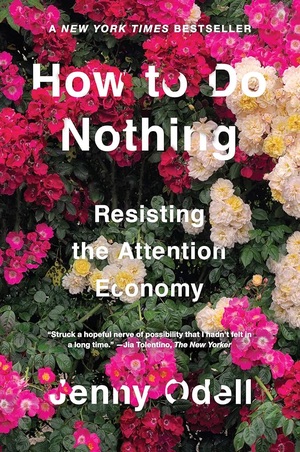
I’d been wanting to read this book for ages, as it was recommended to me by different people. Finally I got my hands on it (thanks to my local library). This was written right after the Trump election of 2016, when many – women, queer people, immigrants – felt terrified. That was the case of the author too. It prompted her to consider the value of art as a tool to bring people together, as well as the importance of nature and feeling connected to our surroundings.
One of the most striking thesis of this book is how Jenny Odell suggests that being able to create art is a very important skill, since it’s conductive to a greater facility to focus. Through art, we learn tothe flow state, which improves our attention span and our ability to excel at whatever we are doing. Being able to focus is becoming a real gift as many things around us – hello email and social media – make us constantly distracted. These days, I rarely manage to watch a whole YouTube video without skipping content or starting a different one that’s being suggested by the algorithm (YouTube is the one social media I struggle to quit). Something a bit similar happens to me with online newsletters – I skip through them a lot and I don’t have the patience to commit to them anymore – (long gone are the days where I sat down happily reading long form blogs from my favourite authors).
This book was a good reminder that connecting with people at a deeper level is important for our well-being, and it helps at a societal level, too. It was collective efforts which won us things such as the eight-hour work day (which is far from perfect, but was a significant improvement over workers’ conditions at the time) weekends, and holidays and the such. And yet, with this enhanced sense of staying connected – through emails and social media – we are losing our freedom. Odell reminds us that nothing comes for free – social media sites buy our attention for the profit of companies and advertisement. The psychological techniques they use to make us stay on them longer (and make more money) are also truly devilish (she explains a few ones, such as the psychological impact of using the colour read to signal that you have notifications and so on). It’s that constant need to chase dopamine that does us in. I keep wondering if in the future the use of smartphones and social media will be seen as the use of tobacco today (something that some may choose to consume, but that we all know is not healthy).
“I am not anti-technology. After all, there are forms of technology—from tools that let us observe the natural world to decentralized, noncommercial social networks—that might situate us more fully in the present. Rather, I am opposed to the way that corporate platforms buy and sell our attention, as well as to designs and uses of technology that enshrine a narrow definition of productivity and ignore the local, the carnal, and the poetic. I am concerned about the effects of current social media on expression—including the right not to express oneself—and its deliberately addictive features. But the villain here is not necessarily the Internet, or even the idea of social media; it is the invasive logic of commercial social media and its financial incentive to keep us in a profitable state of anxiety, envy, and distraction. It is furthermore the cult of individuality and personal branding that grow out of such platforms and affect the way we think about our offline selves and the places where we actually live.”
Jenny Odell
There was the reminder again of nature and the importance of walking among trees and greenery to feel soothed and connected to the world. How important it is to be able to go out and feel small. Having recently moved across the country to a more rural area I feel incredibly lucky to have nature at my doorstep (the North has endless nights in winter, and rain, and gloominess, but it also has lots of beautiful nature that, as Odell suggests, heals the soul).
A very interesting read, it didn’t discover anything new to me at this point but I liked Odell’s argument in support of art as something which gifts us focus and the ability to see the world in different ways.
The Raven’s Nest by Sarah Thomas
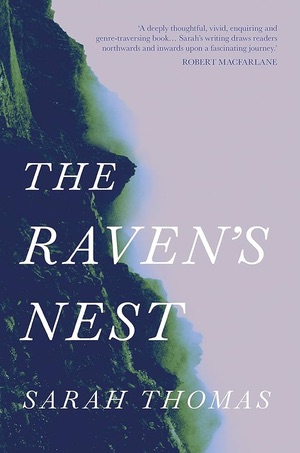
This past July I had the chance to visit Iceland – I was staying with a friend who has moved there – and fell in love with the country right away. Granted, I visited when there is literally no darkness (and, as someone who has relearned the value of sun and daylight after moving to England, this was such a joy). But the landscape was so impressive, so touching. Like the Isle of Skye (one of my favourite places in the whole world) but on steroids. How small and insignificant I felt, and how I loved that. Nature putting things into perspective (we are nothing but specks of dust, aren’t we?)
So after coming back I saw another friend reading this book – about a woman from England who emigrates to Iceland – and of course I had to ask her to lend me the book when she finished.
This is such a beautiful love letter to Iceland. It’s an autobiographical account of the years the author spent living there. She visited by chance (to attend an academic conference in quite a remote area of the north part of the country) and through a series of coincidences she ended meeting the man who would become her husband – and be the reason why she decided to move to Iceland more permanently.
That said, this book also deals with sadness, loss and grief – it opens with Sarah coming back to Iceland to finalise her divorce, so we know, from the very beginning, that her time living there will be limited, which immediately tints the narrative with bittersweetness, and also nostalgia.
As an immigrant myself there were so many things here I could relate to – the falling in love with a place and a culture that’s not your own. The learning of a different language, of different habits, routines, way to relate to each other and ever see the world.
In this book, I enjoyed reading about Icelandic language as the author became more proficient in it. I also liked her details about the foods she ate while she was there – one of the hardest to read, for me, was about her helping with the slaughtering of sheep while on the farm from one of her husband’s relatives – and yet I could see how this is ingrained in the culture – how some people are still so connected to what they eat, how they rear these animals and then eat them, using everything from them so nothing goes to waste. I can see why this is probably a much better alternative to industrial farming, even though when I’m a vegetarian myself and I couldn’t kill an animal like that.
Another very interesting part was her description of living through the Icelandic winter while in the north of the island – in a place where there is no sun for months. I would be terrified of trying something like that – and yet she also shows how this time of darkness and introspection was incredibly helpful for her creativity. Everything else stops and becomes impossible – going out, the frantic work routine, meeting lots of people, going places. There’s only the simple things left to do – reading, writing, contemplating life.
All in all this is a good read about an immigrant experiencing Icelandic culture and falling in love with a country – even when a lot of things about it are far from perfect. I’d be very interested in reading whatever Sarah Thomas writes next. My friend tells me she was recently in Iceland promoting this book – I wish I could have been there to hear her read from it and ask questions about it.
Wintering by Katherine May

I don’t like winters. By which I mean, I don’t like winters here in the UK. In Madrid, I love winters. We have all the beautiful sunny days (mostly) and none of the terrible heat of the summer. But in Scotland and in England winters are gloomy, dark and rainy. I struggle with the absence of daylight the most. The first time I lived outside of Spain for a whole year (Edinburgh) my period stopped as soon as the winter came. Gone. For almost eight months, if I recall correctly. My GP said that perhaps it was the absence of light, because, apparently, that’s how your body monitors the passing of time.
I do believe in SAD as well (Seasonal Affective Disorder) because I get it every year. Every November, to be precise. Like now, as I’m typing this. It’s November in the north of England, it’s around 6pm and it’s been dark and cold outside for more than two hours. Today has been the second sunny day of the week (it’s a Saturday). I feel angry with the world, I feel sad, as if a bit of me was dying, slowly. I don’t know how to define it exactly but this blue feeling comes from the absence of daylight – and every day becoming shorter, and shorter.
So I grabbed this book ready to be convinced that winter is a beautiful, productive and enriching season (I was born in winter, after all, so I’m open to fall in love with it again).
This is not really what the book is about. Katherine May (I see now that her surname alludes to a bright, glorious month) is acknowledging winter as a scary season in which everything crumbles and dies. Things are quiet, dark, and we can’t do anything but wait it out. Which is difficult, because our daily lives are not in synch with nature which is why we struggle so much to keep up with our long working hours and our commitments (if only we could work less hours during the winter, right?). May goes one step further and suggests the idea of winter as a metaphor – there are times in our lives where things are ending and we just need to stay put and endure, rest and stop to heal, until we can gather enough energy to reinvent ourselves or imagine a way out of whatever situation we have been trapped in.
I thought this was a powerful idea and I could definitely see the connection between winter as a season in both, life and the Earth. I also enjoyed how Katherine May described different practices that can help us cope with the darker months and embrace them. From observing sunrises (ah, how nice and sweet is going to feel that first sunrise after the winter equinox, when I know that days will become longer and spring and summer are on their way) to swimming in the cold water to enjoying saunas and using a SAD light. In fact, this book finally convinced me to get a SAD light (I’ve been toying with the idea for years) and it may be pure placebo effect, but it actually works really well for me.
Wintering also reminded me that other parts of the world have it harder – specially the north of the Scandinavian countries and Iceland. Although I think there’s something about the gloominess in the northwest of England that is difficult to match – the general greyness, perhaps (I think if people around here started painting their houses in bright colours perhaps things would feel a bit different).
Ultimately, this book reminded me of the importance of stoping and resting during winter – even though when we work, we really can’t, but I’m also trying to not feel guilty if I’m not as social as ever or if I spend a few more hours in bed or lazing around in the sofa. I’m also running out of the house the first chance I have when I see the sun. To cherish every second of it during these really long wintery months.
For Thy Great Pain Have Mercy on My Little Pain by Victoria MacKenzie
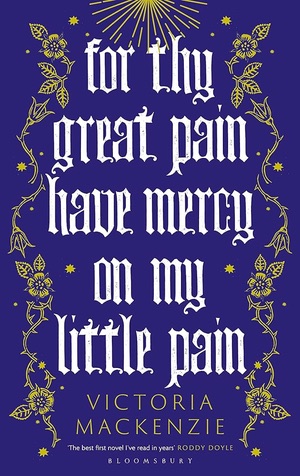
A friend recommended this book – she was quite excited about it and said I’d love it. Well, what can I say, my friend knows me very well. This is, easily, one of the best books I’ve read in the whole year.
The story follows two main characters, who are also historical figures: Margery Kempe and Julian of Norwich. These two women live in England during the Middle Ages and their religious – one could say, mystical – experiences end up bringing them together.
The first chapters establish each character: Margery is born in an affluent family and marries young. Her life is busy as she gives birth to child after child and yet she doesn’t find content in the role of the wife and the mother. She keeps having visions of Jesus and is consumed by his love for him to the point where she can’t stop crying, almost constantly. This ‘excessive’ show of her emotions is a source of frustration for her husband – yet, some people seem to think that Margery is truly communicating with Jesus and God and are ready to listen to her insights and even gift her money.
Julian is also born in an affluent family. But because of the plague she loses everyone but her mother at a very young age. She’s a curious, intelligent child, who begs to be taught reading and writing, like her brother did before he died – her mother doesn’t want to waste education on a girl but finally gives in. Julian has barely reached adulthood, married for love and had a baby when the plague strikes again, this time killing her husband and her baby daughter. Overwhelmed by grief, Julian turns to religion and starts receiving visions, very much like Margery. She takes care of her aging mother but as soon as she passes away Julian decides to become an anchorite. This means that she will abandon her life in the outside world and spend the rest of her days secluded in a single room with a tiny window.
The voices of these two different women come across the pages in such a powerful and raw way. This novella is written in short, lyrical chapters and the sense of the Medieval period – a time where you could lose your loved ones so easily, where people believed in witches and were ready to torture and burn them to protect themselves from the devil – comes across beautifully. This is one of the strengths of the work – how it manages to create the atmosphere in such a striking and believable way.
The most moving part was the ending – when Margery decides to go and visit Julian in Norwich. Julian is an old anchorite at this point. Margery comes to her completely vulnerable – she’s suffering, she is very discontented with her life and she wants to focus more on her spirituality ,but at the same time she’s worried that her visions are not really coming from God, or Jesus, that she’s making them up.
What can I say? I have almost nothing in common with Margery and yet I related to her so strongly. Who doesn’t wish to live a meaningful, special life, whatever that may mean for each of us? And as a woman, I have also felt often so trapped in all those roles which were imposed on me – the role of the nurturing partner, the wife, the caring mother. What becomes of those of us who have no interest in them?
Julian speaks to Margery kindly and with reassurance. It’s so moving to see these two women discuss the meaning of life, love and death that I teared up a bit in this last scene, and crying while I read books is something that very rarely happens to me. Their conversation was so powerful that transcended time.
All in all, this book was a revelation – in awe with Victoria McKenzie’s prose and her characterisation, and her story will stay with me for a long time.
 Inés G. Labarta
One thought on “Embracing winter: October 2023 Reading Log”