
The Gathering by Anne Enright
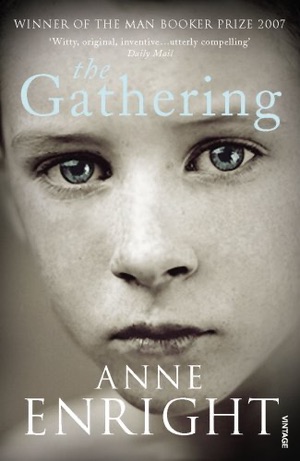
I’m always intrigued by books that whin the Booker prize. To be honest, I wasn’t really aware of the Booker and its significance in the literary world until I started working in a bookshop. There, the day of the launch of the long-list would always be a big event, and we would display all the chosen books in a special table. There would be people who came to buy them all read them and draw their own conclusions about which book deserved to win the final prize and why. Things would get even more interesting with the announcement of the shortlist and, finally, the winner (which was always controversial, some customers would come saying how the winning book was actually not that good and such and such other book should have won instead…) Which really tells you a lot about prizes and how subjectivity plays an essential part when judging their value.
I had no idea what The Gathering was about when I started reading, and it’s also my first piece by this particular author – who I’d heard from before. The first thing that became evident was the quality of the writing: superb. I was immediately drawn into the story by its unreliable narrator, a woman trying to make sense of a memory she has from childhood (or that she think she has, things are not completely clear in that regard). She’s convinced that, if she manages to remember it all, she’ll finally understand why her older brother Liam died by suicide.
This is a very dark novel about shame. The ingrained shame of a Catholic culture in which sex and desire and demonised and blatantly seen as sin unless they are a medium to procreation.
This what shame does. This is the anatomy and mechanism of a family – a whole fucking country – drowning in shame.
Anne Enright
Veronica is one of twelve siblings, and she resents her parents (especially her mother) for being busier having more children instead of having time to take care of them. Early on in the book, we discover that what happened to Veronica and Liam (her favourite sibling) occurred during a time when they (and their younger sister, Kitty9 had been taken to live with their grandparents for a few months.
Veronica is such an interesting narrator – she circles around that particular memory she’s afraid of and offers us a detour into her own life growing up, her life as a married woman with two young daughters and even her speculations around the life of her grandparents, specially her grandmother Ada, who was orphaned at a young age. Veronica sees herself in the figure of Ada – since both have struggled with the madonna-whore complex. Veronica is trapped in a society that sees sex, and especially female desire as something shameful, whilst at the same time she feels like prey haunted by men’s animalistic desires. There’s a particular chilling scene in the book when Veronica remembers travelling alone in Italy and being harassed by a random stranger who follows her around to masturbate near her. This random cases of sexual harassment feel painfully relatable – for example, being flashed by a man in a park when going for a run in my neighbourhood one morning. As a woman, it’s ingrained in you to be alert all the time, understanding that is your body or your condition (which, by the way, I didn’t chose) that is triggering this violence. Be live, it seems, in a permanent unsafe space (our bodies). This cartoon by one of my favourite illustrators, Fran Meneses, tells it well.
I’m not going to lie, reading this book was easy because of the writing, but it wasn’t a pleasant experience. When Veronica’s memory is revealed, almost at the end, it’s not a pleasant one. The family dynamics are also painfully real but, quite honestly, fucked up. I felt dirty after reading this book, I can’t quite explain why, but all I wanted was to take a shower. There are few like touches here too, though. The darkness is mixed with some brief comedic moments. The relationship between Veronica and Liam is touching, even though tinted with sadness and trauma.
History is only biological, – that’s what I think… I don’t know when Liam’s fate was written in his bones, And although Nugget was the first man ton put his name there, for some reason, I don’t think he was the last. Not because I saw anything else going on, but because this is the way these things work. Of course, no one knew how these things worked at the time. We looked at the likes of Liam and had a whole other story for it, a different set of words.
Pup, gurrier, monkey, thug, hopeless, useless, mad, messer.
Anne Enright
World War Z by Max Brooks
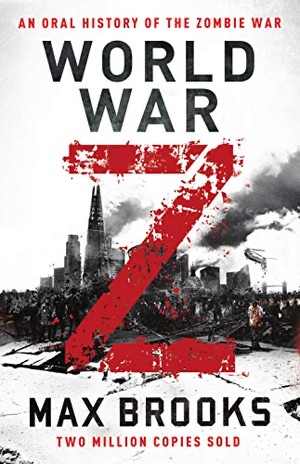
Another book I’d have never picked up by myself because I thought it wasn’t going to be very good, probably too cliché. Well, was I mistaken. I love when books prove me wrong.
One of the things that surprised me the most in this novel was form. This is not written like a conventional sci-fi or dystopian novel. Instead, it borrows the form of a history book – a book that collects the oral stories associated with a war, in this case, World War Z, to create a first-person account of the events. Through all these individual stories – some of them almost anecdotal – we are able not only to understand the chronology of the war and its key events but to see how it affected communities and societies all across the world and what impact it had on different human beings. I think this is a brilliant idea and a fresh approach to the zombie genre. For one, it makes things all the more chilling, because all the details narrated in this statements bring the pandemic, the tragedy and the war to life in a very powerful way. It’s also interesting to note the parallelisms between the zombie pandemic portrayed in this book (which was published in 2006) and the Covid-19 pandemic. Both were global events which were initially met with disbelief. And, in both cases, media played an important part in the unfolding of the events, racial tensions became more pronounced and countries couldn’t agree on what the best strategy was to cope and they adopted different methods (with very different outcomes).
Now, I’m not going to lie. One of the things I disliked the most about this book was the blatant absence of female characters. This is a very long book that covers a war that lasts for twelve years. It has lots of people giving statements from all over the world from all sorts of social backgrounds. And amongst them, there are only three female characters I can recall at this moment. No, wait, five. Yes, five female characters. Like, seriously? Women were not involved in wars, I guess, they were too busy taking care of the house and having children??
Another thing I disliked was that the book was very American-centred – which okay, makes sense, the author is American – and it did have some stereotypical depictions of characters from other places – mainly characters from China and Russia. I think a bit more of research and nuance would have helped in this regard. Even the characters from places like France and England, which were portrayed in a more positive light, still read very much like clichés and secondary additions to the plot. (Also, there was no mention whatsoever to Spain, I wonder how Spain did cope with the zombie threat in this universe… probably not very well.) Also, I was kind of surprised (and, frankly, angry) to read that Iceland in this book was a country swarming with zombies because they don’t have a real army and, also, because of the cold (which freezes the zombies but then they unfreeze once temperatures go high again and there are vicious as ever). I mean, really? After being in Iceland this summer I was pretty impressed to see how people have managed to live in this island for a millennia thanks to all sorts of ingenious solutions to its often inhospitable weather and landscape. I think Brooks was forgetting that Iceland has things like geysers and volcanos – I can very well see a future (in the context of this novel) in which Icelandic people devised tools to boil the zombies and get rid of them.
That said, this did for an entertaining read and an original take to the figure of the zombie. It reminds me of a brilliant essay by Margaret Atwood – which is in her collection Burning Questions – in which she explains that the figure of the zombie seems to become popular when society experiences economical and financial struggles. Which is definitely the case right now for most of us. And yes, we have lots of zombies taking over our imagination (The Last of Us recent adaptation into a TV series is an excellent example).
The living dead had taken more from us than land and loved ones. They’d robbed us of our confidence as the planet’s dominant life form. We were a shaken, broken species, driven to the edge of extinction and grateful only for tomorrow with perhaps a little less suffering than today. Was this the legacy we would leave our children, a level of anxiety and self-doubt not seen since our simian ancestors cowered in the tallest trees? What kind of world would they rebuild? Would they rebuild at all? Could they continue to progress, knowing that they would be powerless to reclaim their future?
Max Brooks
Reservoir 13 by Jon McGregor

This book annoyed me. I’ve only started reading crime fiction very recently, and this is a genre that I enjoy but I don’t seem to gravitate towards. When I picked this book I was expecting to read some sort of literary crime fiction. Which I guess I did. But.
The book opens with the disappearance of a thirteen-year-old girl in a small town in the Peak District. A bit cliché, yes, the young, beautiful girl disappearing and everyone being really shocked (in the way they wouldn’t perhaps be if the person disappearing was a sixty-seven-year-old woman). But you know, I thought I’d read all about the dark secrets of people in the village and those would contain hints that would led me to the actual murder. Well, stop reading here if you don’t want spoilers. But basically, wrong. Very wrong. The murderer of this girl (Rebecca Shaw, which, coincidentally, is also the name of someone I know and used to work with, which makes it all a bit weird) is never discovered. In fact, her murder is not even the point of the book.
The point of the book is to see how this disappearance of a random girl (I say random because Rebecca wasn’t from the village, she was there to spend the Christmas holidays with her parents) affects the small community for thirteen consecutive years.
When I realised this is what was happening (towards the end of the first chapter of the book, titled ‘One’) I did become a bit angry. I felt cheated. I wanted a quick-paced dark (and grubby) mystery and Jon McGregor wasn’t going to give me one.
But this book is well written, so that helps. It uses a detached omniscient narrator that jumps from one character to the other, sharing the minutiae of their lives in the valley. The voice is quite jumpy – and there’s a lot of and this happened, and then this happened, and then this happened. But by the third year you’ve already got into the flow and start to care about the characters. I did have my favourites, of course. For example, Su, the BBC journalist who works mainly from home and has twins with her older husband – Su’s parents fled China and established in Manchester afterwards. Or Catherine, a widow with two older sons who visits her elderly neighbour (he’s also a widower) to take his dog Nelson for a walk.
All in all, I appreciate the original and innovative approach to the crime fiction genre here, focusing on the impact of a sudden, a mystery with no solution, has on a small population. (Also, I don’t know why, but in my mind I kept imagining this town as Settle, which I know it’s not in the Peak District but in the Yorkshire Dales, but hey). I read in an interview that McGregor first wrote each character’s story separately and then he mixed them on in the subsequent chapters (arranged by years) where he had to decided what few details he could keep – almost as suggestions of a much more complex and richer life. In a way, I imagine the writing of this book may have been similar to the writing of a short story – in that short stories need to be, by their nature, a glimpse that suggests a wider world.
(Also, I keep thinking the title of this novel is obviously a clue, right? It means that the girls’ body is in reservoir number thirteen from all the reservoirs that surround the village, right? Right??)
The Shadow Cabinet by Juno Dawson
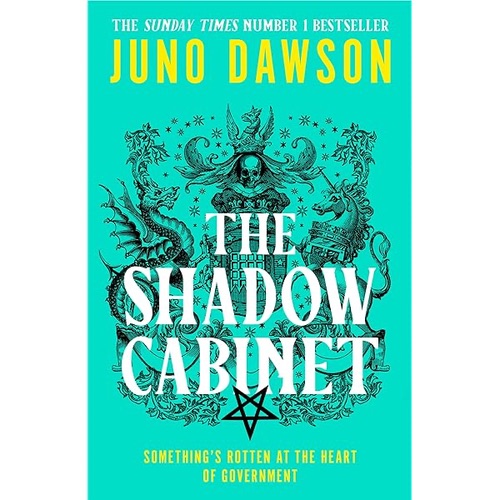
This is the second instalment of Dawson’s witchy series. I read the first one a few months ago and I was very happy to see the second one has just come out and it was available in my library. Fantasy is one of my favourite genres and I enjoy Dawson’s writing a lot, this is a big book but I finished it in a few days.
The story continues when it left in the previous book, and there were a few things here I enjoyed more this second time around. For example, the main character this time is a villain, which makes the whole narrative more nuanced and interesting (in my opinion). There is also more attention drawn to characters I was interested in before, such as Leonie (although I still think she needs her own book) and in general the narrative is fast-paced and engaging. I also learned to like other characters a bit more, such as as Elle. I complained that in the previous book she was too superficial, but I see now this was the point of this character – to be portrayed initially as a milf – to then add some interesting developments in this second book.
The villain-villain of this book was actually hilarious even though very cliché. One of my favourite scenes was when the HRMC (Her Royal Majesty’s Coven, I just love the acronym) meet with the Prime Minister and his cabinet. That Prime Minister reminded me so much of a certain infamous PM we did have in this country so long ago, and I couldn’t avoid laugh when I was reading that part. If only we had a real HRMC here… Also, in case you are wondering, the Royal Majesty of the acronym is not the queen Elizabeth II but Anne Boleyn, who in the book is the first queen of the witches.
The ending was surprising but I wasn’t all too convinced by some last-minute developments – let’s see how they pan out on the next instalment that I’m for sure reading. What can I say. I’ve grown fond of this characters and I really like how English everything in this books feels, because I can relate to it very well, specially to the north of England and the different places that feature a lot such as Manchester and Hebden Bridge. I’m looking forward to the next instalment of the series.
Alice isn’t dead by Joseph Fink

This was the September read for my bookclub. I was very happy to read this book because I really like Welcome to Nigh Vale, a podcast co-written by Joseph Fink. That said, I couldn’t get into this book. At all. The writing style was very difficult for me to follow, I found it too stilted and dry. I can see that the author is trying to recreate a horrific and surreal atmosphere like a David Lynch movie (I love David Lynch, by the way) or the series Too Old to Die Young by Nicolas Winding Refn, but it just doesn’t translate well to the page. For example, in series like Twin Peaks you have things like the music, imagery and visual aesthetics to enhance the dialogue and the storytelling. In a book everything is much more subtle. After disliking this novel so much that I could only read a few chapters (I just couldn’t get into it) I did a bit of research and discovered that this project started originally as a podcast. Since I really like the idea of the book – a dark road trip through America in which we follow Keisha, who know works as a truck driver, as she tries to find Alice, her wife, who everyone thinks is dead – I think I’ll give the podcast a go. I can totally see how music and in general the audio experience might make this story much more enticing.
I normally push myself to finish books (I’ve said before in these reviews that, as I was once a literature student, I have no problem with engaging with books I dislike just see how they work) but this year, for the first time, I’m trying to stop reading the books I don’t enjoy on the basis that there are too many books in the world anyways (and finite time to read them all!) So I’ll prioritise those I found interesting for one thing or the other.
Girl, Woman Other by Bernardine Evaristo

This book was a re-read, which I don’t normally do but in this case it was required as I’m going to have to teach it. Since I’d read it a few years ago – 2020, in the middle of UK’s lockdown – I still remembered fairly well. So, my initial intention was to simply flick through its pages to familiarise myself with it. Soon, however, I found myself completely immersed in the story and the characters and decided to read it again all over. After trying to read Alice Isn’t Dead and finding the whole experience too clunky this book felt so good – I didn’t feel the writer typing at the other side (if that makes sense) I could simply enjoy the story.
Evaristo has a very particular style, almost a mixture of spoken word or poetry and writing. She presents a wide cast of characters in this book through a close an intimate third person perspective. What all these characters have in common is that, at some point of their lives, they have all lived in England. They are also black. Apart from that, they all come from different cultural and social backgrounds. This time around I was more interested in different characters, especially Bummi and Winsome, two women who emigrate to the UK looking for a better life for them and their families. It’s interesting that this time I was more interested in them than the younger or artist type characters this book also features. I suppose this second time the idea of the chosen home spoke to me powerfully.
Overall this was a hugely enjoyable and refreshing read – also a meditation of life in the UK as it is now, including perspectives from those who aren’t British but have made a home of this country, or those who are British and English and also connected to a myriad of other places and cultures – and don’t necessarily accommodate an easy, purist definition of what it is to belong to a country or to a culture.
 Inés G. Labarta
One thought on “Defying form and conventions: September 2023 Reading Log”