
One Last Stop by Casey McQuiston

This is not at all the kind of book I’d normally gravitate towards since romance is one of the genres I read less of (to put it generously). But because this was one my book club’s pick of the month and I decided to go with it. And, spoiler alert, I was pleasantly surprised.
This is the book I would have loved to read when I was a teenager. Honestly. It would have saved me lots of heartache to see more positive queer relationships portrayed in stories back then. You have to understand that during my teenage years in Spain the only queer couple I read about was Louis and Lestat in Interview with the Vampire (a novel that I loved at the time, but that’s another story) or the turbulent gay relationships in Lost Souls and Drawing Blood by Billy Martin. I still remember the first time I realised I was queer – and I thought, fuck. I had a lot of internalised homophobia. I could find some books abut gay men, but women? It was almost as if we didn’t really exist.
So I think it’s very important that young adults can read fiction like this, where the main character, August, can fall in love with a charismatic older girl, Jane, she meets in the New York’s underground, and it’s natural, and it’s fine, and is not even the point of the story. The point of the story, actually, is to show August’s coming of age journey in New York (while she tries to finish university an decide what she wants to do with her life, hello being twenty-three years old). The point of the story is also a bizarre sci-fi twist that includes some time-travelling theory and which definitely didn’t make sense (even for someone like me who doesn’t always get all of the science). But you go with it because by the time this comes up in the plot you’re already invested in the characters.
August and Jane were nuanced, and I was very sympathetic to August’s existential anguish as someone who’s moved to a new city trying to find their call in life. When moving to New York August finds the best cast of flatmates a young queer person could ever wish for. Whereas this is an intended commentary on the importance of chosen family, I found it a tad unrealistic. I have (mostly) horror stories about my experience sharing flats as a student. Life would have been so much easier if I had found myself living with Niko, Myla and Wes. From this trio, I loved Niko, the chill, always handsomely dressed medium trans-guy.
This book does have its very corny moments, but by the end of it I was revelling in the high drama and the soppiness. Don’t be fooled, though, this novel also contains some harsh realities about homophobia and rejection. I thought it was very smart of MaQuiston to have both in her book – a celebration of being queer but also evidence of how difficult it can be, and how sometimes the price to pay can still be too high.
Also, this is one of those books where you can feel the author had so much fun writing it, which always energises me in a really cool way and reminds me why I chose this career in the first place. A final note: this book also has positive descriptions of lesbian sex, which I found refreshing and important – as this is something rarely written about in a way that feels genuine.
Burnt Sugar by Auni Doshi

If the book I previously reviewed can be too soppy and sweet at times, this novel is the perfect antidote with heaps of bitterness and tragedy. Also a very fast read for me – its prose is impeccable – although it brought up some really harsh memories around topics like twisted parental relationships and dementia.
This novel is set in Puna (India) and it focuses on the complicated relationship between Antara, a woman in her thirties, and her mother, Tara, who has started to show signs of dementia. The novel is told from Antara’s point of view and goes back and forth to give readers a portray of her childhood which was problematic to say the least. In the first pages I read a line that I can’t forget.
Sometimes I cry when no one else is around – I am grieving, but it’s too early to burn the body.
Auni Doshi
Antara hates her mother because she didn’t really take good care of her when she was little – for example, Tara abandoned her unhappy marriage with little Antara to go live in an ashram where she cared more about her (implied) romantic relationship with the guru than her daughter’s wellbeing (interesting fact, the ashram in the novel is very much inspired in the real Rajneesh’s ashram in Pune).
Some of the hardest scenes to read is when Antara is abandoned (yet again) by her mother and sent to a terrible boarding school where she suffers excruciating abuse at the hands of the nuns (I’ve heard equally terrible stories from my own mother, who was also taught by nuns, albeit in 1960’s Spain). Things don’t improve when Antara grows up and her mother starts seeing her as a competitor when it comes to gaining attention from men.
As you can see, Antara is less than willing to become the caretaker in the relationship when Tara finds herself unable to live alone because of her nascent dementia. The novel opens with the following line:
I would be lying if I said my mother’s misery has never given me pleasure.
Auni Doshi
Yet this is a novel with examples of complex and layered characterisation. Throughout the story is not easy to cast Antara in the role of the victim and Tara in the role of the abuser. They are both victims and abusers, and they hurt each other, but there are also tender moments between them. They both live in a patriarchal society that is punishing and tries to annihilate who they really are. For example, if Antara had never been pressured to marry and have children, if she (like the men around her) had been given the time and resources to pursue her passions and interests and become her own person, she would have been a better parent (if she had eventually chosen to).
Ultimately, this is an excellent work. Its depictions of dementia and parent and child relationships are chilling but insightful. It’ll be on my mind for a long time.
Cwen by Alice Albinia

A book I saw in my local Waterstones. I resisted the impulse to buy it and checked in my library catalogue instead – they had it! I was very intrigued about this book for my own research – I’m working on a novel at the moment that depicts a (twisted) matriarchal society of sorts too.
This was an intriguing piece of work set in contemporary times in a fictional British island nearby Northumberland. A rich woman moves there and slowly starts using her money to support the local women and build a network for them so the society in the island slowly becomes a matriarchy. When the men realise this they are not happy and they retaliate. The novel is narrated in a particular form: there is a trail to see if the women in the island were discriminating against the men. A handful of women are called to the stage to testify as witness to what happened – all at the same time as this rich woman who was the catalyst for change, Eva Levi, disappears (she was last seen on a small boat in the sea, just before a huge storm).
Some could say that this structure is a bit choppy – as different characters and voices come one after each other, revealing different parts of the plot. All the stories have something in common, though. The women called to speak all knew Eva very well and were aware (in different degrees) of her intentions to changing the societal structures of the island.
I was slightly bothered by the fact that the ‘saviour’ in this book turned out to be a rich woman who had decided to use her monies to support other women. Which I guess is not a bad thing after all. She’s also married to a successful politician from the Conservative Party who has no idea what she’s using all their money for (which yes, it’s funny, wouldn’t that be a thing if this happened in real life?)
As expected, I personally enjoyed some of the perspectives more than others. It was very interesting to see how the women in the island flourished when they were given time, a network of people they could trust and resources. The book makes an interesting case for showing how a better distribution of money and resources can help create a fairer society. It also suggests that a society were women are not discriminated against is also a society more concerned about the natural environment. It was particularly interesting to see how the young female teenagers of the book were written – young women educated to feel confident and capable. It may seem like a small thing, but it made me reflect on the way I was raised (how we get hammered with the idea that we need a man to feel whole, that our bodies are a dangerous thing, that we have to be quiet, and delightful, and pleasing, and caring… etc.)
One of the final scenes were specially shocking – this is the moment when the men from the island realise tha tmost of the positions of power are occupied by women (an interesting contrast, considering is the direct opposite in real life, just think how many female PMs the UK has had, or Spain, for that matter).
At times this novel reads a bit too much like an academic monograph – but I did enjoy all the information on British mythology and British goddesses. It’s refreshing to know that there’s actual evidence of a potential matriarchal past – the archeologist Marija Gimbutas gets mentioned in the book.
Ultimately, this is an exercise on how a matriarchy could be funded in our current times, what would it look like and what challenges would it face.
Stolen Focus by Johann Hari

I got recommended this book and I read it quite fast even though I was a bit weary regarding Johann Hari’s controversial work as a journalist in the past. It confirmed something I’ve experiencing for years, especially since I got my first smartphone (which wasn’t until 2012, I really resisted it). Our focus is getting worse and worse, and I personally don’t like it, especially the way it impacts my writing and my creativity (and my mental health, to be honest).
I have been having a love-hate relationship with smartphones and social media for years now (veering more towards hate). On the one hand, as someone who lives in a different country from her family I am forever grateful we have things like tex, call apps and the lot. Social media can also be useful – I got one of my publishing contracts through Facebook (a friend recommended me to a publisher through there). Yet this yearning for constant stimuli (in the form of new content popping up constantly on our apps or a message notification) has been driving me mad for ages. I also dislike how social media facilitates an extreme version of the comparison trap: it gives you the impression that everyone (in my case, writers, who are colleagues or people I admire) is constantly getting stuff out, and awards, and incredible advances in their career whilst one remains stuck or constantly failure (the artists’ life is mostly failure with a few successes here and there). Jealousy and competition aside, sometimes I find it much easier to procrastinate and see how others create and produce instead of focus on my own work. As you can see, this is a real trap, a dollop of honey in which we (poor little flies) can get stuck so easily.
Johann Hari talks about a similar experience in his book. One of the first chapters is all about his own detox retreat – he goes to an idyllic New England’s sea side town, Provincetown, and spends three months there with no smartphone and no access to the internet (although he does take his laptop with him). I scoffed a bit when I read this because yes, it is an interesting experiment, but also, kind of reeks of privilege in that not many of us can afford to have that beautiful (presumably unpaid) holiday. In the end he spends most of time going for walks by the sea and reading (my ideal holiday, actually) and his life improves and he feels much stronger mentally. The rest of the book is all about how this realisation takes him on to the quest to research the ways our focus has arguably worsened in the last century with the apparition of a series of technological advances.
Some chapters are more interesting than others. There was a chapter about reading. I love reading, if you haven’t noticed, and I feel that when I devote daily time to it my own focus improves and mentally I also feel more at rest (and less twitchy). It’s also a mental exercise – going back to reading after a period in which I may have engaged more with Instagram and YouTube (my two main time sinks, specially the later) is always hard. My focus is definitely broken and reading more than a handful of pages feels strenuous – but the more I keep at it the easier it becomes once again.
One thing I did like from Hari’s book is how it makes it clear that we are not solely responsible from our loss of focus. Social media, for example, is designed by psychologists and data scientists to be addictive – because that is how this ‘free’ companies get their money from. The documentary The Social Dilemma explains this in detail, and I found it illuminating back in the day. So we need to ask for social changes – which could also include, for example, the right to have periods when we can’t be contacted – (am I the only one who experiences an intense anxiety around work emails?) so we can protect our focused and free time if we wish to.
I also enjoyed the chapter about the flow state and how this is the opposite to feeling twitchy and anxious after hours of doomscrolling – you can reach the flow state through all sort of different activities, like writing, painting, taking care of the garden, crocheting, meditating… etc. And the suggestion that reading is not only a wonderful way to practice focus but also of exercising empathy – a quality very much needed to stay in a social environment.
If you are curious about any of these issues this is a book I recommend.
In Ascension by Martin MacInnes

I’ve just very recently started to leave books unfinished if I’m not enjoying them. I always find it very difficult, because, as someone who studied literature at university I’m used to reading something to observe techniques and themes and I’m generally very good at finding things that interest me (even if the book as a whole is not my cup of tea).
This is a book I found by chance in the library in my beloved Horror and SFF section. When I read it was about the depths of the ocean and the stars I was excited. It seemed it was also going to be a piece of weird fiction, one of my favourite genres, and it was chunky (yes!) And had a female protagonist (still not all that common in horror, so double yes!)
Yet, after a few chapters I felt quite disconnected from the story and the characters. I don’t know how to explain it. Do you know that feeling when you read a book and you can see the writer writing the sentences and feeling very pleased with himself, too pleased with himself? Some of the sentences were beautiful and lyrical, but for some reason I felt trapped inside the main character’s point of view and everything outside her seemed too nebulous. When I write a first draft for a novel is often like that, very much rooted in the point of view of the narrator, there’s a lot of telling and many things like setting and other characters are mere sketches. Then, through subsequent drafts, I bring the world to life, and a lot of the telling disappears because by that time it’s become redundant.
I was also reading this book at a weird time – this was the week when the whole thing with the Titan submarine was all over the news and what had happened with it was still very much unclear. At the same time I was reading about people diving into a bottomless bit of the ocean. It was as if the tabloids had somehow infected my fiction reading. That may have put me off a bit.
I left this book around the one-hundred page mark. I’m not going to lie, I feel bad about it. This should be the kind of book I would adore. Does the fact that I can’t enjoy say something about me as a reader? To complicate things further, I just saw recently that it got long listed for the Booker. Of course prizes can also be very problematic, but the literature student in me keeps wondering if I just didn’t get it?
I might give this book another try later. Or not. Will see. I still think the concept is brilliant.
Gender Euphoria edited by Laura Kate Dale

Another pick from my queer book club. I enjoyed this book a lot. It’s very similar in format to We Can Do Better Than This that I read in January this year. A collection of essays written by different people about their experiences on gender. That said, a whole bunch of essays are by Laura Kate Dale, who is also the editor. Whereas I enjoyed her essays, I liked the variety of voices best. Some chapters were very illuminating, like the essay by Halo Jedha Dawn – Gender-Creative Parenting and Me – about parenting while identifying as gender fluid and non-binary – this essay also explains the concept of gender creative, which I had heard before.
We’re both non-binary. Neither of us are ‘mum’ or ‘dad’. In dominant culture the words are loaded with gendered meaning and unwelcome expectations. In so many cases Dad is absent, the breadwinner, only around at weekends, barely finishing their work in time before bedtime. Mum is a martyr, sacrificing work, hobbies and personal satisfaction to the full-time job of childcare and housekeeping. Both roles are alienating, unfulfilling and unfair.
Halo Jedha Dawn
There are other essays talking about topics such as gender fluidity and being a teenager – Fashion, Gender and Not Knowing you’re Non-Binary in Nigeria by Old Niyi-Awosusi – and experiencing sex as a gender fluid person – The Radical Vulnerability of Trans Sex by Katherine Cross and Being Daddy: Sex, Gender, Kink and Everything In Between by Mxtress Luna (these ones I really liked, as sex can be such an important part of our human experience, but sometimes it gets forgotten when discussing gender expression).
If you are curious about gender fluidity, being non-binary and trans this is a very good start point to explore different points of view, and I definitely recommend it.
The Lamplighters by Emma Stonex

I picked this book because of its horror theme – three lighthouse keepers who work in a little island in the sea near Cornwall disappear all of a sudden, leaving three different women behind who have to make peace with the fact that they have lost their loved ones and there won’t ever be an explanation for it.
The concept was very good – apparently loosely based on a real story set in Scotland. That said, this book is not really horror but crime fiction, a genre I started reading a bit more of this year. It was interesting to read the story from the perspective of the three women – two of the lighthouse keepers wives, and one of the girlfriends. This timeline is set in the 90s. There are also chapters told from the point of view of the lighthouse keepers themselves set in the few days before their disappearance in 1972. All this fragmentation creates tension and mystery whilst still allowing you to piece things bit by bit so by the end you can understand what happened.
I enjoyed the unreliability of the narrative and the different voices. It felt a bit too long in places, though, and the final reveal was somehow a bit disappointing – I felt very similarly about The Sanatorium. I think I’d have enjoyed this story a bit more if it had leaned more on the horror than the crime fiction, but that is pure personal taste.
As a side note, the lighthouse keepers’ way of life felt very realistic and well-researched, I learned a lot about it and found it fascinating – the lighthouse keepers spend months at a time in each others’ company and have to learn to be self-sufficient when they are living on a rock in the middle of the angry ocean.
Gender Explorers by Juno Roche
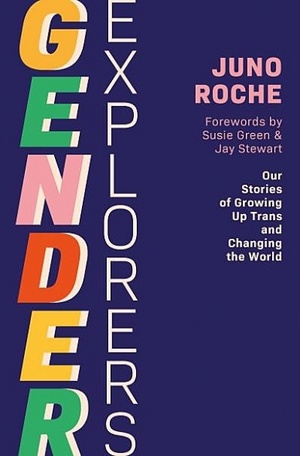
Another book on gender I decided to read this month. It’s way shorter than Gender Euphoria and consists mainly of transcribed interviews Juno Roche conducted with trans children and teenagers and their parents about the trans experience (or the experience of being a parent who has a trans child). These are interesting conversations that show the different ways people experience being trans and the effect this has on their families and social lives. It gives you some insights and I think it’ll certainly will be a good resource for anyone trans or people wanting to know more about this topic.
 Inés G. Labarta